
In This Article
As an Amazon Associate I earn from qualifying purchases. Links in this article may be affiliate links. How we choose products
A driver with a long commute, a car that bakes in an uncovered lot and a dashboard worth protecting needs a different car scent oil setup than someone with a free cup holder and a spare USB port. The same few drops that last a week on a felt pad can overwhelm a small cabin in a mister, and a leaky holder can mark interior plastic, as a Motor1 report about a TikTok creator’s leaking vent-mounted freshener describes.
This 2027 guide sorts four real products by the kind of drive they suit instead of ranking them. The advice rests on maker listings and manuals, specialist-press roundups, buyer reviews on retailer pages, an automaker’s owner’s manual and published research on scent and driver sleepiness, so heat, spills and alertness get as much room as fragrance.
A passive evaporation device or a powered mister? How car diffusers differ
Car diffusers come in three kinds, and the kind decides almost everything else.
A passive evaporation device is the simplest car essential oil diffuser: a felt pad in a locket, a lava stone, a reed or a wooden cap soaks up oil and lets moving air pull it off. Retailer pages for lava-rock and wood vent clips describe the same idea, with oil absorbed and released slowly and no cord, water or power involved. The Drive notes that pad clips need no water and leave nothing to clean up, while Old Cars Weekly says vent clips usually last longer than conventional diffusers but are less effective.
Ultrasonic mist units, the second kind, need water, a USB source and a flat place to sit. The third kind, a nebulizer, atomizes oil without heat or water, as Bustle describes it. Four questions sort the options:
- Airflow: a locket clip works only while the fan pushes air through it, which is why maker instructions for these clips end with turning on the car’s air conditioning.
- Heat: one buyer of a two-pack locket set on Desertcart says the pads barely gave off any scent after a hot day in the car, so a car that sits in the sun favors a holder whose pad you can reload or remove.
- Power and space: InnoGear’s manual calls for a 5V/1A USB source for its car mister, a nebulizer needs charging, and a clip needs neither.
- Oil type: pads and reeds take ordinary essential oil, while powered units are fussier, as the entries below show.
| Product | Delivery | Needs | Oil it takes | Main limit |
|---|---|---|---|---|
| RoyAroma Vent Aromatherapy Diffuser | Felt pad in a vent locket | Fan airflow | A few drops of essential oil per pad | Pads can dry out fast; the clip can snap |
| Scentcares Waterless Diffuser | Nebulizer, no water | USB charging | Essential oil, per Bustle’s description | Nebulizers can be fragile |
| InnoGear USB Car Essential Oil Diffuser | Ultrasonic mist | Water and a 5V/1A USB source | 1 to 3 drops with the water | Tank needs refilling |
| Kindred Aroma Car Essential Oil Diffuser | Reed sticks in a glass bottle | Vent clip or a hanging spot | Included lavender or another essential oil | Holds liquid oil in a bottle |
Old Cars Weekly rates vent clips as less effective than conventional diffusers, so a driver who wants a strong scent leans toward rows two or three. A driver who wants quiet and no charging leans toward rows one or four. Nothing in the table is a ranking, because the right row depends on the car.
Four drives, four picks
Each entry below starts from a situation and works back to the holder. The situations are hypothetical and carry no names or invented numbers.
1. RoyAroma Vent Aromatherapy Diffuser — a cheap pad clip for fan-heavy commutes
A commute with the fan running most of the way is where a locket clip earns its place. The Drive names the RoyAroma Vent Aromatherapy Diffuser its best-value pick, says the inner pad needs only a few drops, and describes the scent lasting about a week. Desertcart’s listing for a RoyAroma 30 mm two-pack shows two stainless lockets with 12 felt pads, which allows a different oil on each pad. Old Cars Weekly counts strong magnets and small vent holes among its strengths and the lack of rotation among its weaknesses.
Real-use reports are mixed in a useful way. One buyer of the two-pack says the clip snapped off the back when pressed hard onto a vent, so easing it on beats forcing it. Buyers of other locket sets on Desertcart report pads that dry out quickly in heat, which makes the spare pads in the box matter more than the locket’s finish. RoyAroma sells several locket designs, so match the one you order to the listing you read. Check the current price on Amazon.com.
2. Scentcares Waterless Diffuser — a water-free mist for long highway stretches
Nebulizers skip the water tank, so a long highway drive never ends with a refill. Bustle’s roundup of waterless diffusers named the Scentcares Waterless Diffuser its overall pick, describing an aluminum shell, a USB-rechargeable battery and three modes, and saying it travels easily. A reviewer quoted there says the unit works beautifully in a car and calls it compact. The same roundup warns that nebulizers in general can be fragile and expensive, a fair concern for a device that rides in a door pocket.
Oil choice needs the most care here. Bustle describes the Scentcares Waterless Diffuser as atomizing essential oils, while Aroma Paradise’s page for its own waterless car unit says to use waterless fragrance oil only and to add no water. Brands disagree on what a waterless unit should run, so the oil notes on the exact listing settle it. Check the current price on Amazon.com.
3. InnoGear USB Car Essential Oil Diffuser — a cup-holder mister with a water tank
Water is what separates this pick from the other three. The manual for the UD50 model describes a tank filled to a 50 ml MAX line, 1 to 3 optional drops of essential oil, an automatic shut-off when the water runs out, and a 5V/1A USB source; the cable is in the box and the adapter is not. The Drive and Old Cars Weekly both put InnoGear first among the car diffusers they list.
Two lines in the manual shape who should buy it. It warns against oils that are too thick or corrosive and says to keep the unit away from children and pets, and it says an overfilled tank or loose top cap can leak, which in a moving car means water near seats and electronics. A driver with a cup holder to spare, a working USB port and trips long enough to justify a refill will get a stronger mist than a pad can give.
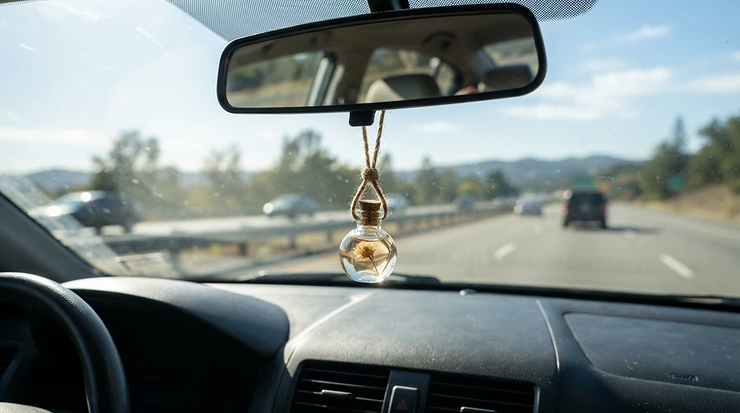
4. Kindred Aroma Car Essential Oil Diffuser — a reed bottle that needs no power
Older cars with weak vents and drivers who dislike charging cords get a no-electronics option in this kit. Momjunction’s roundup lists it as the best no-maintenance pick, with two wooden reed sticks that absorb oil, lavender essential oil in the box and a lifetime warranty worth confirming on the listing. A reviewer on Desertcart describes lining up the holes on the oil bottle and the diffuser, tapping gently to fill it, then moving the diffuser to the rearview mirror because a phone holder already crowded the vents. The same reviewer likes that takeout smells do not linger.
Because it is a liquid-filled bottle, the Motor1 report’s point about concentration applies: that article says the effect on plastic depends on how concentrated the oil is, and a bottle holds more oil than a pad does. Keep it upright, clear of the dashboard and filled only as high as the maker’s instructions allow. Check the current price on Amazon.com.
Which scent essential oil is therapeutic behind the wheel?
No oil earns that label in a car. The National Center for Complementary and Integrative Health defines aromatherapy as using plant essential oils as a complementary approach, and its lavender fact sheet says it is unclear whether lavender aromatherapy helps anxiety or sleep. The same page calls inhaled lavender possibly safe but says it may cause headache or coughing, and it warns that lavender might interact with sedative drugs, so a driver on sedating medicine should ask a pharmacist first. NCCIH’s aromatherapy page adds that in one study of stressed people lemon improved mood while neither lemon nor lavender moved stress markers.
Driving-specific research is thin but concrete. A 2024 paper in Sensors, Scented Solutions, had 11 male volunteers complete simulated motorway drives and released a 10% essential oil spray for one minute at the 30-minute mark. Sleepiness scores fell after peppermint, grapefruit and lavender compared with no scent, and the three scents did not differ significantly from one another. The authors note the small, all-male sample and the simulator setting.
Peppermint carries its own caution around children. NCCIH advises against applying peppermint oil to the face of infants or young children because menthol may affect breathing, which is reason enough to aim a peppermint pad away from a child seat. On alertness itself, the American Academy of Sleep Medicine says no strategy substitutes for enough sleep, and a panel convened by NHTSA and the National Center on Sleep Disorders Research found that a short nap and caffeine made a short-term difference while other steps, such as opening a window, had not been shown to help. A scent belongs in the comfort column, not the safety column: choose it for how you like the cabin to smell, keep it mild, and pull over when you are sleepy.
Scent oil burner or scent machine oils: why home gear stays home
Searches for a scent oil burner and for scent machine oils usually start with home shopping, and both categories change character in a car. A burner heats oil over a flame. Fire Scotland’s guidance for essential-oil burners says never to leave one unattended because oils can be flammable and the burner can become too hot, and it calls for a stable, heat-resistant, non-flammable surface. A moving cabin cannot promise that surface, so no flame-based burner appears in this guide.
Scent machine oils are a separate question. Waterless nebulizers are the car-sized version of a scent machine, and they depend on oil that atomizes cleanly. Aroma Paradise’s help text says pure essential oils and ultrasonic-grade fragrance oils do not nebulize cleanly in cold-air units and points owners to a waterless-formulation oil, while Bustle describes other nebulizers as running essential oils. Sources disagree, so the oil label of the exact unit matters as much as the device label. Pads and reeds are the more forgiving holders for ordinary essential oil.
How to use a car essential oil diffuser without marking the trim
- Start with the least oil. Retailer listings for pad clips give one to three drops, with one maker allowing up to ten, and a PopSci guide describes hospital cotton balls that carry a few drops, not a soaked ball. A damp pad is the target.
- Match the load to the device. InnoGear’s manual says 1 to 3 drops with its 50 ml tank filled only to the MAX line, a waterless unit runs only the oil its maker names, and a reed bottle is filled as its instructions describe.
- Keep oil off the dashboard. Mazda’s owner’s manual for the CX-3 tells owners to “prevent caustic solutions such as perfume and cosmetic oils from contacting the dashboard” and to wipe off any contact right away, warning of damage and discoloration. Motor1’s supplier source adds that some oil compounds act like aggressive solvents on plastics and names citrus oils rich in limonene as a common culprit.
- Think about passengers. VCA Animal Hospitals says inhaling diffused oils is harmful to dogs and cats and that avoiding diffusing altogether is safest, and InnoGear’s manual says to keep its unit away from children and pets.
- Refresh by scent, not by schedule. The Drive describes a pad lasting about a week, and a buyer of a three-pack on Desertcart says a weekly re-dip keeps the scent strong and still costs less than store-bought fresheners.
How to make car scent oil and a simple car essential oil diffuser at home
The blending step comes down to two or three essential oils combined on the pad itself, not a bottle of mixed concentrate. Sample calculation: if a maker’s instructions say 1 to 3 drops per pad, a three-oil blend at one drop each uses the whole allowance, while a two-oil blend at one drop each leaves room for a top-up. Citrus oils deserve restraint near trim for the limonene reason above.
A homemade holder needs only something absorbent. A Hello Glow tutorial shapes air-dry clay, lets it dry, adds drops of essential oil and clips it to a vent, topping up whenever the scent fades. A PopSci guide describes a cotton ball with a few drops carried in a plastic bag, and Kaiser Permanente says a few drops of undiluted oil on cloth are safe to use but may stain. Each option keeps the oil in a solid absorbent, which suits the concentration point from Motor1, and none should rest wet against vent plastic.
Car scent oil, burners and refills: short answers
Which scent essential oil is therapeutic for driving?
Can you use a scent oil burner in a car?
How do you make car scent oil?
How do you use a car essential oil diffuser?
Are scent machine oils the same as essential oils?
Match the delivery to the drive
Choosing car scent oil comes down to matching the delivery to the drive. A fan-heavy commute and a tight budget favor the RoyAroma Vent Aromatherapy Diffuser, long highway runs with no water to refill favor the Scentcares Waterless Diffuser, and a free cup holder with a USB port points to the InnoGear USB Car Essential Oil Diffuser. A cabin with weak vents or no spare ports suits the Kindred Aroma Car Essential Oil Diffuser. Whichever holder wins, start with one to three drops, keep oil off the dashboard, leave burners at home and treat scent as comfort, never as a stand-in for sleep. A holder that fits your vents and your commute is worth a closer look on its listing page.
Recommended for You
- 5 Best Essential Oil Car Fresheners for a Clean Drive (2026)
- Humidifier Scents: 7 Best Scented Humidifiers to Try in 2026
- Essential Oil Diffuser Benefits: 7 Best Picks for 2026
Found the holder that matches your vents and commute? Its listing page is the next stop.