
In This Article
As an Amazon Associate I earn from qualifying purchases. Links in this article may be affiliate links. How we choose products
Car fragrance oil works best when you thin it with an unscented diffuser base, load it into a holder that cannot leak, and keep every drop off your dashboard. Straight concentrate is strong enough to overwhelm a small cabin, and a supplier quoted in Motor1’s report on a leaking air freshener says some scent compounds can act like aggressive solvents on interior plastics.
This 2027 guide follows the mixing ratios and holder instructions that diffuser-supply shops publish, an automaker’s owner’s manual, veterinary guidance and buyer reviews on retailer listings, which is why the advice leans toward a measured recipe and away from a few random drops.
The sections below explain what “unscented” means on a bottle, the exact blend for an 8 ml car bottle, how each kind of holder behaves, ways to strengthen a weak scent, the mistakes that stain trim, and four tools that fit the steps.
Unscented fragrance oil is really a base, and car blends need one
Three different liquids sit behind this one search term. Concentrated fragrance oil is a formulated blend of natural and synthetic aroma compounds built for scent throw and staying power, according to Aroma Paradise’s comparison guide. Essential oil is a plant extract. The third liquid is the diffuser base, a clear, nearly odorless carrier that thins the concentrate so it can travel up a wooden stick or through a wood cap.
That third liquid explains the odd phrase unscented fragrance oil. A fragrance oil that smells like nothing would have no job, so shoppers typing it are almost always after the base. The Common Scents shop says its unscented base makes fragrance less viscous so it flows up the reed, and LorAnn says its base is designed to work with most fragrance and essential oils. Neither promises a match with every scent, and the Common Scents page warns that not every fragrance suits every base.
A fragrance oil for a car diffuser has to be thin enough to wick and mild enough to sit near your face for an hour. Safety limits travel with the concentrate, not the base. Supplies for Candles tells makers to check IFRA and legal limits for their chosen oil, and Northwood Candle & Craft’s help center notes that even skin-safe fragrance oils are not meant to go on skin undiluted. A car blend belongs in a holder, never on you.
How to make car fragrance oil from a base and a scent
Two supply shops publish nearly identical recipes, which makes the method easy to follow.
- Choose the scent. Fragrance oil and essential oil both mix into a base. Read the supplier’s usage notes first for the oil’s own limits.
- Choose the share. Northwood Candle & Craft says the usual car-diffuser mix is 75% reed diffuser base to 25% fragrance, with more base for a lighter scent. Its own base holds up to 50% fragrance without separating, though the page warns that smells very strong. A carrier-oil buying guide from Gardening Beyond quotes LorAnn’s suggestion of about 20% fragrance to 80% base.
- Measure for an 8 ml bottle. Sample calculation at the 25% recipe: 2 ml of fragrance plus 6 ml of base, which matches Northwood’s worked example. The 20% version works out to 1.6 ml and 6.4 ml.
- Mix and fill. Supplies for Candles advises gloves, and Northwood’s tutorial says to use a pipette to move 7 to 8 ml into each bottle. The bottle keeps its plastic stopper in until it is ready to hang.
- Test one bottle first. Because a base can behave differently with different scents, one bottle goes first and the batch follows only if the smell stays clean.
How to use car air freshener oil in each kind of holder
Knowing how to use car fragrance oil comes down to matching the blend to a holder that absorbs it slowly. Four holders cover nearly every case.
Wooden-cap bottles
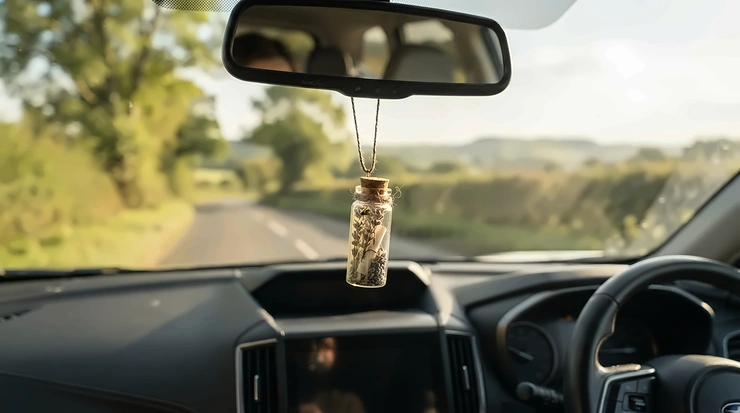
A wooden-cap bottle is the simplest option: the liquid stays in glass and only the cap touches air. Northwood’s tutorial says to remove the cap and the plastic stopper, set the cap back on, tip the bottle upside down so the oil soaks into the wood, then reseat the stopper and hang it.
The soak time is where instructions split. Northwood gives 5 to 10 seconds, while the Surf Shack set sold through Birchbox says 1 to 2 seconds and warns that a longer tip lets oil leak. Starting short and re-tipping later is the cautious reading of both.
A bottle lasts from several weeks to several months, depending on the fragrance load and the weather, and Northwood notes the scent fades faster in hot weather. The Surf Shack seller estimates two to three months. The same tutorial warns that an oversaturated cap can drip, that a wet lid can stain what it touches, that a swinging bottle should never reach the windshield, and that some states restrict objects hanging from the rearview mirror.
Felt-pad vent clips
A vent clip holds a small felt pad in a stainless locket that sits in the airflow. Listings for 30 mm lockets pair them with 22 mm pads, and seller instructions vary widely. One maker’s listing allows up to 10 drops on a pad, while a buyer of another set reports using three or four. Aroma Outfitters tells owners to rinse and dry pads for reuse, and another seller recommends one oil per pad. A pad soaks up whatever it is given, so the measured blend from the previous section beats pouring from a concentrate bottle.
Real-use complaints cluster around two points. Buyers of several 30 mm locket sets on retailer listings keep describing the same pattern: the scent is strong for a few seconds when the fan starts, then fades. One reviewer blames pads thick enough to block airflow and plans to try thinner felt. Others report a pad drying out after a hot day or needing oil every other day. A reviewer of a different set suggests loading the pad before sliding it into the locket, since the lid does not open fully.
There is also a hazard on the vent itself. Daily Dot, citing a California repair shop, reports that oil residue from hanging air fresheners can damage the plastic trim around a car’s air vent, and Torque News says clip-on vent fresheners sometimes leak oil and crack the plastic around the vents.
Using fragrance oil with sticks, in a car and at home
In a car, the stick version is a small sealed bottle with a wooden cap, sticks poking from the cap and a vent clip. Lena Rose’s travel diffuser listing describes that setup and asks that it sit as upright as possible on the vent. Remove the plastic plug, seat the cap, insert the sticks, and the oil climbs the wood.
Reed-diffuser advice written for rooms still applies. Living Etc quotes a fragrance maker recommending that new reeds soak for about 30 minutes before the first flip, and says the number of reeds sets the strength. The Ashleigh Burwood fragrance shop suggests starting with three or four reeds and keeping them away from windows and radiators, because heat makes the oil evaporate faster. A sun-warmed windshield is a window. When you change scents, CandleDust advises fresh reeds, since mixing fragrances on old ones muddles the blend. A full-size jar with loose reeds is built for a shelf, not a cup holder, so the car versions are the ones to buy.
Using fragrance oil without a diffuser
It works, because the holder only has to absorb oil and let it evaporate. Nearstore’s DIY guide lists felt, wood discs, cotton balls and clay ornaments as standard absorbers. The safer versions keep soaked material away from trim. Torque News suggests a cotton ball with a few drops in an open plastic bag tucked where it cannot spill, or small cloth sachets in door pockets and the glove compartment, and warns that some oils can discolor surfaces.
A clothespin clipped to a vent slat with an oiled felt pad is a popular shortcut, as Hometalk’s tutorial shows, but it presses wet material against vent plastic, the spot the repair-shop warning describes. For a steady background scent, a sachet or bagged cotton ball carries less risk. For scent that rides the airflow, a locket or clip is the tool.
Making the scent stronger without flooding the cabin
Searchers asking how to increase essential oils fragrance for a diffuser usually need one of five levers, and some are safer than others.
- Share: moving from 20% toward 25% fragrance is a gentle step. Northwood’s page says pushing toward the 50% ceiling of its base smells very strong.
- Sticks: Living Etc says more reeds mean more surface area and a stronger throw.
- Refreshing: flipping reeds once a week is the usual advice from Living Etc and the Homesick shop, and Northwood says to re-tip a wooden-cap bottle when the scent fades.
- Airflow: reviewers who found vent-clip pads too thick for air to pass are describing a design problem that more oil does not fix.
- Heat: warmth speeds evaporation, so a bottle in a sunny spot gives a strong first week and an empty second one.
Powered diffusers follow different rules. Manuals for USB mist models list small drop counts that differ by tank size, from 1 to 3 drops in a 50 ml car unit to 5 to 7 in a larger home model, and The Essence Vault warns that too much oil can overwhelm the senses and may damage the diffuser. The manual’s number is the ceiling.
Oversaturation backfires on passive holders too. A cap or pad that holds more than it can release will drip, and a drip on trim costs far more than a weaker scent.
Where car fragrance oil goes wrong, and what to do after a spill
Oil on the dashboard
Mazda’s owner’s manual for the CX-3 is blunt: “Prevent caustic solutions such as perfume and cosmetic oils from contacting the dashboard”, and it says to wipe off anything that lands there immediately.
The reasoning is chemical. Motor1 relays a supplier’s view that some compounds in essential oils act as aggressive solvents, with citrus oils rich in limonene a common culprit, and a plastics maker’s view that HDPE and polypropylene resist them better than polystyrene and PVC. Warmth speeds the reaction.
Reports from drivers line up. The Mary Sue described a Reddit post from May 2026 in which a driver blamed a Bath & Body Works car freshener for dashboard damage, with other commenters describing harm to buttons, plastic trim and leather. Torque News describes a Camry owner whose leaking freshener peeled paint on the dash. These cases involve ready-made products, not DIY blends, but the mechanism is the same: concentrated scent oil against interior plastic.
After a spill, wipe at once, as Mazda says. Motor1 offers no cleanup method, and the driver in its report calls the damage permanent, so your owner’s manual and a dealer are the places to ask.
Wrong oil, wrong device
Powered diffusers are built around water or thin, pure oils. A Welledia ultrasonic manual says not to use synthetic fragrance oils, perfumes or other liquids because they may contain corrosive chemicals. Appellation’s FAQ recommends only 100% essential oils, House of Scent says heavier synthetic blends can clog nebulizing systems, and Perfumedom says undissolved oil can coat the plate in many ultrasonic units. BestReviews’ USB-diffuser buying guide draws the same line up front: essential oils are not fragrance oils.
Fragrance oil belongs in passive holders, meaning wood, felt and sticks, unless the device’s own manual says otherwise.
Pets, children and small cabins
A small cabin concentrates exposure. VCA Animal Hospitals says pets are far more vulnerable to fragrance oils than people, that skin contact can cause irritation or chemical burns, that licking a spill can burn the mouth and throat, and that most fragrance oils are not safe for cats. Poison Control says to store essential oils out of sight and reach of children and pets, and the ASPCA advises avoiding oil diffusers around birds. A pet that rides along is a reason to pick a sealed bottle over an open pad and to keep spare oil out of reach.
Tools for each stage of the method
Four products cover the method. They are tools for specific steps, not a ranking, and only the first three accept a fragrance-oil blend.
| Product | Step it serves | Oil it takes | Main limit |
|---|---|---|---|
| LorAnn Oils Reed Diffuser Base Unscented | Mixing the blend | Fragrance oil or essential oil | Carries scent but adds none; not for skin or cooking |
| ttstar Car Diffuser Vent Clip | Felt-pad holder in the airflow | A few drops of a blend on one pad | Scent can fade fast; thick pads block air |
| BBTO 50 Pcs Hanging Car Air Freshener | Wooden-cap bottles | Premixed base and fragrance | Sold empty; 50 bottles is a bulk count |
| InnoGear USB Car Essential Oil Diffuser | Powered mist | Essential oil only | Not meant for fragrance oil |
The first row is the only one that changes the quality of the scent itself, because the base decides how smoothly the concentrate wicks. The next two rows are passive holders that differ mainly in how they fail: a locket fades, while a bottle can drip if oversaturated. The last row sits apart because it needs a different oil entirely.
1. LorAnn Oils Reed Diffuser Base Unscented — the blank base for mixing
This is the ingredient that turns concentrate into a usable fragrance oil for a car diffuser. LorAnn’s own page says the unscented base is designed to work with most fragrance oils and essential oils, and its retail listing is titled for home and car fragrance. Gardening Beyond’s carrier-oil guide ranks it best overall and quotes the maker’s suggestion of about 20% fragrance to 80% base.
Sample calculation: one listing gives the volume as 14 fluid ounces, roughly 414 ml. At 6 ml of base per 8 ml bottle, that is close to 70 refills, so a single jug outlasts most cars. Reports differ in tone. One buyer on a retailer listing calls it scent-free and good for car diffusers, while another reports an unpleasant smell, so the first batch deserves a sniff before it goes into bottles. The maker’s store and a retailer listing put it between about $15 and $19.
Pros:
- Made to carry fragrance and essential oils without adding a scent of its own
- Jug size covers many small bottles
- Cited by reviewers for car diffusers
Cons:
- Not meant for skin use or cooking, per Gardening Beyond
- One buyer reports an off smell
2. ttstar Car Diffuser Vent Clip — a felt-pad locket for the vent
Retailer listings describe a 30 mm locket in 316L stainless steel with a magnetic closure and reusable felt pads. Pad counts differ by listing, with ten on one and thirty-six alongside three clips on another, so the pack contents are worth reading. It suits the felt-pad step: a few drops of the measured blend go on one pad, the locket clips onto a vent slat, and airflow carries the scent.
The complaints described earlier apply here, including one buyer of this clip who says the pads are thick enough to block air and plans to try thin felt. Thinner felt in the 22 mm size these lockets use is the obvious experiment. Check the current price on Amazon.com.
3. BBTO 50 Pcs Hanging Car Air Freshener — wooden-cap bottles for DIY blends
Fifty bottles is far more than one car needs, and that is the main limit. BBTO’s listing describes 8 ml clear glass bottles with natural wooden caps and adjustable hanging ropes, and the maker’s bulk listings sell this style as empty bottles, so the scent is entirely yours. The format matches the Northwood and Surf Shack tutorials: fill with a base-and-fragrance mix, keep the stopper in until use, then tip briefly to wet the cap.
The extra bottles make sense for gifts or for rotating scents. By the same logic CandleDust applies to reeds, a cap that has soaked one fragrance will carry traces of it, so one bottle per scent keeps blends clean. Check the current price on Amazon.com.
Pros:
- Glass body with a wood cap, the format the DIY tutorials describe
- Enough bottles to rotate or gift scents
- Hanging rope included
Cons:
- A bulk count far beyond one car’s need
- An oversaturated cap can drip, per Northwood
- Swinging bottles and mirror-hanging rules need attention
4. InnoGear USB Car Essential Oil Diffuser — powered mist, essential oils only
The Drive names this the best overall pick among USB car diffusers, and Old Cars Weekly also lists InnoGear first among its car diffusers. InnoGear’s manual for its UD50 car model describes a USB-powered unit for a cup holder, a 50 ml water line and 1 to 3 optional drops of essential oil.
That design is why it comes last in this guide. Water-based misters are meant for essential oils, and the fragrance-oil warnings from Welledia and Appellation apply. It fits a driver who wants an essential-oil diffuser, not a place to use up fragrance oil. Match the model number on the listing to the manual before relying on its drop count.
Mixing, sticks and no-diffuser use: quick answers on car fragrance oil
How do you make car fragrance oil?
Can you use fragrance oil without a diffuser?
How do you use fragrance oils with sticks?
How can you make a car diffuser smell stronger?
Can fragrance oil go in an electric car diffuser?
A measured recipe, a leak-proof holder, and a short routine
Good car fragrance oil comes from three decisions made in order: a measured blend of unscented base and scent, a holder matched to that oil, and a placement that keeps drips away from trim. For most drivers, 25% fragrance in an 8 ml wooden-cap bottle is a sensible starting point, with the 20% mix for a milder cabin.
Reach for the ttstar Car Diffuser Vent Clip when airflow matters most, and treat the InnoGear USB Car Essential Oil Diffuser as an essential-oil-only tool. Wipe any spill the moment it happens, keep spare oil away from pets and children, and refill only when the scent fades. Take a look at the holders above and pick the one that suits your vents.
Recommended for You
- 7 Best Reed Diffuser Oil Refills to Refresh Your Space (2026)
- Car Fragrance Refill: 7 Best Long-Lasting Picks for 2026
- 7 Best Aroma Oil for Car Performers in 2026
Compare each listing’s oil guidance with your own blend before the order goes through.