
In This Article
If you’ve ever walked into a friend’s living room and immediately felt calmer without knowing why, there’s a decent chance a small device humming quietly in the corner had something to do with it. The essential oil diffuser benefits people talk about most — better sleep, a calmer mood, a home that smells intentional instead of like last night’s dinner — aren’t just marketing fluff, but they’re also not magic. They’re the result of a simple mechanical process (turning water and oil into a fine mist) paired with genuine, if still-developing, science on how scent affects mood and relaxation.
This guide skips the vague promises you’ll find on most product listings. Instead, you’ll get an honest look at what diffusers can and can’t do, seven real models worth considering across every budget, and the kind of practical buying advice that actually holds up once the box is open and the device is sitting on your nightstand. Whether you’re chasing better sleep, trying to mask cooking smells, or just want your apartment to feel more like a retreat, essential oil diffuser benefits show up differently depending on the device, the oil, and how consistently you use it — and we’ll walk through all three.
By the end, you’ll know exactly which type of diffuser fits your space, your budget, and your goals, along with the maintenance habits that keep any diffuser running well past its first year.
Disclosure: This post contains affiliate links. As an Amazon Associate, I earn from qualifying purchases made through these links, at no additional cost to you.
Quick Comparison: Top Essential Oil Diffusers at a Glance
| Diffuser | Type | Capacity | Coverage | Price Range | Best For |
|---|---|---|---|---|---|
| ASAKUKI 500ML Premium | Ultrasonic | 500ml | ~300 sq ft | Under $35 | Bedrooms & living rooms |
| InnoGear 150ml Ceramic | Ultrasonic | 150ml | 100–250 sq ft | Under $30 | Nightstands, small spaces |
| Vitruvi Stone Diffuser | Ultrasonic | 70ml | Up to 500 sq ft | Around $100–$130 | Design-conscious buyers |
| Organic Aromas Raindrop 3.0 | Nebulizing | N/A (oil only) | Up to 800 sq ft | Around $100–$150 | Concentrated aromatherapy |
| URPOWER 2nd Gen 300ml | Ultrasonic | 300ml | Small-to-medium rooms | Under $30 | First-time buyers |
| Pura 4 Smart Diffuser | Waterless/App | 2 vial slots | Medium-to-large rooms | Around $50 | Smart home integration |
| NOW Foods Ultrasonic Faux Wood | Ultrasonic | 500ml | Up to 1,000 sq ft | Around $40–$50 | Wellness-focused shoppers |
Looking at the table above, the differences that matter most aren’t really about brand — they’re about technology and capacity. Ultrasonic models like the ASAKUKI 500ML Premium and NOW Foods Ultrasonic Faux Wood dilute oil with water, which stretches your oil supply but slightly softens the scent’s intensity. The Organic Aromas Raindrop 3.0, by contrast, skips water entirely, which means a stronger aroma but a faster-draining oil bottle. If you want something you never have to think about, the Pura 4 Smart Diffuser‘s app-based automation is hard to beat, though it locks you into proprietary scent vials rather than any essential oil you like.
💬 One click helps other shoppers make an informed choice too! 😊
What Is an Essential Oil Diffuser?
An essential oil diffuser is a small electric device that disperses essential oils into the air, typically by breaking them into a fine mist (ultrasonic models) or atomizing pure oil without water (nebulizing models). Most essential oil diffuser benefits — mood support, ambient fragrance, and a calmer atmosphere — stem from inhaling these diffused aromatic compounds during daily use.
The category has expanded well beyond the plug-in humidifier-style devices most people picture. Today it spans ceramic decor pieces, glass nebulizers, and app-controlled smart diffusers, each delivering scent through a different mechanism with different trade-offs in intensity, oil consumption, and maintenance. According to the National Institutes of Health’s National Center for Complementary and Integrative Health, aromatherapy using essential oils is most commonly explored for stress, mood, and comfort-related outcomes — an important starting point for setting realistic expectations before you buy.
Top 7 Essential Oil Diffusers for Every Budget and Room
We researched real specs, verified current availability on Amazon, and cross-referenced aggregated customer sentiment to build this lineup. It spans true budget picks, premium design pieces, and a couple of category outliers worth knowing about before you commit.
1. ASAKUKI 500ML Premium Essential Oil Diffuser — biggest tank at the lowest price
The ASAKUKI 500ML Premium built its reputation on generous capacity without a generous price tag. At 500ml, its water tank is roughly double what most budget ultrasonic diffusers offer, which translates directly into fewer midnight refills.
Key features carry real practical weight here: the unit runs at just 23 decibels, quiet enough to disappear into bedroom white noise, and its remote control means you can adjust mist intensity or LED color without getting out of bed. The 7-color LED cycle and multiple timer settings (1, 3, and 6 hours, or continuous) give you flexibility most similarly priced diffusers skip entirely.
Based on comparing this unit against pricier competitors, the ASAKUKI 500ML Premium earns its spot for anyone who wants a large-capacity diffuser for a bedroom or living room without paying a design premium. It’s not the one to buy if you want something that doubles as a decor centerpiece — the plastic housing is functional, not fashionable.
Reviews consistently report strong satisfaction with mist output and quiet operation, with tens of thousands of ratings averaging around 4.5 stars. What the spec sheet doesn’t say, but a meaningful share of longer-term reviews reveal, is that a subset of units develop mist or connectivity issues after several months of regular use — worth knowing if you tend to run a diffuser nightly.
Pros:
- ✅ Large 500ml tank means fewer refills
- ✅ Whisper-quiet 23dB operation for bedrooms
- ✅ Remote control adjusts mist and lighting from bed
Cons:
- ❌ Some units report reduced reliability after several months
- ❌ Plastic housing feels basic next to ceramic models
Expect to pay under $35 for the ASAKUKI 500ML Premium, and at that price point, it delivers strong day-to-day value for anyone prioritizing tank size and quiet operation over premium materials.
2. InnoGear 150ml Ceramic Diffuser — best for tight spaces and nightstands
The InnoGear 150ml Ceramic Diffuser trades tank size for footprint, making it one of the more space-efficient options for a nightstand, desk, or small bathroom shelf.
Its handcrafted ceramic cover isn’t just cosmetic — the engineered chimney outlet directs mist upward and away from furniture, addressing a real complaint with cheaper diffusers (mist pooling and leaving a damp ring on wood surfaces). The two mist modes let you choose between intermittent and continuous output depending on room size, and the auto-off-when-empty feature means you can start it before bed without worrying about it running dry and overheating.
What most buyers overlook with compact diffusers like this one is that smaller capacity isn’t purely a downside — a 150ml tank is plenty for rooms under 250 square feet, and it means the unit finishes its cycle before you wake up rather than misting an empty room for hours. The InnoGear 150ml Ceramic Diffuser is well suited to anyone furnishing a smaller bedroom, studio apartment, or shared office space.
With well over 100,000 aggregated ratings across its various colorways, the InnoGear line carries some of the deepest review history in the category, and sentiment leans heavily positive on quiet operation and build quality for the price.
Pros:
- ✅ Compact ceramic design fits small spaces
- ✅ Chimney outlet prevents moisture damage to furniture
- ✅ Two mist modes suit different room sizes
Cons:
- ❌ 150ml tank needs more frequent refilling in larger rooms
- ❌ Limited to roughly 100–250 sq ft coverage
The InnoGear 150ml Ceramic Diffuser typically runs under $30, making it one of the more accessible entry points into ceramic-style diffusers.
3. Vitruvi Stone Diffuser — best design-forward option
If the ASAKUKI 500ML Premium is about capacity and the InnoGear 150ml Ceramic Diffuser is about footprint, the Vitruvi Stone Diffuser is about looking like it belongs on a design blog rather than hidden behind a lamp.
Its matte ceramic cover and hand-milled porcelain construction genuinely function as home decor, and the specs back up the aesthetics: ultrasonic technology at 2.5 vibrations per second, two run-time settings (a 4-hour continuous mode and an 8-hour intermittent mode), and a diffusing capacity Vitruvi rates at up to 500 square feet — respectable for a diffuser with a modest 70ml reservoir.
Here’s what to weigh with a premium pick like this: you’re paying for materials and design language, not dramatically more diffusion power than cheaper ultrasonic models. The Vitruvi Stone Diffuser makes the most sense for buyers who want their diffuser visible on an open shelf or bedside table rather than tucked away, and who are willing to pay for that visual upgrade.
Aggregated customer feedback frequently praises the build quality and describes it as feeling meaningfully more substantial than plastic alternatives, though a portion of reviewers note that at this price, some expected an even larger water reservoir.
Pros:
- ✅ Genuinely doubles as home decor
- ✅ Auto shut-off when water runs out or time elapses
- ✅ Backed by a manufacturer warranty and dedicated support team
Cons:
- ❌ Small 70ml tank needs frequent refills for its price tier
- ❌ Premium pricing compared to plastic ultrasonic models
Pricing for the Vitruvi Stone Diffuser generally falls in the $100–$130 range, occasionally with promotional pricing bringing it closer to $100 — check the current price at the time of purchase, since Vitruvi periodically runs sales.
4. Organic Aromas Raindrop 3.0 Nebulizing Diffuser — most concentrated aroma, no water needed
The Organic Aromas Raindrop 3.0 belongs to a different category entirely: nebulizing diffusers, which atomize pure essential oil using air pressure rather than mixing it with water and vibrating it into mist.
The practical difference is significant. Because there’s no water involved, the therapeutic compounds in the oil aren’t diluted, and there’s no standing water reservoir where mold or bacteria could develop between cleanings. The hand-blown glass reservoir and plantation hardwood base sit atop a magnetic breakaway cord — a genuinely useful safety feature for households with pets, kids, or robot vacuums that might otherwise yank the cord and topple the unit. Organic Aromas rates coverage at over 800 square feet, among the largest in this lineup.
Based on comparing nebulizing technology against ultrasonic alternatives, the Organic Aromas Raindrop 3.0 is the clear pick for anyone who wants the strongest, most concentrated scent throw in a room, or who specifically wants to avoid diluting their oils with water. The trade-off is oil consumption: nebulizing diffusers use pure oil faster than ultrasonic models, so your ongoing cost per use is higher.
The Raindrop line has accumulated hundreds of five-star reviews, with aggregated sentiment highlighting scent strength and the quiet pump as standout features.
Pros:
- ✅ No water dilution means full-strength aroma
- ✅ No standing water, so no mold risk
- ✅ Magnetic cord reduces tip-over accidents
Cons:
- ❌ Uses pure oil faster than ultrasonic models
- ❌ Higher upfront price than basic diffusers
Expect the Organic Aromas Raindrop 3.0 to fall somewhere in the $100–$150 range depending on finish and any current promotions.
5. URPOWER 2nd Gen 300ml Diffuser — best true budget pick
For shoppers who want to try aromatherapy without a big investment, the URPOWER 2nd Gen 300ml Diffuser consistently comes up as one of the strongest value options in the category.
Its 300ml tank runs for roughly seven to eight hours on a fill, with automatic shut-off protecting the unit once the water runs dry. The seven-color LED cycling light and multiple timer settings (60, 180, or 360 minutes, or continuous) match features found on diffusers costing considerably more. What most buyers overlook with entry-level diffusers is how much the basics matter more than extra features — and the URPOWER 2nd Gen 300ml Diffuser nails the fundamentals: consistent mist output, a tank that doesn’t quit early, and simple one-piece cleaning.
This is the diffuser to recommend to someone who isn’t sure yet whether they’ll actually stick with a diffusing habit. Reviews consistently report that the light controls (which cycle through all seven colors rather than allowing direct color selection) are the most common minor gripe, and that the unit lacks a remote — reasonable trade-offs at this price.
Pros:
- ✅ Strong mist output for the price
- ✅ Auto shut-off protects against dry running
- ✅ Simple single-piece lid for easy cleaning
Cons:
- ❌ No remote control included
- ❌ Light color cycling isn’t independently adjustable
The URPOWER 2nd Gen 300ml Diffuser typically sells for well under $30, and at that price, it’s difficult to find a more capable starter diffuser.
6. Pura 4 Smart Fragrance Diffuser — best for app and voice control
The Pura 4 Smart Fragrance Diffuser takes a fundamentally different approach: instead of water and essential oils you add yourself, it uses proprietary scent vials and Wi-Fi connectivity to let you schedule, adjust intensity, and switch scents from a phone app, with Alexa compatibility for voice control.
Puralast technology is rated to deliver up to 120 hours of scenting per vial, and the device monitors room temperature to help spread fragrance evenly — a genuinely useful feature for larger, open-concept rooms where cheaper diffusers under-perform. The Pura 4 Smart Fragrance Diffuser is best suited to buyers who want convenience and consistency over hands-on customization with pure essential oils, since it isn’t designed to run oils you supply yourself.
One honest and important note: in 2025, the U.S. Consumer Product Safety Commission oversaw a recall of roughly 851,400 Pura 4 Smart Fragrance Diffuser units after magnets in the detachable cover were found to pose an ingestion hazard to children. Pura has since redesigned the cover and offers free replacements to affected owners — you can check your device’s serial number against the recall notice before use if you own or are considering an earlier unit. It’s a useful reminder that “smart” features and magnetic hardware both deserve a closer safety look in homes with young children.
Pros:
- ✅ Full app scheduling and intensity control
- ✅ Alexa voice command compatibility
- ✅ Monitors room temperature for even scent spread
Cons:
- ❌ Locked into proprietary scent vials, not standard essential oils
- ❌ Earlier units were subject to a 2025 magnet-related recall
Pricing for the Pura 4 Smart Fragrance Diffuser generally lands around $50 for the device itself, with scent vials sold separately on an ongoing basis.
7. NOW Foods Ultrasonic Faux Wood Grain Diffuser — best from a trusted wellness brand
Rounding out the list, the NOW Foods Ultrasonic Faux Wood Grain Diffuser comes from a supplement and essential-oil brand many shoppers already trust, and it’s built to match: a 500ml tank, up to eight hours of run time, and a manufacturer-rated coverage of up to 1,000 square feet, among the largest claimed coverage areas in this roundup.
The flower-shaped, faux-wood-grain housing uses recycled plastic, a small but genuine sustainability nod, and the warm white or rotating color light modes give it more ambient flexibility than most diffusers in its price tier. Here’s what to weigh: the 1,000 sq ft coverage figure reflects the manufacturer’s rating under ideal conditions, and real-world performance in a large, open room will diffuse more subtly than in an enclosed bedroom.
The NOW Foods Ultrasonic Faux Wood Grain Diffuser is a strong fit for buyers who already use NOW’s essential oil line and want a diffuser from the same brand ecosystem, or for anyone who specifically wants a larger-capacity ultrasonic unit without stepping up to Vitruvi-level pricing.
Pros:
- ✅ Large-room coverage rating up to 1,000 sq ft
- ✅ Recycled plastic housing
- ✅ Up to 8 hours of run time per fill
Cons:
- ❌ Real-world coverage in large rooms may fall short of the rated figure
- ❌ Fewer smart features than app-controlled competitors
Expect to pay in the $40–$50 range for the NOW Foods Ultrasonic Faux Wood Grain Diffuser, positioning it as a mid-tier pick between true budget models and premium design pieces.
How to Choose an Essential Oil Diffuser
Matching a diffuser to your actual habits, not just its spec sheet, is where most buyers go wrong. Use this framework:
- Match capacity to your room size. A 70–150ml tank suits bedrooms and offices under 250 square feet; anything larger benefits from a 300ml-plus tank or a higher-coverage model like the NOW Foods Ultrasonic Faux Wood Grain Diffuser.
- Decide between ultrasonic and nebulizing. Ultrasonic diffusers like the ASAKUKI 500ML Premium stretch your oil supply and double as light humidifiers; nebulizing units like the Organic Aromas Raindrop 3.0 deliver stronger, undiluted scent but consume oil faster.
- Check the noise rating if it’s going in a bedroom. Anything above roughly 30 decibels can be noticeable in a quiet room at night; the ASAKUKI 500ML Premium‘s 23dB rating is a useful benchmark.
- Consider auto shut-off as non-negotiable. Every diffuser in this guide includes it, and it should be a hard requirement for any model you consider, given the fire and overheating risk of a dry-running unit.
- Weigh convenience against control. Smart, app-based options like the Pura 4 Smart Fragrance Diffuser offer scheduling and consistency but lock you into proprietary refills; traditional diffusers give you full control over which essential oils you use.
- Factor in cleaning frequency. Ultrasonic diffusers need weekly cleaning to prevent mineral buildup and bacterial growth in standing water; waterless and nebulizing models need less frequent but more careful cleaning of the oil pathway.
- Set a realistic budget band. Genuinely usable diffusers start under $30 (the URPOWER 2nd Gen 300ml Diffuser and InnoGear 150ml Ceramic Diffuser both qualify), while premium design or nebulizing options run $100 and up.
Getting Started: Your First 30 Days With a Diffuser
The first month with a new diffuser is where most people either build a lasting habit or let the device gather dust on a shelf. Start with a single, well-studied oil rather than a complicated blend — lavender is the most extensively researched scent for relaxation purposes, according to NIH’s National Center for Complementary and Integrative Health, which notes that current evidence on its aromatherapy benefits remains preliminary but that it’s generally considered possibly safe when diffused.
Run your diffuser for 30- to 60-minute sessions rather than leaving it on continuously; this both conserves oil and avoids the “nose fatigue” that makes a scent seem to fade the longer you’re exposed to it. Clean the water reservoir of ultrasonic models like the ASAKUKI 500ML Premium or InnoGear 150ml Ceramic Diffuser at least once a week with a diluted vinegar rinse — skipping this is the single most common reason diffusers start smelling musty or misting unevenly after a few months.
Place your diffuser at least a few feet from walls, electronics, and wood furniture, and avoid running it directly on an unprotected wood nightstand, since ultrasonic mist can leave water rings over time even with well-designed units. By the end of your first month, you should have a sense of which oils, session lengths, and rooms work best for your routine — that’s the point where essential oil diffuser benefits start to feel less like an experiment and more like a habit.
Real-World Scenarios: Matching a Diffuser to Your Lifestyle
The apartment dweller in a studio. With limited square footage and often shared walls, a compact, quiet unit matters most. The InnoGear 150ml Ceramic Diffuser‘s small footprint and sub-250-square-foot coverage fit naturally on a nightstand or desk, and its modest price makes it low-risk for a first purchase.
The parent optimizing a nursery or kids’ shared bedroom. Coverage and safety take priority here. A larger-capacity, auto-shut-off ultrasonic model like the ASAKUKI 500ML Premium covers a bigger room quietly, and because it uses standard essential oils rather than proprietary vials, parents can choose gentler, well-studied scents and control dilution themselves.
The remote worker scenting a home office. Someone at a desk for eight hours a day benefits from scheduling and consistency more than raw scent strength. The Pura 4 Smart Fragrance Diffuser‘s app scheduling lets you automate scent changes around meetings or focus blocks without manual refilling — worth the trade-off of proprietary vials for many home-office users.
The design-conscious renter furnishing a shared living room. Where the diffuser will be seen and judged as decor, the Vitruvi Stone Diffuser‘s ceramic build justifies its higher price, particularly for anyone entertaining guests regularly.
Essential Oil Diffuser Benefits for Sleep, Stress, and Everyday Wellness
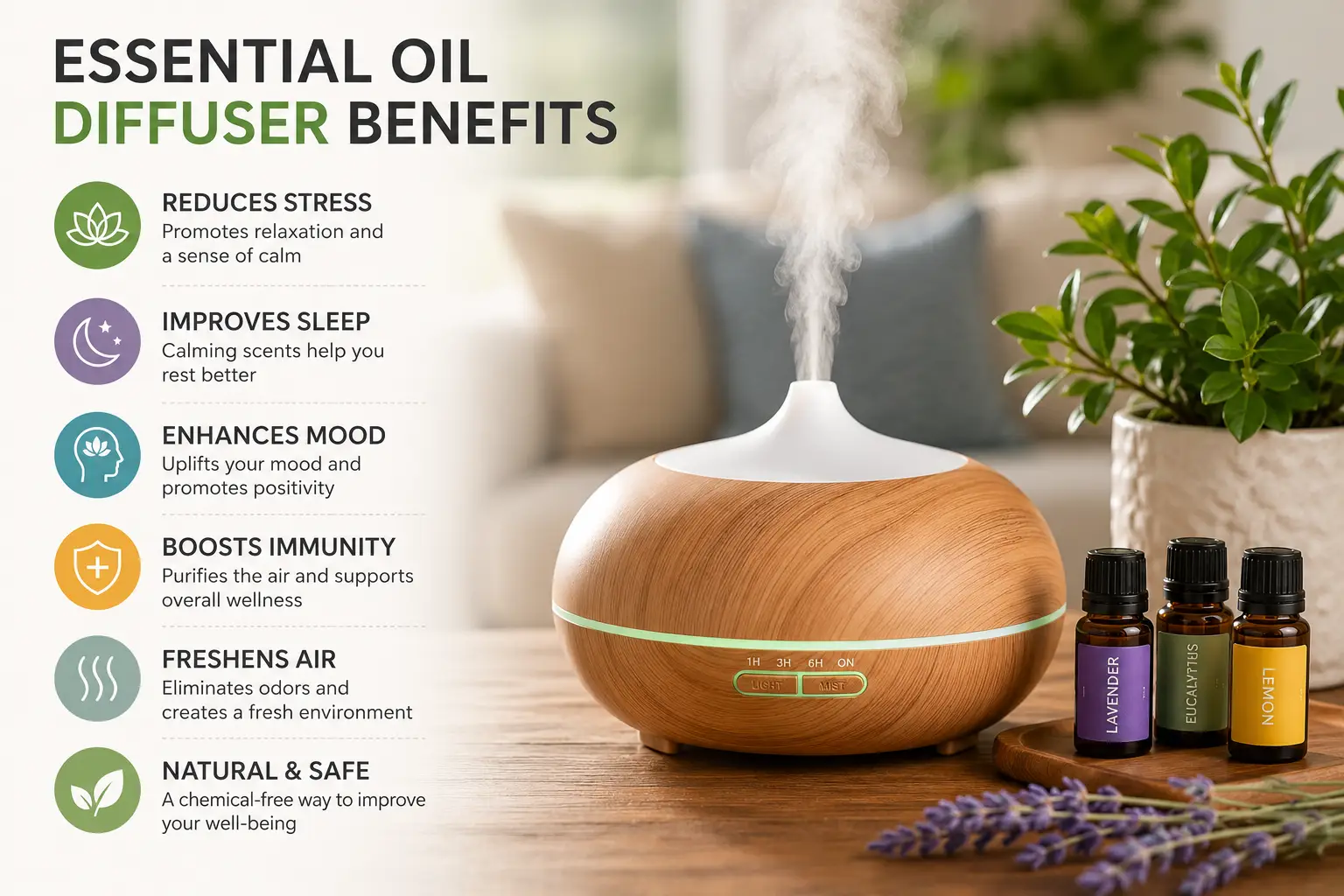
The essential oil diffuser benefits most people are chasing fall into three broad, honestly-described categories: sleep support, stress and mood, and general ambiance. It’s worth being precise about what current research actually supports. The NIH’s aromatherapy overview notes that while lavender and other oils are commonly used for insomnia, rigorous research on whether aromatherapy meaningfully improves sleep remains limited — a fair, if less exciting, summary than what most product listings imply.
That said, the psychological and ambiance-related benefits of a pleasantly scented, softly lit room are harder to dismiss, even without clinical-grade evidence. Reviews consistently report that diffuser owners associate their evening routine — dimming the lights, starting the Vitruvi Stone Diffuser or ASAKUKI 500ML Premium, and settling in — with a subjective sense of winding down, even if the mechanism is more about ritual and association than a direct pharmacological effect of the oil itself.
For stress and everyday mood, citrus and herbal scents tend to get the most anecdotal praise for feeling “uplifting,” while lavender, chamomile, and cedarwood dominate the relaxation-focused reviews across every diffuser in this guide. The honest takeaway: essential oil diffuser benefits are real as a sensory and ritual-based wellness tool, but they work best paired with — not as a replacement for — sleep hygiene basics like a consistent bedtime and a dark, cool room.
Ultrasonic vs Nebulizing vs Waterless Diffusers: Which Technology Wins?
There’s no single best technology — only the best fit for your priorities. Ultrasonic diffusers, represented here by the ASAKUKI 500ML Premium, InnoGear 150ml Ceramic Diffuser, URPOWER 2nd Gen 300ml Diffuser, Vitruvi Stone Diffuser, and NOW Foods Ultrasonic Faux Wood Grain Diffuser, use water and high-frequency vibration to create a cool mist. They’re the most affordable category, work with any essential oil, and add a small amount of humidity to a room — useful in dry climates, less useful if you already run a humidifier.
Nebulizing diffusers, represented by the Organic Aromas Raindrop 3.0, skip water entirely and atomize pure oil directly. The result is a noticeably stronger, more concentrated aroma that fills larger spaces faster, but oil consumption is higher and ongoing costs add up if you diffuse daily.
Waterless smart diffusers like the Pura 4 Smart Fragrance Diffuser occupy a third category: proprietary fragrance capsules paired with app control. They trade the flexibility of choosing your own essential oils for hands-off convenience and even scent distribution, which suits buyers who prioritize consistency over customization.
If you’re deciding between the three, ultrasonic is the right default for most first-time buyers, nebulizing suits anyone chasing maximum scent strength in a larger room, and waterless smart diffusers fit people who already have a smart-home ecosystem and don’t mind subscription-style refills.
Common Mistakes to Avoid When Using an Essential Oil Diffuser
Even good diffusers get sabotaged by a handful of avoidable habits:
Overfilling with oil. More drops don’t mean more benefit — most ultrasonic diffusers need just 5–10 drops per fill. Overdosing oil can gum up the ultrasonic disc and shorten the unit’s lifespan, a common complaint buried in negative reviews across nearly every ultrasonic model, including the ASAKUKI 500ML Premium.
Skipping regular cleaning. Mineral deposits from tap water and oil residue build up quickly. A weekly rinse with diluted white vinegar, followed by a clear-water rinse, keeps ultrasonic discs functioning and prevents the musty smell that’s the top complaint in long-term reviews of budget diffusers.
Running it continuously, all day, every day. This shortens both device lifespan and oil supply, and can lead to scent fatigue where you stop noticing the aroma altogether. Intermittent 30–60 minute sessions, an option built into most models in this guide, work better for both your nose and your wallet.
Using synthetic fragrance oils in a diffuser built for essential oils. Fragrance oils often contain additives that clog ultrasonic components not designed to handle them, and they lack the aromatic compounds researchers actually study when discussing essential oil diffuser benefits.
Ignoring pets in the room. Certain essential oils, including tea tree and some citrus oils, can be irritating or toxic to cats and dogs in enclosed spaces. If you share your home with pets, stick to well-tolerated oils in moderate concentrations and always ensure the room is ventilated.
Long-Term Cost and Maintenance: What Diffusers Really Cost Over Time
The sticker price is only part of the equation. A budget ultrasonic diffuser like the URPOWER 2nd Gen 300ml Diffuser costs less upfront, but because water dilutes the oil, your bottle of essential oil lasts considerably longer per use than it would in a nebulizing unit like the Organic Aromas Raindrop 3.0. Over a year of nightly use, that difference in oil consumption can offset a meaningful chunk of the nebulizer’s higher upfront cost — or widen the gap further, depending on how often you diffuse.
Smart diffusers like the Pura 4 Smart Fragrance Diffuser flip the cost structure entirely: a relatively low device price paired with an ongoing subscription-style cost for proprietary scent vials, similar in spirit to a razor-and-blades model. Budget accordingly if convenience is your priority — a vial lasting up to 120 hours means moderate users will replace vials every few weeks.
Maintenance costs are mostly about time rather than money: a weekly five-minute clean keeps any ultrasonic diffuser, from the InnoGear 150ml Ceramic Diffuser to the NOW Foods Ultrasonic Faux Wood Grain Diffuser, running well past its first year. Skipping this is the most common reason diffusers get replaced early, not mechanical failure.
✨ Don’t miss these exclusive deals! 🔍 Take your home aromatherapy routine to the next level with this carefully curated lineup. Click a highlighted item to check current pricing and availability. These picks will help you get a calmer, better-smelling home the whole family will enjoy!
Safety, Regulations, and Standards for Essential Oil Diffuser Benefits
Essential oil diffusers themselves are lightly regulated as small household electronics, but the essential oils used in them fall under more specific consumer-safety scrutiny than many buyers realize. The Consumer Product Safety Commission has issued multiple recent recalls involving essential oil products, including wintergreen oils recalled for lacking child-resistant packaging required under the Poison Prevention Packaging Act, since methyl salicylate — a common component of wintergreen and birch oils — can be dangerous if swallowed by young children.
Diffuser hardware itself isn’t immune to recalls either, as the Pura 4 Smart Fragrance Diffuser‘s 2025 magnet-related recall demonstrates. When shopping, prioritize models with a secure, non-detachable housing if young children or pets are in the home, and always store essential oil bottles out of reach, ideally in a locked cabinet.
On the research side, aromatherapy products are not required to undergo FDA approval, and the NIH’s cancer-information division notes that safety testing on essential oils has found relatively few side effects when used as directed via inhalation, though topical use and ingestion carry higher risk profiles and aren’t the focus of this guide. Always ventilate the room you’re diffusing in, avoid running a diffuser directly next to a crib or bassinet, and consult a healthcare provider before diffusing around infants, pregnant individuals, or anyone with respiratory conditions like asthma.
Essential Oil Diffuser Benefits for Beginners vs. Experienced Users
Beginners get the most value from simplicity. A budget-friendly, easy-to-clean ultrasonic model like the URPOWER 2nd Gen 300ml Diffuser removes the friction that causes first-time buyers to abandon the habit — minimal setup, forgiving oil dosing, and a low financial commitment if it turns out diffusing isn’t for you.
Experienced users who already know their preferred oils and routines tend to gravitate toward either maximum scent strength (the Organic Aromas Raindrop 3.0‘s nebulizing technology) or maximum convenience (the Pura 4 Smart Fragrance Diffuser‘s scheduling and app control). Both represent a step up in either cost or complexity that makes more sense once you’ve confirmed diffusing fits your routine.
Somewhere in the middle sits a buyer who wants dependable daily performance without fuss — that’s where the ASAKUKI 500ML Premium and NOW Foods Ultrasonic Faux Wood Grain Diffuser shine, offering larger tanks and longer run times without the premium price tag of design-forward or smart options.
Features That Actually Matter (and Ones That Don’t)
Marketing copy across this category leans heavily on features that sound impressive but rarely change your day-to-day experience. Here’s a cut-through:
Actually matters: tank capacity relative to your room size, noise rating for bedroom use, auto shut-off, ease of cleaning, and whether the model works with any essential oil versus proprietary refills.
Matters less than it seems: the total number of LED color options (seven versus fourteen makes little practical difference), remote controls (convenient, not essential, and the URPOWER 2nd Gen 300ml Diffuser proves you don’t need one), and claimed maximum coverage figures, which — as with the NOW Foods Ultrasonic Faux Wood Grain Diffuser‘s 1,000-square-foot rating — are typically measured under ideal, enclosed conditions rather than open-concept layouts.
Genuinely underrated: the design of the mist outlet (a well-engineered chimney, like on the InnoGear 150ml Ceramic Diffuser, prevents furniture damage that cheaper designs don’t address), and whether replacement parts or customer support are readily available, which matters more once a unit is a year or two old.
FAQs
❓ Do essential oil diffusers actually work?
❓ How often should you clean an essential oil diffuser?
❓ Is it safe to run a diffuser all night?
❓ What's the difference between an essential oil diffuser and a humidifier?
❓ How much does a good essential oil diffuser cost?
Conclusion
The honest version of essential oil diffuser benefits sits somewhere between “life-changing wellness device” and “just a scented humidifier” — it’s a genuinely useful tool for ambiance, ritual, and mood support, backed by real if still-developing research, and it works best when you match the right technology to your space and habits rather than chasing the flashiest feature list.
For most first-time buyers, a dependable ultrasonic model like the ASAKUKI 500ML Premium or URPOWER 2nd Gen 300ml Diffuser offers the easiest entry point. Design-conscious buyers will get more lasting satisfaction from the Vitruvi Stone Diffuser, while anyone chasing maximum scent strength should look to the Organic Aromas Raindrop 3.0. Whichever you choose, consistent cleaning and sensible oil dosing will do more for your long-term experience than any single feature on the spec sheet.
Recommended for You
- Diffuser Gift Set 2026: 7 Best Picks Worth Buying (Ranked)
- Diffuser Distilled Water: 7 Best Diffusers & Why It Matters (2026)
- Commercial Air Freshener for Hotel Lobby: 7 Best Systems (2026)
Disclaimer: This post contains affiliate links. As an Amazon Associate, I earn from qualifying purchases made through these links, at no additional cost to you.
✨ Found this article helpful? Share it with someone who needs it! 💬🤗