
In This Article
If you’ve ever stood over your diffuser holding the bottle and thought, “okay, but how much essential oil to add to diffuser water, exactly?” — you’re in good company. It’s the single most common question new diffuser owners ask, and the honest answer is: it depends on your tank size, your oil, and how big the room is. As a quick working definition: diffusing is the process of dispersing tiny essential oil particles into the air, usually mixed with water in an ultrasonic device, so the scent and aromatic compounds spread evenly through a space without heat or flame.
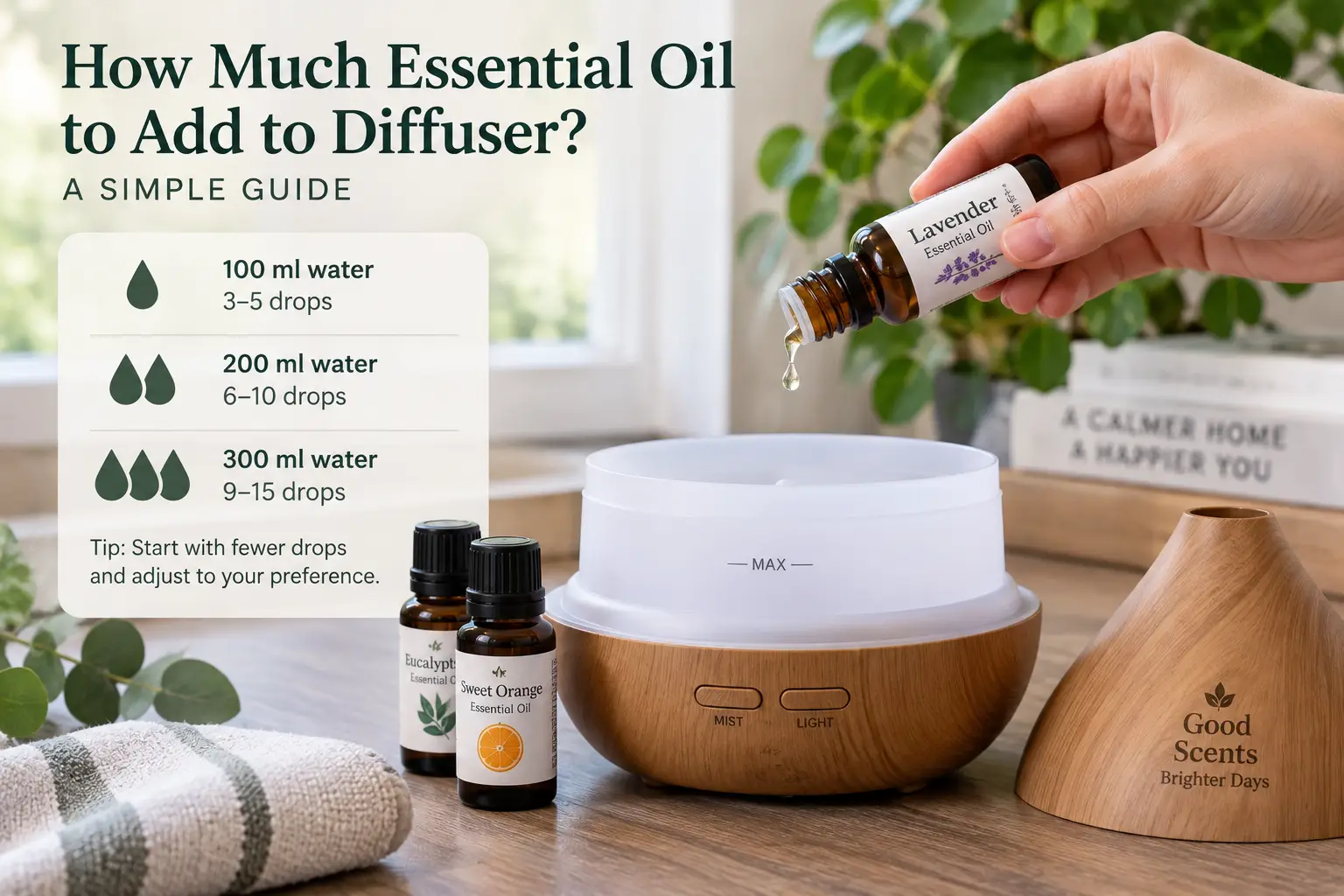
Most manufacturers land somewhere between 3 and 6 drops per 100 milliliters of water as a baseline, but that number shifts once you factor in a 500ml tank, a nebulizing diffuser that skips water altogether, or a citrus oil that evaporates twice as fast as a heavy base note like patchouli. Get the ratio wrong in one direction and you’re left with a diffuser that barely smells like anything; get it wrong in the other direction and you risk a headache-inducing cloud, a gunked-up ultrasonic disc, or worse, a reaction in someone with sensitive airways. According to the National Institutes of Health’s National Center for Complementary and Integrative Health, aromatherapy is generally used by inhaling essential oils or applying a diluted form to the skin — inhalation through a diffuser being the most common household use case.
This guide breaks down the exact ratios for every tank size, walks through the diffuser types that change the math, and reviews seven real diffusers currently available on Amazon so you can match the right device to the right dose. We’ll also cover the mistakes that quietly ruin a diffuser’s lifespan and the safety details that matter if you have kids or pets in the house.
Quick Comparison: Top Essential Oil Diffusers at a Glance
Before we get into the full reviews, here’s a fast snapshot of where each pick lands on capacity, coverage, and budget.
| Diffuser | Tank Size | Coverage | Runtime | Price Range | Best For |
|---|---|---|---|---|---|
| InnoGear Upgraded Diffuser | 100ml | ~250 sq ft | Up to 8 hrs | Around $15–$20 | First-time buyers |
| URPOWER 2nd Gen | 300ml | ~200–300 sq ft | 6–7 hrs | Around $20–$30 | Compact bedrooms |
| ASAKUKI 500ml Premium | 500ml | ~300 sq ft | Up to 16–18 hrs | Around $25–$35 | Overnight use |
| ASAKUKI Smart Wi-Fi | 500ml | ~300 sq ft | Up to 12 hrs | Around $35–$50 | App/voice control |
| Vitruvi Stone Diffuser | ~200ml | ~250–350 sq ft | Varies by mode | Around $100–$130 | Home décor lovers |
| Organic Aromas Raindrop 3.0 | Waterless (nebulizing) | Open-plan rooms | Intermittent cycles | Around $100–$115 | Maximum oil potency |
| Pura 4 Smart Diffuser | Waterless (vial-based) | Up to 1,000 sq ft | Weeks per vial | Around $50–$90 | Whole-room ambient scent |
Looking at the table, the split really comes down to how you plan to dose oil: the InnoGear Upgraded Diffuser, URPOWER 2nd Gen, ASAKUKI 500ml Premium, and ASAKUKI Smart Wi-Fi all take water plus drops, so the ratios in this guide apply directly to them. The Organic Aromas Raindrop 3.0 skips water and doses pure oil differently, while the Pura 4 and to a lesser extent the Vitruvi Stone Diffuser shift the “how many drops” question into “how many vials” or “how much oil per fill,” which we’ll unpack in their individual reviews below.
💬 One click helps other shoppers make an informed choice too! 😊
Top 7 Essential Oil Diffusers for Every Budget and Room
We looked at real spec sheets, aggregated Amazon customer feedback, and independent product testing coverage to put together this lineup — from a sub-$20 starter unit to a waterless nebulizing diffuser built for oil purists. Every price below is a range, since Amazon pricing shifts constantly; always check the current price before buying.
1. InnoGear Upgraded Diffuser — best starter ratio-friendly diffuser
The InnoGear Upgraded Diffuser is the diffuser most people cut their teeth on, and for good reason: its 100ml tank makes the “3-5 drops per 100ml” rule almost foolproof. It runs on ultrasonic vibration rather than heat, cycles through 7 LED colors, and offers two mist modes — continuous and intermittent — so you can stretch a single fill across a longer session. The waterless auto shut-off means you don’t have to babysit it, which matters if you tend to forget things are running.
What stands out on paper is how directly the tank size maps to the dosing math: fill to the line, add 3 to 5 drops, and you’re diffusing at the ratio aromatherapists actually recommend, without having to do any conversion. Reviews consistently report that this model holds up well for bedside or desk use in smaller rooms, though a few buyers note the mist output tapers off noticeably as the tank empties. It’s the model we’d point a first-time buyer toward specifically because getting the ratio wrong is hard to do with a tank this small.
Aggregated customer sentiment on Amazon (with reviews numbering in the tens of thousands) skews strongly positive, with the light/mist independence — you can run the light without the mist, or vice versa — called out repeatedly as a favorite feature.
Pros:
- ✅ Small 100ml tank makes standard drop ratios simple
- ✅ Mist and light functions run independently
- ✅ Auto shut-off protects the unit when water runs low
Cons:
- ❌ Mist output weakens noticeably near empty
- ❌ Coverage area is limited to smaller rooms
Typically priced around $15–$20, the InnoGear Upgraded Diffuser is one of the best value entry points if you just want to learn proper dosing before upgrading to a larger unit.
2. URPOWER 2nd Gen — compact design with flexible timers
The URPOWER 2nd Gen sits in a similar price tier to the InnoGear but adds four timer settings (continuous, 30-second interval on/off, and two longer cycles) that let you stretch a 300ml tank across 6 to 7 hours. That timer flexibility actually changes how you should think about dosing: on the intermittent settings, oil evaporates more slowly, so you can lean toward the lower end of the ratio (closer to 3 drops per 100ml) without losing scent strength.
The wood-grain and white housing options make it a popular pick for people who want something that doesn’t scream “gadget” on a nightstand. Where it falls short, based on aggregated review themes, is mist strength — several buyers describe the output as noticeably gentler than competitors at the same price, and the tank lid is reported as a bit snug for quick refills. For anyone diffusing in a small bedroom rather than an open living space, that gentler mist is arguably a feature rather than a flaw.
Real customer sentiment puts this model at a solid 4.4-star average, with praise concentrated on quiet operation and criticism concentrated on mist intensity in larger rooms.
Pros:
- ✅ Four timer settings for flexible dosing sessions
- ✅ Quiet ultrasonic operation, good for light sleepers
- ✅ Auto shut-off when water runs empty
Cons:
- ❌ Mist output is weaker than similarly priced rivals
- ❌ Tank lid can be tight to remove for refills
Generally priced in the $20–$30 range, the URPOWER 2nd Gen is a fair value pick if quiet, gentle diffusion matters more to you than maximum scent throw.
3. ASAKUKI 500ml Premium Diffuser — best for overnight coverage
The ASAKUKI 500ml Premium Diffuser is one of Amazon’s best-selling diffusers, and the reason is simple math: a 500ml tank paired with a low-mist mode gets you up to 16-18 hours of runtime, which means it can realistically run from bedtime through morning without a refill. At that tank size, the ratio scales up proportionally — where a 100ml tank takes 3-5 drops, a 500ml tank takes roughly 15-25 drops, and the included remote lets you dial mist intensity down if that starts to feel like too much for the room.
What the spec sheet doesn’t say, but reviews reveal, is that the noise level (rated under 23 decibels) is genuinely bedroom-appropriate — quieter than most white noise machines. The 5-in-1 functionality (diffuser, humidifier, ionizer, night light, timer) means you’re not just buying a scent device, you’re buying a mild humidity boost for dry winter air too, which matters if you live somewhere with forced-air heating.
Aggregated reviews (over 50,000 on Amazon, averaging 4.4-4.5 stars) consistently mention the remote control as a genuine convenience rather than a gimmick, since it lets you adjust mist and light without getting out of bed. The most common complaint is footprint — this is a larger unit than the compact models above, so it needs real nightstand or shelf space.
Pros:
- ✅ Large 500ml tank runs up to 16–18 hours
- ✅ Under-23dB operation is genuinely bedroom-quiet
- ✅ Remote control adjusts mist and light without getting up
Cons:
- ❌ Larger footprint needs more surface space
- ❌ LED lights can feel bright even on the lowest setting
Typically found in the $25–$35 range, the ASAKUKI 500ml Premium Diffuser delivers strong value for anyone who wants a full night of diffusing without refilling.
4. ASAKUKI Smart Wi-Fi Diffuser — best for app and voice control
The ASAKUKI Smart Wi-Fi Diffuser takes the same 500ml tank as its non-smart sibling and adds app control plus Amazon Alexa voice compatibility, which changes the dosing conversation in a subtle way: you can schedule shorter, more frequent diffusing sessions from your phone instead of relying purely on a fixed timer dial. That matters because essential oil ratios are partly about session length — running a strong ratio continuously all day is very different from running the same ratio in 20-minute scheduled bursts.
On paper this is a #1 best-seller in its Amazon category, and the review volume (over 68,000 ratings at a 4.4-star average) backs that up. Reviews consistently report that the app is straightforward to pair and that voice commands work reliably for basic on/off and intensity control, though a handful of users note the accompanying starter essential oil set is weaker in scent than the diffuser hardware deserves — a reminder that the device and the oil you put in it are two separate purchases worth evaluating independently.
Based on comparing the specs to the standard ASAKUKI model, the smart features add real day-to-day convenience for anyone who wants to start diffusing before walking in the door, but they don’t change the underlying water-to-oil ratio math — this is still a 500ml tank that follows the same proportional scaling as any other ultrasonic diffuser.
Pros:
- ✅ App and Alexa voice control for remote scheduling
- ✅ Same reliable 500ml ultrasonic hardware as the standard model
- ✅ Large, established review base backs long-term reliability
Cons:
- ❌ Bundled starter oils are weaker than the hardware
- ❌ App dependency means Wi-Fi outages limit remote features
Expect to pay around $35–$50, which is a reasonable premium over the standard ASAKUKI for the added smart-home integration.
5. Vitruvi Stone Diffuser — best design-forward option
The Vitruvi Stone Diffuser trades some of the multi-feature approach of the budget picks for a matte ceramic housing that’s genuinely built to sit out as home décor rather than get tucked behind a lamp. It’s an ultrasonic diffuser at heart, so the same drop-per-100ml logic applies, but the stone exterior and whisper-quiet motor are the entire value proposition here — this is a diffuser for people who care as much about how it looks on a shelf as how it smells.
Here’s what to weigh: you’re paying a significant premium over the plastic ultrasonic models above for materials and aesthetics, not for meaningfully different diffusing performance. That’s a legitimate trade-off if you’ve tried a budget diffuser and found the plastic housing or blinking LED lights genuinely annoying in your living space, but it’s not the pick if your priority is squeezing the most runtime or coverage per dollar.
Independent testing coverage from outlets that evaluate home goods has repeatedly called out the Vitruvi Stone’s build quality and quiet operation as standouts in the premium diffuser category, which lines up with the brand’s reputation for design-led small appliances.
Pros:
- ✅ Matte ceramic housing doubles as home décor
- ✅ Genuinely whisper-quiet ultrasonic motor
- ✅ Simple, minimalist control layout with no flashing lights
Cons:
- ❌ Premium price for essentially standard diffusing performance
- ❌ Smaller accessory and color ecosystem than budget competitors
Typically priced around $100–$130, the Vitruvi Stone Diffuser is best suited to buyers who’ve already decided design matters as much as function.
6. Organic Aromas Raindrop 3.0 Nebulizing Diffuser — best for pure oil potency
The Organic Aromas Raindrop 3.0 is a different animal entirely: it’s a nebulizing diffuser, meaning there’s no water tank and no dilution — it atomizes pure essential oil directly into the air using air pressure rather than ultrasonic vibration. That changes the dosing conversation completely. Instead of drops per 100ml of water, you’re typically adding a small amount of undiluted oil (often specified in milliliters, not drops) directly to the glass reservoir, and running it in short intermittent cycles rather than continuously.
Here’s what most buyers overlook with nebulizing diffusers: because there’s no water diluting the oil, the aromatic concentration in the air is substantially stronger per minute of runtime than any ultrasonic model on this list. That’s the appeal for aromatherapy purists who want maximum therapeutic aroma delivery, but it also means oil consumption is faster and the diffuser needs intermittent cycling (a few minutes on, several minutes off) to avoid oversaturating a room.
Reviews and product testing consistently frame the trade-off honestly: stronger, purer scent throw against a higher ongoing cost per use, since a nebulizer burns through a bottle of oil noticeably faster than a diluted ultrasonic tank would.
Pros:
- ✅ No water dilution means maximum aromatic concentration
- ✅ Handblown glass design has genuine longevity
- ✅ Intermittent cycling settings help manage oil usage
Cons:
- ❌ Consumes essential oil faster than ultrasonic models
- ❌ Requires more attentive dosing since there’s no water buffer
Generally priced around $100–$115, the Organic Aromas Raindrop 3.0 rewards buyers who already know they prefer strong, undiluted scent over the gentler ultrasonic mist.
7. Pura 4 Smart Fragrance Diffuser — best for whole-home ambient scent
The Pura 4 Smart Fragrance Diffuser is the outlier on this list because it doesn’t use loose drops at all — it’s a waterless, vial-based system where you insert a pre-filled fragrance or essential oil vial and control intensity through an app rather than by counting drops. If the entire reason you’re asking “how much essential oil to add” is that you find drop-counting tedious, this is the category built to solve that exact problem.
Based on comparing the specs, the app lets you dial intensity from a light setting up to a much stronger one, plus schedule fragrance to activate on a timer or via geo-location when you’re heading home. Amazon and third-party listings put its rated coverage at up to 1,000 square feet, which is considerably larger than any ultrasonic model here, though real-world “how strong does it smell across that whole space” results vary by home layout.
The honest trade-off: you lose the granular, oil-specific control that comes with counting your own drops, and you’re now buying proprietary vials on an ongoing basis rather than a bottle of essential oil that works in any diffuser. For buyers who want consistent, low-maintenance scent throughout an open floor plan, that trade-off is often worth it; for essential-oil purists who want to blend and dose their own oils, it isn’t.
Pros:
- ✅ App control removes drop-counting entirely
- ✅ Rated coverage up to 1,000 square feet
- ✅ Geo-location scheduling activates scent automatically
Cons:
- ❌ Requires proprietary vials instead of any essential oil bottle
- ❌ Ongoing vial cost adds up compared to a bottle of oil
Typically priced around $50–$90 for the device (vials sold separately), the Pura 4 Smart Fragrance Diffuser is the pick for buyers who want scent without the ratio math.
How to Get the Ratio Right: A Step-by-Step Dosing Guide
Getting the essential oil to water ratio right isn’t complicated once you break it into a repeatable process, but skipping steps is exactly how people end up with a diffuser that either smells like nothing or gives them a headache.
Start by filling the tank to its marked line with room-temperature water — overfilling is one of the most common causes of leaking or a diffuser that won’t mist properly, since ultrasonic discs need a specific water depth to vibrate correctly. From there, add oil in the 3-to-5-drops-per-100ml range as your baseline, then adjust: heavier base notes like patchouli or sandalwood can go lower in the range, while lighter citrus oils like lemon or bergamot evaporate faster and can tolerate the higher end.
Run the diffuser on an intermittent mist setting rather than continuous if your model offers one — most rooms reach saturation well before a tank runs dry, and intermittent cycling both conserves oil and prevents the “nose fatigue” that makes a strong scent seem to disappear after 20 minutes. Finally, clean the tank with a cotton swab dipped in white vinegar every few fills; oil residue builds up on the ultrasonic disc over time and can throw off mist output even when your ratio is technically correct.
✨ Ready to find your perfect ratio? Browse the diffusers above and start dialing it in tonight! 🌿
Real-World Scenarios: Matching Drops to Your Space and Lifestyle
The right ratio also depends heavily on who’s in the room and what you’re using the diffuser for, so here are three common profiles worth recognizing yourself in.
If you’re a student or remote worker diffusing at a desk in a home office under 150 square feet, a small-tank model like the InnoGear Upgraded Diffuser running on the low end of the ratio (3 drops per 100ml) with a citrus or peppermint oil during work hours is usually plenty — anything stronger in that small a space tends to become distracting rather than energizing. If you’re setting up a nursery or shared kids’ bedroom, the safety guidance below matters more than the ratio itself: many pediatric and safety sources recommend running diffusers at the gentlest setting, well away from cribs, and only with oils confirmed safe for the child’s age.
For a parent trying to wind a whole household down at night in an open-plan living and dining space of 300+ square feet, a larger-tank model like the ASAKUKI 500ml Premium Diffuser on its low-mist overnight setting, dosed toward the higher end of the ratio (around 20-25 drops in a full 500ml tank) with a calming blend like lavender, tends to carry evenly through the space without needing a midnight refill.
Common Diffusing Problems and How to Fix Them
A handful of issues account for most of the “my diffuser isn’t working right” complaints, and nearly all of them trace back to ratio or maintenance rather than a defective unit.
Weak or no scent despite adding oil: this is almost always a buildup issue rather than a dosing issue — oil residue coats the ultrasonic disc over repeated fills and blocks proper vibration. A vinegar-and-water rinse every 3-5 fills usually restores full mist output.
Scent disappears quickly, then room smells overpowering all at once: this pattern points to continuous misting in a small room. Switching to intermittent mode lets your nose reset between bursts instead of adapting to a constant background scent you eventually stop noticing.
Water leaking from the base: almost always caused by overfilling past the marked line, or filling with water that’s too hot, which can warp the tank seal over time.
Headache or irritation after extended use: this usually means the ratio is too strong for the room size, the session ran too long without a break, or the specific oil (strong options like eucalyptus, peppermint, or wintergreen) simply needs a lower dose than a gentler oil like lavender. Cutting the drop count and shortening sessions to 30-60 minutes at a time typically resolves it.
How to Choose the Right Essential Oil Diffuser for Your Home
- Match tank size to room size. A 100ml tank suits a desk or small bedroom; a 300-500ml tank suits an average bedroom or living room; anything over 500 sq ft usually calls for a waterless smart diffuser rated for larger coverage.
- Decide between ultrasonic and nebulizing. Ultrasonic diffusers dilute oil with water and are gentler and more economical; nebulizing diffusers use pure oil for stronger, purer scent at a faster consumption rate.
- Check the noise rating if it’s for a bedroom. Anything under 25 decibels is genuinely sleep-friendly; louder units are better suited to living spaces where background noise is already present.
- Look at runtime relative to your schedule. If you want overnight coverage, prioritize a larger tank with a documented low-mist runtime of 12+ hours rather than assuming all diffusers scale the same way.
- Consider whether you want app or remote control. Convenience features like scheduling and voice control add cost but can meaningfully change how consistently you actually use the diffuser.
- Factor in cleaning difficulty. Diffusers with narrow openings or complex disc assemblies are harder to keep residue-free, which directly affects long-term mist performance.
- Confirm auto shut-off is included. This is a baseline safety feature at this point, and nearly every reputable model includes it, but it’s worth double-checking on off-brand listings.
Essential Oil to Water Ratio by Tank Size and Room
This is the core question most people land on this page for, so here’s the direct answer in table form.
| Tank Size | Typical Drop Range | Best For |
|---|---|---|
| 100ml | 3–5 drops | Desks, small bedrooms |
| 150–200ml | 5–7 drops | Home offices, bathrooms |
| 300ml | 8–12 drops | Standard bedrooms |
| 500ml | 15–25 drops | Large bedrooms, open living rooms |
| 700ml+ | 25–35 drops | Open-plan spaces, large living areas |
Reading across this table, the ratio scales roughly proportionally with tank size rather than staying fixed, which is why a flat “just use 5 drops” answer you’ll see repeated online doesn’t actually hold up once you move past a 100-200ml tank. Nebulizing diffusers like the Organic Aromas Raindrop 3.0 don’t fit this table at all, since they use undiluted oil in milliliters rather than drops in diluted water — always check that specific manufacturer’s guidance for waterless models.
Ultrasonic vs Nebulizing Diffusers: Which Uses More Oil
Ultrasonic diffusers like the InnoGear Upgraded Diffuser, URPOWER 2nd Gen, and both ASAKUKI models mix oil with water, which means the oil itself gets diluted and stretched further — a single 15ml bottle of essential oil can realistically last weeks of regular use in a 100-300ml tank at standard ratios. Nebulizing diffusers like the Organic Aromas Raindrop 3.0 skip water entirely, so the same 15ml bottle empties considerably faster, often within days of regular intermittent use, because every drop that goes in is pure, undiluted oil rather than a diluted mist.
The trade-off is aroma strength and purity: ultrasonic diffusion produces a gentler, longer-lasting ambient scent that’s forgiving if your ratio is slightly off, while nebulizing produces a noticeably stronger, more concentrated aroma that some aromatherapy practitioners consider more therapeutically effective for short, targeted sessions. For most households diffusing daily in a bedroom or living room, the ultrasonic route offers a better cost-per-use; for someone doing focused aromatherapy sessions rather than all-day ambient scent, the nebulizing route’s efficiency in oil-per-benefit can still make sense despite the higher consumption rate.
Common Mistakes to Avoid When Dosing Essential Oils in a Diffuser
The most frequent mistake is treating every diffuser like it takes the same number of drops regardless of tank size — as the ratio table above shows, a 500ml tank at “the standard 5 drops” will smell like almost nothing, while a 100ml tank at “25 drops because that’s what my friend’s big diffuser uses” will be overwhelming and wasteful. A close second is running a diffuser continuously for hours on end instead of using an intermittent setting, which both burns through oil faster and desensitizes your nose to the scent, making people compensate by adding even more oil than they need.
Skipping tank cleaning is another quiet problem: oil residue builds a film on the ultrasonic disc that reduces mist output over time, which then gets misread as “I need to add more drops” rather than “I need to clean the tank.” Finally, using synthetic fragrance oils interchangeably with pure essential oils is a mistake worth flagging — fragrance oils are formulated differently and often require different (usually lower) dosing than pure essential oils, so following a pure-oil ratio with a synthetic blend can result in an unexpectedly strong scent.
Features That Actually Matter (and Ones That Don’t)
Cutting through the marketing, a handful of features genuinely affect your day-to-day diffusing experience, and a few are mostly cosmetic. Tank size and documented runtime matter enormously, since they directly determine how often you’re refilling and how the ratio math scales. A genuinely low noise rating matters if the diffuser is going in a bedroom, and auto shut-off matters everywhere, full stop, since it prevents the motor from running dry and burning out.
What matters less than it seems: the number of LED color options. Seven colors versus three doesn’t change how well a diffuser diffuses, and most buyers settle on one or two colors they actually use regularly. Similarly, app connectivity is genuinely useful for scheduling convenience but doesn’t improve the physical diffusing performance of the hardware underneath it — a smart diffuser with a mediocre ultrasonic disc still diffuses like a mediocre ultrasonic disc, just with a nicer interface for controlling it.
Long-Term Cost and Maintenance: How Ratio Affects Your Oil Spend
Because most household essential oils run somewhere in the range of $8 to $20 per 15ml bottle, your diffusing ratio has a direct, compounding effect on your ongoing cost. At a standard 3-5 drops per 100ml in an ultrasonic diffuser, a single bottle (roughly 250-300 drops) can last anywhere from several weeks to a couple of months of regular daily use, depending on tank size and how often you’re running it. Push that same bottle through a nebulizing diffuser at a stronger, undiluted dose, and it can disappear in a matter of days.
Maintenance costs stay comparatively low for ultrasonic models — periodic vinegar cleaning and, eventually, replacing the unit after a few years of daily ultrasonic disc wear is typically the extent of it. Vial-based systems like the Pura 4 shift the cost structure entirely: you’re not buying loose oil bottles at all, but recurring proprietary vials, which tends to run a comparable or slightly higher ongoing cost depending on how many rooms you’re scenting and how often you replace them.
Safety, Regulations, and Standards for Diffusing Around Kids and Pets
Essential oils are unregulated as drugs by the FDA, and aromatherapy products in general don’t require FDA approval before reaching store shelves, which places most of the responsibility for safe use on the household. The bigger everyday risk isn’t the diffused mist itself — inhaled aromatherapy vapor is generally considered low-risk for healthy adults — it’s the concentrated liquid in the bottle. Poison control centers have documented that a small amount of concentrated essential oil, well under a teaspoon in some cases, can cause serious symptoms in a young child who swallows it directly from the bottle, and the National Capital Poison Center specifically warns that home diffusing and fragrance liquids should always be stored in a sealed, out-of-reach location precisely because children are drawn to pleasant-smelling products.
Pets add another layer of consideration. Cats in particular lack certain liver enzymes that help metabolize some essential oil compounds, and birds have especially sensitive respiratory systems, so it’s worth confirming which oils are appropriate for a household with animals before running a diffuser continuously in a shared space. The ASPCA’s Animal Poison Control Center notes that risk varies significantly by oil type and exposure length, and recommends giving pets the option to leave the room where a diffuser is running rather than confining them to it.
For nurseries or rooms with infants, keep the diffuser on the lowest mist setting, place it well away from the crib, run it for short sessions rather than continuously, and stick to oils generally considered gentle, like lavender, in appropriately diluted amounts.
✨ Don’t miss these exclusive deals! 🔍 Take your aromatherapy setup to the next level with this carefully curated lineup. Click a highlighted item to check current pricing and availability. These picks will help you get a calmer, better-smelling home the whole family will enjoy!
FAQs
❓ How much essential oil should I add to a diffuser?
❓ Can you use too much essential oil in a diffuser?
❓ How many drops of essential oil for a 300ml diffuser?
❓ Is it safe to diffuse essential oils every day?
❓ Do essential oil diffusers need distilled water?
Conclusion
The honest answer to “how much essential oil to add to diffuser” tanks isn’t a single fixed number — it’s a ratio that scales with your tank size, shifts based on the oil you’re using, and depends on how big the room actually is. Starting at 3-5 drops per 100ml and adjusting from there gets nearly everyone to a good result within a fill or two, whether you’re running a compact 100ml unit like the InnoGear Upgraded Diffuser on a desk or a full 500ml tank like the ASAKUKI 500ml Premium Diffuser through an overnight session.
Beyond the ratio, the diffuser itself matters more than most buyers expect going in. Tank size determines how often you’re refilling, noise rating determines whether it belongs in a bedroom, and the choice between ultrasonic and nebulizing technology changes both how strong the scent is and how fast you’ll go through a bottle of oil. Whichever of the seven models above fits your space and budget, dialing in the right ratio — and keeping the tank clean — is what actually determines whether your diffuser becomes a daily habit or ends up back in a drawer within a month.
✨ Found your ratio? Grab the diffuser that fits your space and start diffusing tonight! 💬🤗
Recommended for You
- 7 Best Sticks in Oil for Effortless Home Fragrance (2026 Guide)
- Stress Relief with Essential Oils: 7 Proven Picks for 2026
- Essential Oil Diffuser Benefits: 7 Best Picks for 2026
Disclaimer: This post contains affiliate links. As an Amazon Associate, I earn from qualifying purchases made through these links, at no additional cost to you.
✨ Found this article helpful? Share it with someone who needs it! 💬🤗