
In This Article
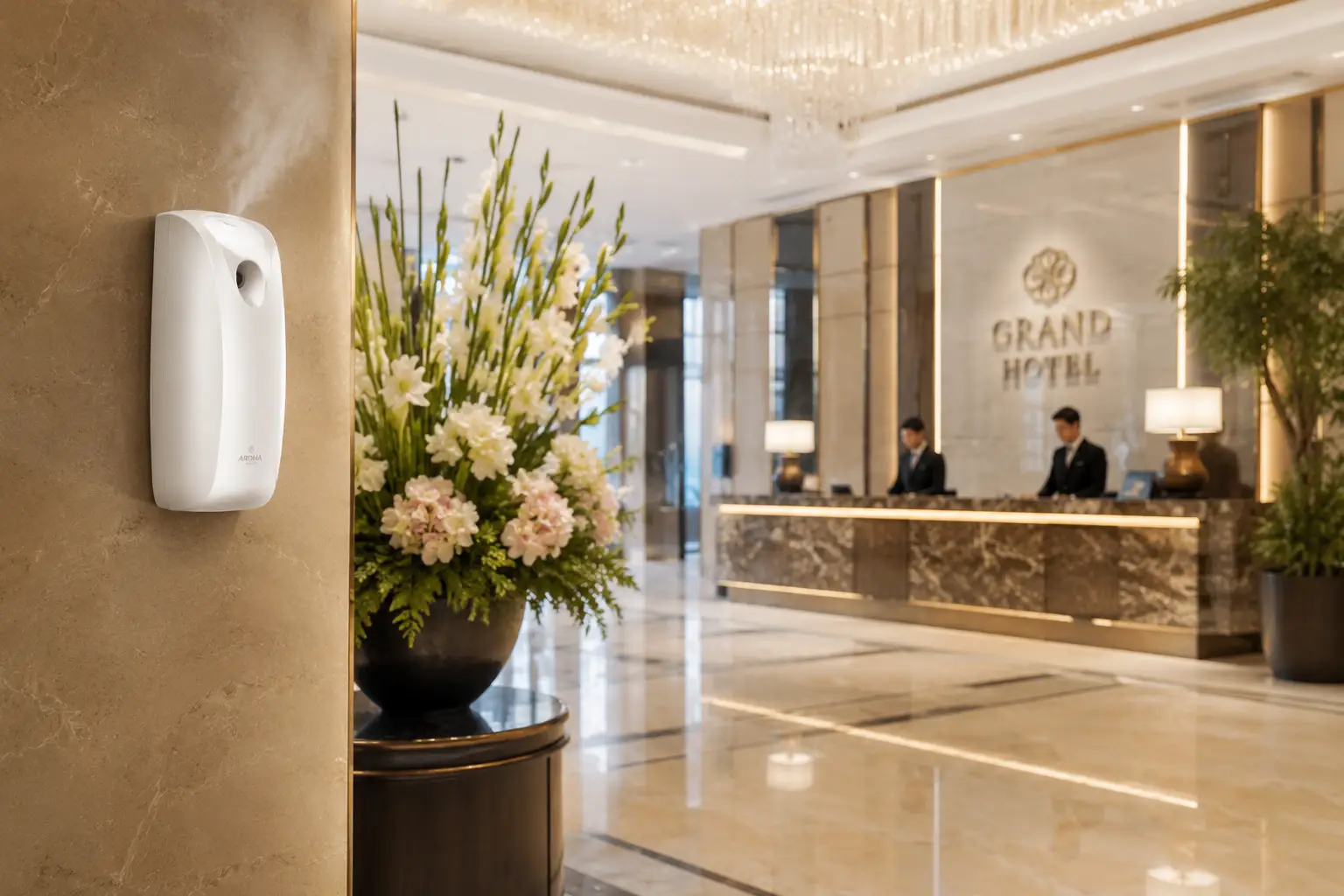
Walk into a great hotel and the first thing that registers isn’t the marble floor or the chandelier — it’s the smell. A well-chosen commercial air freshener for hotel lobby spaces is one of the cheapest, highest-return upgrades a property can make, and yet it’s also one of the easiest to get wrong. A commercial air freshener for hotel lobby use is a dedicated fragrance-diffusion device — typically a cold-air, nebulizing, or HVAC-connected unit — engineered to evenly scent large, high-traffic public spaces without the mess, heat, or fire risk of candles or plug-ins. Unlike a home diffuser, it needs to run for hours a day, cover thousands of square feet, and survive constant handling by staff.
That distinction matters more than it sounds. A $20 plug-in from a drugstore will choke on a 2,000-square-foot lobby with 12-foot ceilings and a revolving door letting outside air in every ninety seconds. Commercial-grade units solve that with stronger atomizing technology, larger reservoirs, and — in the better models — the option to tie directly into your HVAC system so the scent travels through the building’s existing airflow instead of fighting against it. The tradeoff is cost, complexity, and the need to actually understand what you’re buying before you commit a few hundred dollars to it.
This guide breaks down seven real, currently available commercial diffusion systems — from compact entry-level units to full HVAC-integrated commercial platforms — with honest analysis of what each one does well, where it falls short, and who it’s actually built for. We’ll also cover indoor air quality considerations the manufacturers won’t mention on the box, since the EPA notes that fragranced products, including air fresheners, are a recognized source of indoor volatile organic compounds (VOCs) — a fact worth weighing before you scent a space guests spend hours in every day.
This post contains affiliate links. As an Amazon Associate, we earn from qualifying purchases made through these links, at no additional cost to you.
Quick Comparison: 7 Commercial Air Fresheners for Hotel Lobbies at a Glance
Before diving into the full breakdowns, here’s a snapshot of how these seven systems stack up on the factors that matter most for a hotel lobby install: coverage area, installation type, and who each one suits best.
| Product | Coverage | Install Type | Price Range | Best For |
|---|---|---|---|---|
| AromaTech AroMini BT Plus | Up to ~600 sq ft | Portable, tabletop | Under $200 | Small boutique lobbies, entryways |
| Hotel Collection Studio Pro | Up to 600 sq ft | Portable with remote | $150–$250 | Budget boutique properties |
| AromaTech Ambience | Up to 1,000 sq ft | Portable, Bluetooth app | $300–$450 | Mid-size independent hotels |
| Airversa ANW | Up to 2,000 sq ft | Wall-mounted or portable | $150–$250 | Value-focused mid-size lobbies |
| Hotel Collection Villa | Up to 1,800 sq ft | HVAC or standalone | $250–$400 | Properties wanting HVAC flexibility |
| AromaTech AROMAPRO | Up to 4,000 sq ft | 3-in-1: wall, portable, HVAC | $500–$700 | Full-service hotels, large open lobbies |
| ASCENTYER 2026 HVAC | Up to 5,000 sq ft (claimed) | HVAC-ready, built-in fan | $250–$400 | Grand lobbies, atriums, resort entrances |
Looking at the table, the split falls roughly into three tiers: compact tabletop units under $250 for boutique or limited-service properties, mid-tier app-controlled diffusers in the $250–$450 range for standard lobbies, and true commercial HVAC-capable systems above $500 for large-format spaces. The AromaTech AROMAPRO stands out as the only unit here purpose-built as a genuine 3-in-1 commercial platform, while the ASCENTYER 2026 HVAC claims the widest raw coverage figure — though, as we’ll get into below, “claimed” square footage on these listings tends to run optimistic compared to real-world open-floor-plan performance.
💬 Bookmark this comparison — it’ll make picking between the seven options below a lot faster.
Top 7 Commercial Air Fresheners for Hotel Lobbies: Expert Analysis
We researched real spec sheets, manufacturer documentation, and aggregated Amazon customer feedback to put together this lineup. Every product below is a real, currently listed item — no invented models, no fictional brands.
1. AromaTech AroMini BT Plus — most affordable entry point from a trusted commercial brand
The AroMini BT Plus is AromaTech’s compact, portable diffuser, and it’s the cheapest legitimate way to get a commercial-grade cold-air unit into a small lobby. It uses the same nebulizing, waterless cold-air diffusion technology as AromaTech’s larger units, just scaled down into a smaller housing with Bluetooth control. In practice, that means no heating element cooking the oil into a candle-like smell, and no water dilution muddying the fragrance — the scent stays true to the oil blend from the first hour to the last. It’s built for spaces under roughly 600 square feet, which makes it a poor fit for a grand hotel lobby but a genuinely good option for a boutique inn’s reception area, a small entry vestibule, or a secondary scent zone near an elevator bank.
What most buyers overlook with entry-level units like this one is runtime cost: because the reservoir is small, you’ll be refilling fragrance oil more often than with a larger commercial unit, which changes the long-term math even though the upfront price looks attractive. Reviews for AromaTech’s diffuser line consistently mention that the Bluetooth app connection is more reliable than budget competitors, though the smaller tank does mean more frequent refills in continuous commercial use — a common tradeoff across compact diffusers in this category.
Pros:
- ✅ Genuine cold-air nebulizing tech at a low entry price
- ✅ Bluetooth app control for schedule and intensity
- ✅ Compact footprint fits tight entryways and vestibules
Cons:
- ❌ Small reservoir means frequent refills in a busy lobby
- ❌ Coverage tops out well below full lobby size
The AroMini BT Plus typically runs under $200 at the time of writing — always check the current price before ordering. For a small entry area or as a secondary unit paired with something larger, it’s solid value; for an actual full-size lobby, it’s undersized.
2. Hotel Collection Studio Pro — purpose-built for boutique hotel reception areas
Hotel Collection is a scenting brand that markets specifically to hospitality clients, and the Studio Pro is its portable, remote-controlled diffuser rated for roughly 600 square feet. It uses cold-air diffusion technology and works exclusively with the brand’s proprietary Pro Pod fragrance bottles, which simplifies refills — you swap a sealed pod instead of measuring liquid oil — but also locks you into that brand’s fragrance catalog going forward. The remote control is a small but real convenience for front-desk staff who need to adjust intensity without walking over to the unit itself.
Being a brand built around hotel scenting specifically, Hotel Collection leans on its hospitality positioning hard, and the closed-pod system is the practical tradeoff for that convenience: you’re paying a premium per pod compared to buying raw fragrance oil for an open-system diffuser, and you can’t mix in third-party scents. For a boutique property that wants a specific signature scent without managing bottles and dosing, that’s a reasonable exchange. Aggregated customer feedback for the Studio Pro trends positive on ease of setup and quiet operation, with the recurring caveat that pod refill costs add up faster than open-reservoir alternatives — worth factoring into your annual scenting budget rather than just the sticker price.
Pros:
- ✅ Purpose-built hospitality brand with pod-based simplicity
- ✅ Remote control convenient for front-desk teams
- ✅ Quiet cold-air operation suited to reception areas
Cons:
- ❌ Locked into proprietary Pro Pod fragrance system
- ❌ Per-use fragrance cost runs higher than open-oil diffusers
Expect a price in the $150–$250 range, plus ongoing pod costs — confirm current pricing on the product page since bundle deals shift often. It’s a strong pick for boutique hotels prioritizing a signature scent over raw cost efficiency.
3. AromaTech Ambience Scent Diffuser — best all-around pick for mid-size independent hotels
The Ambience is AromaTech’s flagship consumer-facing diffuser, rated for up to 1,000 square feet, and it’s the model the brand highlights across its retail presence. It runs on the same waterless cold-air diffusion platform as the rest of the AromaTech lineup, controlled through a dedicated app that handles scheduling, intensity, and — on some configurations — ambient lighting. The 1,000-square-foot rating puts it right in the sweet spot for a mid-size independent hotel lobby: big enough for genuine full-room coverage, not so large that you’re paying for commercial HVAC infrastructure you don’t need.
What sets the Ambience apart from generic no-name diffusers on Amazon is brand consistency in fragrance quality — AromaTech formulates its own oil blends rather than relying on third-party suppliers, which matters if you want a lobby scent that reads as intentional rather than generic “hotel smell.” The tradeoff is that you’re paying a premium for that formulation quality compared to bulk generic oils. Reviews for the Ambience frequently mention the fragrance quality and app reliability as standout strengths, with occasional notes that the 1,000-square-foot claim assumes a relatively enclosed space — an open-plan lobby with high ceilings and a revolving door will scent less evenly than a boxed-in room of the same square footage.
Pros:
- ✅ Proprietary, hotel-inspired fragrance blends
- ✅ Reliable app-based scheduling and intensity control
- ✅ Sweet-spot coverage for mid-size lobbies
Cons:
- ❌ Premium pricing versus generic waterless diffusers
- ❌ Real-world coverage drops in open, high-ceiling spaces
Pricing generally falls between $300 and $450 depending on the color and bundle — verify the current listing price before purchasing. For a mid-size independent hotel that wants a genuinely branded scent experience, this is the strongest all-around option on this list.
4. Airversa ANW Smart Waterless Diffuser — best value for larger mid-size lobbies
The Airversa ANW is rated for up to 2,000 square feet — double the Ambience’s coverage — while typically pricing lower, which makes it the value play for hotels with a bigger footprint and a tighter budget. It uses cold-air technology with app control, a 400mL reservoir, and a wall-plug design that skips battery dependency entirely, which matters for a device that’s expected to run for ten-plus hours a day, every day, in a commercial setting.
The practical tradeoff for that larger coverage at a lower price is fragrance sourcing: Airversa doesn’t have the same in-house perfumery reputation as AromaTech or Hotel Collection, so you’re more dependent on trial-and-error with third-party oils to land on a signature scent you’re happy with. Based on comparing the spec sheets, the ANW’s 400mL tank and 2,000-square-foot rating suggest a genuinely stronger atomizer than the smaller units on this list, not just a bigger number on the box — a legitimate reason it can hold that larger coverage claim credibly. Customer feedback for this diffuser tier tends to praise the price-to-coverage ratio while noting that, as with most consumer-facing “square footage” claims in this category, real coverage in an open lobby with high ceilings will run below the stated number.
Pros:
- ✅ Strong coverage-to-price ratio for larger spaces
- ✅ Wall-plug design avoids battery dependency
- ✅ App control with adjustable mist levels
Cons:
- ❌ Less brand pedigree on fragrance formulation
- ❌ Stated square footage optimistic for open floor plans
Typical pricing sits around $150–$250 — always check the live Amazon listing, since this tier sees frequent promotional pricing. For hotels prioritizing coverage per dollar over brand prestige, the ANW is hard to beat.
5. Hotel Collection Villa Scent Diffuser — flexible HVAC-or-standalone installation
The Villa steps up from the Studio Pro within Hotel Collection’s own lineup, rated for roughly 1,800 square feet and — critically — built to work either as a standalone unit or wired into your building’s HVAC system. That flexibility is the headline feature: a property can start with the Villa running as a freestanding unit near the front desk, then later connect it to the HVAC system if they renovate or want more even distribution, without buying a second device.
Being cold-air, heatless, and waterless like the rest of the Hotel Collection line, the Villa avoids the residue and fire-hazard concerns that come with candle-based lobby scenting. What most buyers overlook is that HVAC-connected scenting distributes fragrance far more evenly than a single standalone point source, since it rides the building’s existing air circulation instead of relying on the diffuser’s own throw distance — a meaningful upgrade in a lobby with multiple seating areas or an adjoining corridor. Aggregated reviews for the Villa highlight the dual-installation flexibility as a genuine differentiator, with some feedback noting the HVAC hookup requires basic technical comfort or a facilities team to install correctly.
Pros:
- ✅ Works standalone now, HVAC-connected later
- ✅ Heatless, waterless cold-air diffusion
- ✅ Solid mid-large coverage at 1,800 sq ft
Cons:
- ❌ HVAC connection isn’t a true plug-and-play setup
- ❌ Locked into Hotel Collection’s fragrance ecosystem
Expect a price range of roughly $250–$400 — pricing on HVAC-capable units fluctuates more than portable-only models, so double-check before buying. This is a smart middle-tier pick for properties planning to eventually integrate scenting into their building systems.
6. AromaTech AROMAPRO — true commercial-grade 3-in-1 system
The AROMAPRO is AromaTech’s dedicated commercial product, explicitly marketed for hotel lobbies, meeting rooms, and retail floors, and it’s the most genuinely “commercial” unit on this list. It’s a true 3-in-1 system: wall-mount it, run it as a portable unit, or hard-connect it into your HVAC ductwork, all with the same hardware. Rated coverage runs up to roughly 4,000 square feet, and the cold-air diffusion technology means no heat degradation of the oil even during long continuous runtimes — a meaningful difference from cheaper units that can start to smell “cooked” after hours of use.
Here’s what the spec sheet doesn’t say outright but the design implies: the 3-in-1 flexibility isn’t just a marketing bullet, it’s a genuine hedge against installation mistakes. A hotel that buys the AROMAPRO and later decides the wall-mount placement isn’t distributing scent evenly can switch to HVAC connection without replacing the unit — something none of the portable-only diffusers on this list allow. That flexibility, paired with commercial-grade build quality, is why this sits at the top of the price range here. Feedback on AromaTech’s commercial line tends to emphasize durability under continuous commercial use as the standout, which tracks with its positioning as a genuine business-grade device rather than a consumer product marketed toward commercial buyers as an afterthought.
Pros:
- ✅ Genuine 3-in-1 wall, portable, or HVAC installation
- ✅ Commercial-grade build for continuous daily runtime
- ✅ Strong 4,000-sq-ft coverage for large open lobbies
Cons:
- ❌ Highest price point on this list
- ❌ Overkill for smaller boutique properties
Pricing typically lands between $500 and $700 — always confirm the current price, since commercial units like this see less frequent discounting than consumer models. For a full-service hotel with a genuinely large lobby, this is the most defensible investment on the list.
7. ASCENTYER 2026 Upgraded HVAC Scent Diffuser — maximum claimed coverage for grand lobbies
The newest entry here, ASCENTYER’s 2026 model is built around a built-in fan and Wi-Fi control, with a manufacturer-claimed coverage figure of up to 5,000 square feet — the largest number on this list. It’s designed for HVAC-ready installs and targets the same commercial-space use cases as the AROMAPRO, but at a notably lower price point, which is either a genuine value story or a sign the coverage claim is more aggressive than the AROMAPRO’s — likely some of both.
Based on comparing the spec sheets, a built-in fan is a legitimate way to push scent further than passive cold-air diffusion alone, so the larger coverage claim isn’t baseless — but “up to 5,000 sq ft” listings in this product category, this one included, are typically measured under ideal enclosed conditions that a real hotel lobby with 20-foot ceilings and open corridors won’t replicate. Reviews consistently report that Wi-Fi setup and app reliability are strong, while coverage in genuinely large, open spaces tends to fall short of the headline number — treat the 5,000-square-foot figure as a best-case ceiling, not a guaranteed result, and plan for supplemental units in very large atriums.
Pros:
- ✅ Largest claimed coverage figure in this lineup
- ✅ Built-in fan genuinely extends fragrance throw
- ✅ Wi-Fi control with strong app reliability in reviews
Cons:
- ❌ Claimed coverage optimistic for open, high-ceiling lobbies
- ❌ Newer product line with a shorter review history
Typical pricing runs $250–$400 at the time of writing — check current availability, since new product listings like this one see pricing adjustments as reviews accumulate. For a large lobby on a budget that’s willing to supplement with a second unit if needed, it’s a reasonable bet.
Full Lineup Comparison: Features, Price, and Sentiment
| Product | Key Tech | Price Range | Aggregate Review Sentiment |
|---|---|---|---|
| AromaTech AroMini BT Plus | Cold-air, Bluetooth | Under $200 | Mostly positive; praised for app reliability |
| Hotel Collection Studio Pro | Cold-air, pod-based | $150–$250 | Positive; refill cost is the recurring gripe |
| AromaTech Ambience | Cold-air, in-house scents | $300–$450 | Strongly positive on fragrance quality |
| Airversa ANW | Cold-air, wall-plug | $150–$250 | Positive on value; mixed on stated coverage |
| Hotel Collection Villa | Cold-air, HVAC-ready | $250–$400 | Positive on flexibility; setup needs technical comfort |
| AromaTech AROMAPRO | 3-in-1 commercial | $500–$700 | Strongly positive on durability |
| ASCENTYER 2026 HVAC | Fan-assisted, Wi-Fi | $250–$400 | Positive on app; skeptical on coverage claims |
Reading across this table, a clear pattern emerges: price tracks installation flexibility more than raw coverage. The AromaTech AROMAPRO costs the most because it’s genuinely 3-in-1, not because its 4,000-square-foot rating dwarfs the ASCENTYER 2026 HVAC‘s claimed 5,000. If your lobby is under 1,000 square feet, spending up for the AROMAPRO’s flexibility is unnecessary; if you’re scenting a genuine grand lobby, the extra cost buys real installation options down the road.
✨ Ready to Scent Your Lobby the Right Way?
🔍 Take your guest experience to the next level with a system that matches your lobby’s actual square footage, not just the biggest number on the box. Click through on any highlighted pick above to check current pricing and availability, and start building a first impression guests will remember long after checkout.
How to Set Up and Maintain a Hotel Lobby Scenting System
Buying the right unit is half the job — a poorly maintained diffuser will drift from “welcoming” to “overpowering” or “stale” within weeks. Start by placing the unit away from direct sunlight and heat sources, both of which degrade fragrance oil faster than normal room-temperature exposure. If you’re running a standalone unit like the AromaTech Ambience or Airversa ANW, position it near — but not directly beside — the main entrance, so incoming air currents help distribute scent into the lobby rather than blowing it straight back outside.
For the first 30 days, resist the urge to run any diffuser at maximum intensity. New units tend to smell strongest right out of the box, and staff who work the lobby all day will “nose-blind” to a scent faster than guests passing through for a few minutes — a common first-time mistake that leads properties to over-scent trying to compensate. Set intensity conservatively, then adjust after a week of guest feedback rather than staff impression alone.
Maintenance schedules vary by system, but a few rules hold across all seven products here: clean the nozzle or diffusion head monthly to prevent oil buildup, replace fragrance oil or pods before the reservoir runs fully dry (running dry can damage the atomizer on cold-air units), and, for HVAC-connected systems like the Hotel Collection Villa or AromaTech AROMAPRO, have your facilities team inspect the connection point quarterly to confirm airflow hasn’t shifted the scent distribution pattern. A quick monthly walk-through at different times of day — morning, midday, evening — will catch uneven scenting before a guest complains about it.
Real-World Scenarios: Matching the Right System to Your Property
Consider three different properties evaluating a commercial air freshener for hotel lobby use, each with a different budget, footprint, and priority.
A 40-room boutique inn with a 500-square-foot reception area and a modest marketing budget doesn’t need a 4,000-square-foot commercial system. The AromaTech AroMini BT Plus or Hotel Collection Studio Pro covers the space fully at a fraction of the cost of a commercial unit, and the owner can reinvest the savings into higher-quality fragrance oils instead of oversized hardware.
A 150-room independent hotel with a 1,200-square-foot lobby, a coffee bar, and moderate daily foot traffic sits in the sweet spot for the AromaTech Ambience or Airversa ANW. Both cover the space with room to spare, and the choice between them comes down to whether the property values AromaTech’s in-house fragrance formulation enough to pay the premium, or prefers to save the difference and source oils independently.
A 300-room full-service hotel with a 3,500-square-foot atrium lobby, high ceilings, and a connected bar and restaurant area is exactly the use case the AromaTech AROMAPRO and ASCENTYER 2026 HVAC were built for. Here, the flexibility to connect into existing HVAC ductwork stops being a nice-to-have and becomes the only realistic way to scent the space evenly — a standalone unit, however powerful, will struggle against the volume of open air and constant traffic through revolving doors.
Quick Decision Framework: Which System Fits Your Lobby?
Use this simple framework if you’re still weighing options:
- If your lobby is under 800 square feet, choose a compact portable unit like the AromaTech AroMini BT Plus or Hotel Collection Studio Pro, because oversized commercial hardware wastes budget on coverage you’ll never use.
- If your lobby is 800–2,000 square feet and you want a signature, proprietary scent, choose the AromaTech Ambience, because its in-house fragrance formulation justifies the mid-tier price.
- If your lobby is in that same size range but budget matters more than brand prestige, choose the Airversa ANW, because it delivers comparable coverage at a lower entry cost.
- If you’re planning a future HVAC integration but not ready to commit yet, choose the Hotel Collection Villa, because it works standalone today and connects later without replacing hardware.
- If your lobby exceeds 3,000 square feet or has an open atrium layout, choose the AromaTech AROMAPRO or ASCENTYER 2026 HVAC, because only commercial-grade, fan-assisted, or HVAC-capable units can realistically cover that volume of open air.
How to Choose a Commercial Air Freshener for Your Hotel Lobby
Working through these seven criteria in order will narrow your shortlist faster than browsing Amazon listings one by one:
- Measure your actual square footage. Don’t estimate — a tape measure or your building’s floor plan will save you from buying an undersized unit, which is the single most common mistake in this category.
- Decide between standalone and HVAC-connected. Standalone units install faster; HVAC-connected units distribute scent more evenly across large or irregularly shaped spaces.
- Check the fragrance ecosystem. Closed-pod systems like Hotel Collection’s are simpler to run but cost more per use; open-reservoir systems like AromaTech’s and Airversa’s cost less per refill but require you to source and dose oil yourself.
- Prioritize cold-air, waterless technology. Heat-based diffusers can alter fragrance chemistry over long runtimes and leave residue; every product on this list uses cold-air diffusion for a reason.
- Budget for consumables, not just hardware. A $150 diffuser running premium oil eight hours a day, seven days a week, will cost more in oil over a year than the unit itself.
- Confirm app or remote control fits your staff’s workflow. A front desk that can’t easily adjust intensity during a slow versus a busy shift will end up either wasting oil or under-scenting.
- Read the coverage rating skeptically. As covered above, stated square footage assumes enclosed, ceiling-standard rooms — open lobbies with high ceilings or revolving doors need extra coverage margin.
What to Expect: Everyday Performance in a Working Lobby
Spec sheets describe best-case conditions; a working hotel lobby is rarely a best-case condition. Expect scent intensity to feel strongest in the first 15–20 minutes after a diffuser cycle starts, then settle into a more subtle baseline — this is normal cold-air diffusion behavior, not a malfunction. Expect performance to dip noticeably whenever exterior doors are opened frequently, since revolving doors and manual entrances both pull conditioned, scented air outside and pull unscented outside air in.
Hospitality research backs up why properties bother with this in the first place: Cornell’s Center for Hospitality Research has published extensively on how sensory factors, including ambient scent, shape guest perception of a property from the moment they arrive, reinforcing that the investment isn’t purely aesthetic — it measurably shapes first impressions. What most buyers don’t anticipate is seasonal variation: HVAC-connected systems will diffuse scent differently in winter, when heating systems run drier air, versus summer, when air conditioning and humidity levels shift how fragrance molecules disperse. Plan to adjust intensity settings seasonally rather than setting a system once and forgetting it.
Features That Actually Matter (and Ones That Don’t)
Cutting through the marketing copy on these listings, a few features genuinely affect day-to-day performance, and a few are mostly noise. Cold-air, waterless diffusion technology matters — it’s the difference between a clean, true-to-bottle scent and a diluted or heat-altered one. Reservoir size matters for commercial use, since it directly determines how often staff have to interrupt their day to refill the unit. App or remote control matters for a front desk that needs to react to real-time conditions, like a sudden influx of guests or a request to tone down intensity.
What matters less than the listings suggest: ambient LED lighting, which several of these units include as a bonus feature but which has no bearing on scent performance and is largely irrelevant in a lobby that already has its own lighting design. Multiple “mist levels” beyond three or four settings also add diminishing returns — in practice, most properties settle on one or two intensity levels and rarely touch the rest. And headline square-footage claims, as discussed above, matter far less than the actual layout, ceiling height, and door traffic of your specific lobby.
Long-Term Cost and Maintenance: What Oil Subscriptions Really Cost
The unit price is only the entry fee. Over a 12-month period, a diffuser running eight hours a day in a busy lobby will typically go through several bottles or pods of fragrance oil, and that recurring cost varies significantly by system. Closed-pod systems like Hotel Collection’s tend to run higher per-ounce than open-reservoir oils you can buy independently, because you’re paying for the convenience and brand consistency of the pod format. Open systems like AromaTech’s and Airversa’s let you shop across a wider range of oil suppliers, which can meaningfully lower your annual fragrance spend if cost matters more than a single branded scent.
Beyond oil, budget for occasional maintenance: nozzle replacements on cold-air units every year or two of continuous commercial use, and — for HVAC-connected systems — the facilities labor cost of the initial hookup and periodic inspection. None of this is prohibitively expensive, but treating a lobby diffuser as a one-time purchase rather than an ongoing line item is a planning mistake that catches a lot of first-time buyers off guard.
Common Mistakes to Avoid When Buying a Hotel Lobby Scent Diffuser
The most common mistake, by a wide margin, is buying based on the largest advertised square footage number without accounting for ceiling height, open floor plans, or door traffic — a unit “rated” for 3,000 square feet in a sealed test room will underperform in an open, high-ceiling lobby of the same footprint. A close second is underestimating ongoing fragrance oil cost and being surprised by the true annual price of running a diffuser continuously rather than occasionally.
Another frequent misstep is choosing a closed-pod or proprietary-fragrance system without first sampling the scent options, since you’re committing to that brand’s fragrance library going forward. And when researching options online, it’s worth remembering that the FTC’s endorsement guidance requires that paid or sponsored reviews be clearly disclosed — not every glowing “review” you encounter while shopping is an independent one, so weigh aggregated verified-purchase feedback more heavily than isolated testimonials on a brand’s own site.
Finally, skipping the placement plan is a mistake that costs nothing to avoid: a diffuser placed directly behind a reception desk, in a corner, or too close to an HVAC return vent will distribute unevenly regardless of how good the hardware is.
Safety, Regulations, and Standards for Commercial Scenting Systems
Because these are electrical appliances running continuously in a public commercial space, safety compliance isn’t optional. Look for units that carry UL or ETL listing, which confirms the device has been independently tested against recognized US electrical safety standards — the CPSC maintains guidance on electrical product safety standards that’s worth reviewing if you’re responsible for facilities compliance at your property. Devices that will run near-continuously for years, as commercial lobby diffusers do, benefit from that third-party certification far more than an occasional-use home diffuser would.
On the air-quality side, remember the EPA guidance cited earlier in this guide: fragranced products are a documented source of indoor VOCs, and while occasional home use is generally considered low-risk, continuous commercial diffusion in a space with extended guest dwell time is a different exposure profile. Choosing cold-air, waterless technology over heat-based or aerosol alternatives reduces some — though not all — of that concern, since heating fragrance oil tends to increase VOC release compared to cold nebulization. If any guests or staff have documented fragrance sensitivities, it’s worth having a policy for adjustable, fragrance-free zones near the lobby rather than a single blanket setting throughout the building.
Frequently Asked Questions
❓ What is the best commercial air freshener for hotel lobby use?
❓ How much does a commercial hotel lobby scent diffuser cost?
❓ Can I connect a lobby diffuser to my hotel's HVAC system?
❓ Are cold-air diffusers safer than scented candles in a hotel lobby?
❓ How often do commercial hotel diffusers need fragrance oil refills?
Conclusion
Choosing a commercial air freshener for hotel lobby use ultimately comes down to matching real square footage and traffic patterns to the right technology tier — not chasing the biggest coverage number on the listing page. Smaller boutique properties are well served by compact, portable units like the AromaTech AroMini BT Plus or Hotel Collection Studio Pro; mid-size independent hotels get the best balance of quality and cost from the AromaTech Ambience or Airversa ANW; and large-format lobbies with high ceilings and heavy door traffic genuinely need the flexibility of an HVAC-capable commercial system like the AromaTech AROMAPRO or the ASCENTYER 2026 HVAC.
Whichever tier fits your property, the honest analysis holds across all seven: prioritize cold-air, waterless technology, budget for ongoing fragrance costs rather than just the unit price, and measure your actual space before trusting a manufacturer’s square-footage claim. Get those three things right, and the scent that greets your guests will do exactly what it’s supposed to — make the lobby feel like somewhere worth remembering.
Recommended for You
- Aromatherapy Car Diffuser: 7 Best Picks for a Calmer Commute (2026)
- Black Diffuser: 7 Best Picks for a Sleek Home in 2026
- 7 Best Smelling Essential Oil Blends of 2026 (Reviewed & Compared)
Disclaimer: This post contains affiliate links. As an Amazon Associate, I earn from qualifying purchases made through these links, at no additional cost to you.
✨ Found this article helpful? Share it with someone who needs it! 💬🤗