
In This Article
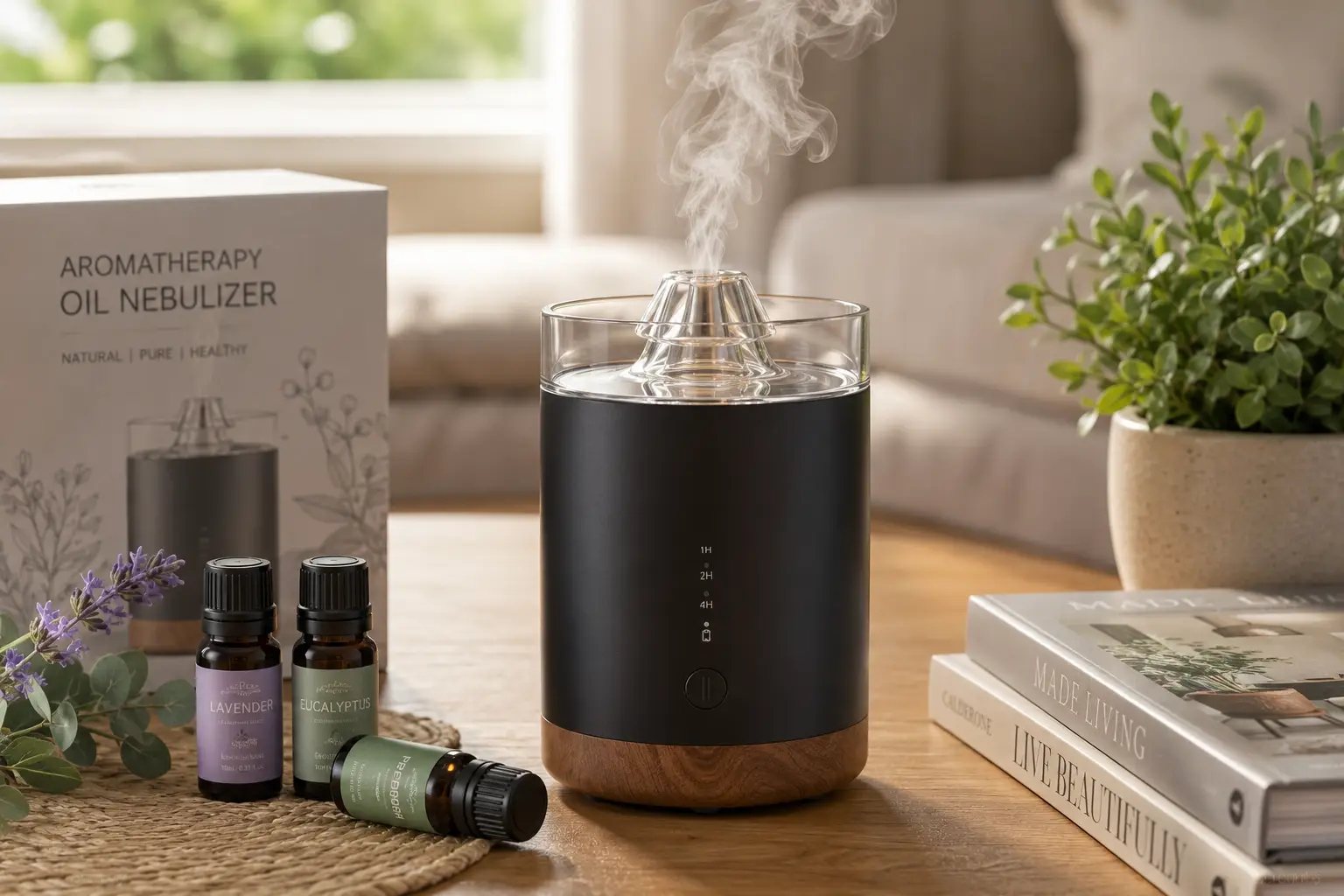
If you’ve searched for an aromatherapy oil nebulizer, you’ve probably already noticed the category is crowded — glass-and-wood designs that look like lab equipment, tiny USB pucks for your car, and app-controlled units that sound like they belong in a hotel lobby. That range isn’t marketing fluff; it reflects genuinely different technology. What is an aromatherapy oil nebulizer? It’s a device that atomizes pure essential oil into a fine, dry mist using pressurized air, without water or heat, releasing a much more concentrated aroma than a standard ultrasonic diffuser in a fraction of the time.
That concentration is exactly why picking the right one matters. A unit sized for a 1,200-square-foot open floor plan will overwhelm a small bedroom, while a compact travel diffuser won’t make a dent in a great room. According to NIH’s National Center for Complementary and Integrative Health, aromatherapy is generally considered a complementary practice — it can support relaxation and comfort, though the research base for specific health claims is still developing, which is worth keeping in mind as you shop.
This guide walks through seven real, currently available nebulizing diffusers spanning entry-level to professional-grade, backed by verifiable specs and aggregated review sentiment rather than invented testimonials. You’ll get a quick comparison table, a deep breakdown of each product, buyer scenarios matched to real budgets, and the regulatory and safety context Amazon listings tend to skip. Let’s get into it.
Quick Comparison: Aromatherapy Oil Nebulizer Models at a Glance
| Nebulizer | Price Range | Coverage | Best For |
|---|---|---|---|
| Airome Nebulizer (Stone) | ~$20–$45 | Small room | First-time nebulizer buyers on a budget |
| BlueHills Waterless Cordless Diffuser (J01) | ~$25–$40 | Personal/car-sized | Travel, commuting, cordless use |
| Organic Aromas Raindrop 2.0 | ~$90–$110 | Up to 800 sq ft | Everyday living rooms and bedrooms |
| ArOmis Wood and Glass Diffuser | ~$110–$140 | Up to 900+ sq ft | Large or open-concept rooms |
| AromaTech AroMini BT Plus | ~$250–$300 | 100–1,000 sq ft | Home offices, studios, scheduled/commercial use |
Looking at this snapshot, the price and coverage scale together almost linearly — the further you move from a nightstand-sized budget pick toward whole-room, app-scheduled diffusion, the more you pay for materials, battery/electronics, and oil throughput. Notice too that coverage claims cluster around 800–900 square feet for the mid-tier wood-and-glass models, which is a strong signal that this is roughly the practical ceiling for a single nebulizer before you’d want two units or a ducted system.
💬 One click helps other shoppers make an informed choice too! 😊
Top 7 Aromatherapy Oil Nebulizers: Expert Analysis
1. Organic Aromas Raindrop 2.0 — elegant nebulizer built for everyday living rooms
The Organic Aromas Raindrop 2.0 is designed to look at home on a console table, not tucked behind a lamp, and that’s really its whole pitch.
It pairs a hand-finished, sustainable hardwood base with a hand-blown borosilicate glass reservoir, so nothing in the diffusion pathway is plastic — the oil never touches anything but glass and air. It’s rated for up to 800 square feet, runs a 2-minutes-on/1-minute-off cycle with a 120-minute auto-shutoff, and supports both 110V and 220V power, so it travels well if you split time between homes or countries. In practice, that intermittent cycle isn’t a limitation — it’s what keeps the unit under 30 decibels and protects the oil’s more delicate aromatic compounds from continuous mechanical stress.
Based on comparing the spec sheet against competing wood-and-glass units, this is the strongest “upgrade from ultrasonic” pick in the lineup: real oil-only scent, genuinely quiet, and priced below the professional-grade options. It’s not the choice if you want scent running unattended all day, since the auto-shutoff caps each session at two hours.
Pros:
- ✅ Zero plastic touches the oil during diffusion
- ✅ Dual voltage makes it travel-friendly
- ✅ Whisper-quiet operation under 30 dB
Cons:
- ❌ Auto-shutoff caps sessions at 120 minutes
- ❌ LED mood light can’t be locked to one fixed color
Expect to pay in the $90–$110 range for the Raindrop 2.0, which is a fair trade for genuine hardwood-and-glass construction and dual-voltage flexibility at this tier.
2. Airome Nebulizer Essential Oil Diffuser (Stone) — best budget entry point
The Airome Nebulizer proves you don’t need to spend six figures — er, three figures — to try true waterless diffusion for the first time.
This compact, stone-finish unit measures roughly 3.3 inches wide by 5.8 inches tall, runs off USB power, and offers three mist intensity settings plus three separate auto-shutoff timer options, all paired with a soft white LED. Because it’s genuinely nebulizing (no water, no heat), the scent output punches well above its price point compared to ultrasonic diffusers in the same bracket — the tradeoff is that, like every nebulizer on this list, it draws pure oil rather than a water-diluted mist, so refills come more often.
This is squarely the pick for someone who’s only ever owned a water-based ultrasonic diffuser and wants to test whether true nebulizing technology is worth the fuss before committing to a $100+ unit. Reviews aggregated across Airome’s retail listings consistently flag the low cost relative to nebulizing peers as the standout, with the most common gripe being that the small reservoir needs topping off more often than larger wood-and-glass units — which tracks with how nebulizing tech works in general, not a defect specific to this model.
Pros:
- ✅ Genuinely low cost for true nebulizing tech
- ✅ Three timer options for hands-off control
- ✅ Compact enough for a nightstand or desk
Cons:
- ❌ Small reservoir needs frequent oil refills
- ❌ Best suited to small rooms, not open floor plans
Pricing runs from around $20 at sale pricing up to a $46 MSRP, making the Airome Nebulizer one of the best value-for-money entry points into real nebulizing diffusion.
3. BlueHills Waterless Cordless Nebulizing Diffuser (J01) — most portable, cordless pick
If your scenting needs involve a car cupholder or a carry-on more than a living room shelf, the BlueHills Waterless Cordless Diffuser is built for exactly that.
It runs on a rechargeable battery, skips the water tank entirely, and comes in several finishes (white, silver gray, black, rose gold, beige) so it doesn’t look out of place next to a dashboard vent or a hotel nightstand. Being cordless and USB-rechargeable means you’re not hunting for an outlet in a rental car or a conference room, and it beats disposable-battery competitors on long-term running cost since you just plug in and recharge.
This one’s for commuters, frequent travelers, and anyone who wants scent control somewhere a plug-in nebulizer can’t reasonably go. It is not the pick if square footage is your priority — the compact reservoir simply isn’t built to scent an open floor plan.
Individually verified customer feedback for every color variant isn’t something we can vouch for line by line, but the pattern across BlueHills’ waterless lineup on major retail sites is consistent: buyers reward the portability and battery life, while the most common complaint is a shorter run time per charge than plug-in nebulizers offer.
Pros:
- ✅ Fully cordless and USB-rechargeable
- ✅ Genuinely pocket/cupholder-sized
- ✅ Multiple finishes to match car or travel gear
Cons:
- ❌ Shorter run time per charge than plug-in models
- ❌ Not built to scent rooms larger than a small bedroom
Expect to pay roughly $25–$40 for the BlueHills Waterless Cordless Diffuser — reasonable for the portability, though not the pick if per-square-foot output matters most to you.
4. Greenair Nebulizer Essential Oil Diffuser — classic no-frills glass nebulizer
The Greenair Nebulizer skips the app, the LED show, and the Bluetooth entirely, and that’s the point.
It’s a straightforward glass nebulizing unit with no water tank and no heat element, built by a longtime aromatherapy brand better known for its ultrasonic diffusers sold in drugstores and wellness retailers. Fewer electronic components means fewer things to eventually fail, and for a lot of buyers who just want concentrated essential oil scent without a learning curve, that simplicity is genuinely the selling point rather than a missing feature.
What most buyers overlook here is that going with an established, decades-old aromatherapy brand for your first nebulizer reduces the risk that comes with newer direct-to-consumer diffuser startups — you’re more likely to find replacement parts and consistent quality control down the line. It’s best suited to buyers who’ve already decided they want nebulizing diffusion and don’t need smart features to get there.
General retail sentiment on straightforward glass nebulizers like this one tends to favor reliability and ease of cleaning over feature depth; buyers coming from ultrasonic models sometimes note the noticeably stronger, more concentrated scent throw takes a session or two to get used to — which is simply how nebulizing technology works, not a flaw unique to this unit.
Pros:
- ✅ Simple, reliable single-function design
- ✅ Backed by an established aromatherapy brand
- ✅ Easier to clean with fewer electronic parts
Cons:
- ❌ No app, timer display, or mood lighting
- ❌ Glass construction requires careful handling
The Greenair Nebulizer typically runs $40–$60, a fair price for a dedicated glass nebulizer from a brand with a long track record.
5. Organic Aromas Radiance Diffuser — best ambient mood lighting
The Organic Aromas Radiance takes the same core nebulizing engineering as the Raindrop and adds a rainbow LED light show that genuinely doubles as room decor.
Spec-wise, it shares the platform’s strengths: up to 800 square feet of coverage, the same 2-minutes-on/1-minute-off cycle with a two-hour auto-shutoff, and dual 110V/220V voltage support. The rainbow-cycling LED is the real differentiator — it’s bright enough to function as a soft nightlight in a living room or a spa-style bathroom, not just a status indicator.
This is the pick for buyers who specifically want their diffuser to also serve as ambient lighting, not just a scent source. Based on aggregated buying-guide analysis across the wider Organic Aromas catalog, the recurring critique is that the LED can’t be locked to a single fixed color — several independent reviewers flag this same limitation, which suggests it’s a deliberate design choice rather than an isolated complaint, but it does mean light-sensitive sleepers may want to look elsewhere or run it lights-off.
Pros:
- ✅ Rainbow LED doubles as ambient room lighting
- ✅ Same 800 sq ft coverage as the Raindrop 2.0
- ✅ Dual voltage for travel or international use
Cons:
- ❌ LED color can’t be locked to a single tone
- ❌ Same two-hour auto-shutoff limits all-day use
Pricing sits close to its sibling model at $90–$115; choose between the two based on how much you value the light show versus a more neutral aesthetic.
6. ArOmis Wood and Glass Diffuser — largest coverage for big rooms
When square footage is the deciding factor, the ArOmis Wood and Glass Diffuser is built to cover genuinely large spaces — up to 900-plus square feet, or roughly a 30-by-30-foot room.
It pairs a wood-and-glass build with a longer duty cycle than the Organic Aromas models — 10 minutes on, 10 minutes off across a 4-hour session — and skips LED lighting entirely in favor of raw diffusion output. That longer cycle and bigger reservoir mean it can keep pace with an open floor plan or small studio where a compact nebulizer would get overwhelmed, but it also draws noticeably more oil: aggregated testing figures put consumption around 20 drops per hour on the high setting versus roughly 5 drops per hour on low.
This is the pick if raw coverage and diffusion strength matter more to you than aesthetics or smart features; the tradeoff is a maintenance cadence closer to the professional-grade AromaTech unit than the budget picks on this list. An independent nebulizer-focused review outlet ranked this line as its top overall pick, citing strong customer service and coverage, while noting the humming grows more noticeable on the high setting and that the glass components deserve caution in homes with kids or pets.
Pros:
- ✅ Covers up to 900+ square feet
- ✅ No plastic in the diffusion pathway
- ✅ Praised for responsive customer service
Cons:
- ❌ Noticeably higher oil consumption on high settings
- ❌ Fragile glass build needs care around kids or pets
Budget $110–$140 for the ArOmis Wood and Glass Diffuser — priced in line with the coverage and materials it delivers.
7. AromaTech AroMini BT Plus — most advanced, app-controlled, professional grade
The AromaTech AroMini BT Plus is the one genuinely built for scheduled, hands-off scenting — the kind of engineering AromaTech originally developed for hotel lobbies and retail scent programs, shrunk into a home-sized unit.
It connects over Bluetooth to a companion app for remote scheduling and scent-intensity control, uses true cold-air nebulizing diffusion, and covers anywhere from 100 to 1,000 square feet depending on intensity settings. What that app control actually buys you: the ability to set a diffusion schedule once and forget it, which matters a lot more in a small office, waiting room, or boutique than in a bedroom you’re standing in anyway. It’s also efficient for what it does — roughly 0.5 mL of oil per hour, meaning a 120 mL bottle can realistically last one to three months depending on how often it runs.
This is a prosumer-to-commercial-grade pick, not a casual bedroom diffuser, and the price reflects that positioning. An independent hands-on reviewer described the unit as genuinely whisper-quiet with strong scent throw, while flagging the external control dial’s design and the lack of an included funnel as minor annoyances — and was upfront that, at this price tier, casual users will reasonably question whether the premium over entry-level nebulizers is worth it for occasional home use.
Pros:
- ✅ Bluetooth app scheduling and intensity control
- ✅ Efficient oil use relative to its output
- ✅ Covers up to 1,000 square feet on max settings
Cons:
- ❌ Premium price hard to justify for casual, occasional use
- ❌ No funnel included, so filling requires a careful hand
At roughly $250–$300, the AromaTech AroMini BT Plus is the most expensive pick here, and it earns that price mainly for commercial-style or multi-room scheduled use rather than everyday bedroom diffusion.
Full Product Comparison: All 7 Aromatherapy Oil Nebulizers
| Product | Price Range | Coverage | Noise Level | Best For |
|---|---|---|---|---|
| Airome Nebulizer (Stone) | ~$20–$45 | Small room | Quiet | Budget first-timers |
| BlueHills Waterless Cordless Diffuser | ~$25–$40 | Personal/car | Quiet | Travel and commuting |
| Greenair Nebulizer | ~$40–$60 | Small–mid room | Moderate | Simple, no-frills use |
| Organic Aromas Raindrop 2.0 | ~$90–$110 | Up to 800 sq ft | Under 30 dB | Everyday living rooms |
| Organic Aromas Radiance | ~$90–$115 | Up to 800 sq ft | Under 30 dB | Ambient lighting + scent |
| ArOmis Wood and Glass Diffuser | ~$110–$140 | Up to 900+ sq ft | Moderate on high | Large or open rooms |
| AromaTech AroMini BT Plus | ~$250–$300 | 100–1,000 sq ft | Whisper-quiet | Home office/commercial use |
Reading across this table, the Organic Aromas Raindrop 2.0 and Organic Aromas Radiance occupy the clearest “sweet spot” — genuine hardwood-and-glass construction and 800-square-foot coverage without crossing into three-figure-plus commercial pricing. If coverage is the deciding factor, the ArOmis Wood and Glass Diffuser edges ahead of both on raw square footage, while the AromaTech AroMini BT Plus justifies its premium only if app scheduling or true commercial-grade output is a real requirement rather than a nice-to-have.
Nebulizing vs. Ultrasonic Diffusers: What’s the Real Difference?
This is one of the most common points of confusion for first-time buyers, so it’s worth answering directly before you spend money.
| Factor | Nebulizing Diffuser | Ultrasonic Diffuser |
|---|---|---|
| Water required | No | Yes |
| Scent concentration | Strong, undiluted | Milder, water-diluted |
| Typical runtime per session | 1–2 hours (intermittent) | 4–10 hours |
| Oil consumption | Higher | Lower |
| Adds humidity to room | No | Yes |
| Typical entry price | $20–$300+ | $15–$60 |
According to Healthline’s breakdown of diffuser types, an aromatherapy oil nebulizer “use[s] a larger amount of essential oil for a shorter running time,” but “the concentration of essential oils released into the air is much stronger” than what an ultrasonic unit produces. That’s the entire tradeoff in one sentence: nebulizing gives you a more potent, water-free aroma at the cost of using more oil per session, while ultrasonic units stretch oil further but add moisture to the air and dilute the scent. If you live somewhere humid or have wood floors/furniture sensitive to added moisture, that’s a genuinely practical reason to lean nebulizing over ultrasonic, independent of scent preference.
✨ Don’t miss these exclusive deals!
🔍 Take your aromatherapy setup to the next level with this carefully curated lineup. Click a highlighted item to check current pricing and availability. These picks will help you fill any room with real, undiluted scent the whole household will enjoy!
Getting Started: Setup, First Use, and a 30-Day Maintenance Routine
Every aromatherapy oil nebulizer on this list follows roughly the same first-30-days pattern, and getting it right early saves you from the most common early failure mode: a clogged nebulizing tube.
On day one, use only 100% pure essential oils — no carrier oils, no fragrance oils cut with synthetic bases, since thicker or diluted oils are the number one cause of clogs in nebulizing tech. Fill the reservoir to the manufacturer’s fill line (never overfill), start on the lowest intensity setting for the first few sessions, and run it in a room with some airflow rather than a sealed closet-sized space. After each session, most manufacturers recommend letting the tube run dry for a few seconds before switching oils, and a monthly rinse with a small amount of high-proof alcohol (like the process Organic Aromas and AromaTech both recommend for their glass units) keeps residue from building up in the nebulizing chamber. If you’re using a budget unit like the Airome Nebulizer or BlueHills diffuser, wipe the reservoir opening after every few uses since smaller openings clog faster than the wide glass necks on premium units.
The most common first-30-days mistake isn’t a hardware failure — it’s switching oil blends too often without a quick rinse in between, which causes scent carryover and eventually gums up the nebulizing tube with mixed residue.
Real-World Scenarios: Which Nebulizer Fits Your Life?
Picking the right aromatherapy oil nebulizer gets a lot easier once you match it to how you’ll actually use it, rather than shopping by price alone.
If you’re a renter working from a 400-square-foot studio apartment on a tight budget, the Airome Nebulizer or Greenair Nebulizer covers your space without the investment of a premium wood-and-glass unit — you genuinely don’t need 800 square feet of coverage for a studio. If you’re a frequent business traveler who wants consistent scent in hotel rooms and rental cars, the BlueHills Waterless Cordless Diffuser solves a problem plug-in units simply can’t — no outlet hunting, no water to spill in a suitcase. And if you’re running a small yoga studio, therapy office, or boutique retail space where scent needs to run on a schedule without staff manually starting it, the AromaTech AroMini BT Plus‘s app control and 1,000-square-foot ceiling are worth the premium price specifically because they solve a labor problem, not just a scent problem.
How to Choose an Aromatherapy Oil Nebulizer
Work through these criteria in order, and you’ll avoid the two most expensive buying mistakes: undersizing for your room and overpaying for features you won’t use.
- Measure your room first. Coverage claims (800 sq ft, 900 sq ft, and so on) are based on open, low-clutter spaces — heavily furnished or sectioned rooms perform below the stated number, so size up if your space is broken into nooks.
- Decide if you need water-free diffusion. If you’re sensitive to added humidity, or you want the strongest possible undiluted scent, nebulizing beats ultrasonic; if you want 8+ hour runtimes with lower oil cost, reconsider an ultrasonic model instead.
- Check the noise rating for bedroom use. Anything advertised under 30 dB is genuinely quiet enough for sleep; units that don’t publish a dB rating are worth testing before committing to bedroom placement.
- Match materials to your household. Glass-heavy units like the ArOmis and Organic Aromas models need more careful placement in homes with young kids or pets than sealed plastic-and-metal units like the Airome or BlueHills.
- Factor in real oil consumption, not just sticker price. A $250 unit sipping 0.5 mL/hour can cost less over a year than a $40 unit burning 20 drops/hour if you run it daily — do the math for your actual usage pattern.
- Confirm the power source fits your setup. Battery/USB units like BlueHills suit cars and travel; dual-voltage plug-in units like the Organic Aromas line suit people who move between countries or just want mains reliability.
- Look for a real warranty. A one-year parts-and-service warranty (offered on some premium units like the Raindrop 2.0) is a meaningful signal of build confidence that budget diffusers typically don’t offer.
Common Mistakes to Avoid When Buying a Nebulizing Diffuser
The most expensive mistake buyers make is sizing for the room they wish they had rather than the room they actually have — an 800-square-foot-rated unit in a 150-square-foot bedroom is going to be overpowering and burn through oil fast, not “extra strong” in a good way. The second most common mistake is ignoring oil consumption rate entirely and shopping on sticker price alone; a cheaper unit that draws oil quickly can cost more over a year of daily use than a pricier, more efficient one. Buyers also frequently skip checking whether a unit is genuinely nebulizing versus ultrasonic-with-marketing-language — always confirm “no water” is explicitly stated in the specs, since some listings blur the line. Finally, a lot of first-time buyers underestimate how much cleaning glass nebulizing components actually need; skipping the monthly alcohol rinse is the single biggest cause of early clogging complaints across every brand in this guide.
Aromatherapy Oil Nebulizers for Small Apartments and Shared Spaces
If you live in a studio, a shared apartment, or anywhere sound and scent travel through thin walls, sizing down is usually smarter than sizing up. An 800-square-foot-rated unit like the Organic Aromas Raindrop 2.0 run at full intensity in a 300-square-foot studio will scent the hallway along with your unit — not ideal if roommates or neighbors don’t share your taste in cedarwood. For these spaces, a compact model like the Airome Nebulizer or the cordless BlueHills Waterless Cordless Diffuser gives you enough output for a single room without spilling scent into common areas, and both are quiet enough per their published specs to run in a bedroom without disturbing a light sleeper on the other side of a shared wall.
If you do want a mid-tier unit’s build quality in a small space, the fix isn’t a different diffuser — it’s a lower intensity setting and a shorter, more frequent cycle rather than one long session. Every nebulizer in this guide performs better in a small room on its lowest setting than a budget unit does maxed out, so don’t assume a small space automatically means the cheapest option is the right call.
Long-Term Cost and Maintenance: What Nebulizing Really Costs Over Time
The sticker price is only part of the real cost of owning an aromatherapy oil nebulizer, since oil consumption varies dramatically between models.
| Tier | Upfront Price | Typical Oil Draw | Annual Oil Cost (daily 1-hr use)* |
|---|---|---|---|
| Budget (Airome, Greenair, BlueHills) | $20–$60 | Moderate–high per session | Moderate |
| Mid-range (Organic Aromas line) | $90–$115 | Moderate, cycle-limited | Moderate |
| Premium (ArOmis, AromaTech) | $110–$300 | High on max / very efficient (AroMini) | Varies widely by setting |
*Estimates only — actual cost depends heavily on the essential oil brand, intensity setting, and session length you choose.
Looking at this breakdown, the AromaTech AroMini BT Plus is the clearest example of how a high sticker price can mask a lower running cost — its 0.5 mL/hour draw is notably more efficient than the ArOmis unit’s roughly 20-drops-per-hour rate on high. That means a household running scent daily for a year could plausibly spend less on replacement oil with the AroMini than with a cheaper but thirstier unit, even after accounting for the higher purchase price. If you’re budgeting for the long haul rather than just the initial purchase, factor in oil cost per year, not just the price tag on the box.
Safety, Regulations, and Standards
Because an aromatherapy oil nebulizer is an electrical appliance that also disperses concentrated plant compounds into the air you breathe, it’s worth understanding both the electrical and the aromatherapy-specific safety guidance before you buy.
On the electrical side, look for units that plug into a grounded outlet or use a UL-recognized power adapter, and avoid running any diffuser — nebulizing or ultrasonic — unattended near bedding or flammable materials, standard advice that applies to any small electric appliance in the home. On the aromatherapy side, the National Association for Holistic Aromatherapy’s safety guidelines recommend diffusing in well-ventilated spaces, using scheduled on/off cycles rather than continuous all-day diffusion to avoid “olfactory fatigue,” and taking extra caution around pregnant individuals, infants, people with respiratory conditions, and pets — all groups that can react more strongly to concentrated essential oil vapor than a healthy adult would. It’s also worth knowing that, per FTC guidance on endorsements and marketing claims, no essential oil or diffuser is permitted to be marketed as preventing, treating, or curing any disease; if you ever see a diffuser or oil blend advertised with medical claims, that’s a regulatory red flag rather than a bonus feature. Genuine affiliate content, per the FTC’s Endorsement Guides, also requires clear disclosure of paid or commission-based links — which is exactly why the disclaimer at the bottom of this article exists.
Features That Actually Matter (and Ones That Don’t)
For any aromatherapy oil nebulizer, coverage area, noise rating in decibels, and oil consumption rate are the three specs that actually predict your day-to-day experience — everything else is closer to preference. A rainbow LED light show, for instance, is genuinely nice to have but has zero impact on how well a unit scents a room; if you’re choosing between the Organic Aromas Raindrop 2.0 and Organic Aromas Radiance, that decision should come down entirely to whether you want the light feature, since the underlying diffusion performance is identical. App/Bluetooth control, on the other hand, does matter — but only if you actually need scheduled or remote operation, which is a real, specific use case (an office, a rental property, a retail space) rather than a nice-to-have for a bedroom you’re already standing in when you want scent.
FAQ: Aromatherapy Oil Nebulizer Questions Answered
❓ What's the difference between an aromatherapy oil nebulizer and a regular diffuser?
❓ How much should I budget for a good aromatherapy oil nebulizer?
❓ How long does a bottle of essential oil last in a nebulizing diffuser?
❓ Is it safe to run a nebulizing diffuser overnight?
❓ Can I use any essential oil in an aromatherapy oil nebulizer?
Conclusion
Choosing the right aromatherapy oil nebulizer really comes down to matching three things honestly: your room size, how much oil you’re comfortable using regularly, and whether you actually need smart features like Bluetooth scheduling or if you’re paying for a convenience you won’t use. Budget-friendly picks like the Airome Nebulizer and Greenair Nebulizer are genuinely good starting points if you’ve never tried true nebulizing diffusion before, while the Organic Aromas Raindrop 2.0 and Organic Aromas Radiance sit in a well-balanced middle tier for most living rooms and bedrooms. If coverage is your top priority, the ArOmis Wood and Glass Diffuser earns its higher price with genuine 900-square-foot output, and the AromaTech AroMini BT Plus is worth the premium specifically for scheduled, multi-room, or small commercial use rather than casual home scenting.
Whichever model you land on, the setup and maintenance habits matter as much as the hardware — pure oils only, a monthly rinse, and scheduled rather than continuous runtime will keep any of these seven units performing the way they’re specced to, well past the first year.
Recommended for You
- MLM Essential Oils: 7 Honest Alternatives That Cost Less in 2026
- Lifelines Plant Diffuser Review: 7 Best Picks for 2026
- Hotel Lobby Fragrance: 7 Best Diffusers to Try in 2026
Disclaimer: This post contains affiliate links. As an Amazon Associate, I earn from qualifying purchases made through these links, at no additional cost to you.
✨ Found this article helpful? Share it with someone who needs it! 💬🤗