
In This Article
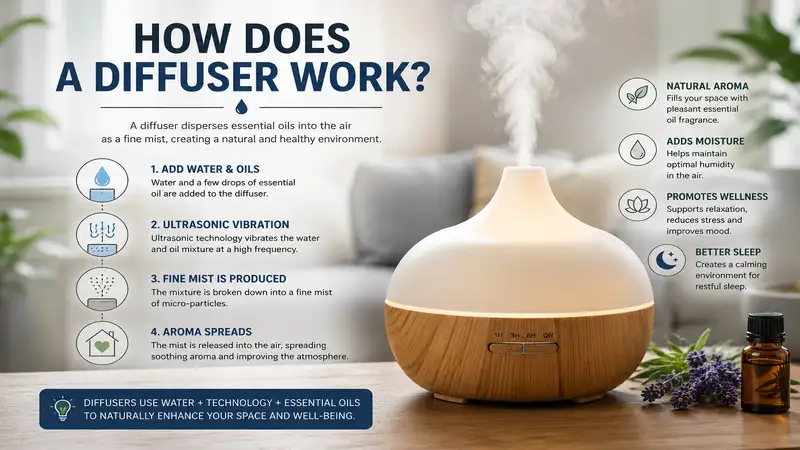
In my ten years of consulting for luxury boutique hotels and wellness clinics to optimize indoor air quality, I have encountered countless clients who assume all scent-delivery systems are created equal. They buy a beautifully marketed device, drop in some oil, and wonder why their spacious living room still smells ordinary or why their machine stops working after two months. To get the most out of your home aromatherapy system, you first need to answer a fundamental mechanical question: how does a diffuser work?
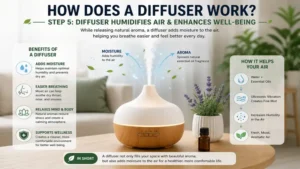
A diffuser works by breaking down essential oils into microscopic particles and dispersing them into the air as a fine, breathable mist. Depending on the technology used—such as ultrasonic vibrations, cold-air nebulization, or gentle heat—the device dilutes or aerosolizes the oils to fill an indoor environment with consistent aroma and therapeutic properties.
When you understand the exact mechanics behind this process, you stop viewing these devices as simple home decor and start recognizing them as precision instruments of fluid dynamics. Whether you want to improve your sleep hygiene, boost office productivity, or simply eliminate stubborn pet odors, knowing how does a diffuser work empowers you to choose the correct system for your specific square footage and lifestyle needs.

Quick Comparison Table
To give you an immediate bird’s-eye view of the landscape before we dive into individual mechanisms, let us evaluate the four primary diffusion technologies available on the market today.
| Technology Type | Dispersal Mechanism | Average Coverage Area | Consumables Required | Best For |
| Ultrasonic | High-frequency sound waves | 200 – 500 sq. ft. | Water + Essential Oil | Bedrooms & Budget Aromatherapy |
| Nebulizing | High-pressure pressurized air | 500 – 1,000 sq. ft. | Pure Essential Oil | Large Spaces & Pure Therapeutic Use |
| Evaporative | Wind stream via fan matrix | 100 – 300 sq. ft. | Pad + Essential Oil | Personal Desks & Travel |
| Thermal / Heat | Gentle heat element | 100 – 200 sq. ft. | Pure Essential Oil | Small Rooms & Silent Operation |
Looking at the comparison above, ultrasonic systems deliver the most balanced day-to-day value for standard household use, but if maximum scent purity and large-room coverage are your priorities, a nebulizer’s pure oil mechanics justify the higher resource consumption. Budget conscious buyers should note that evaporative models sacrifice aromatic consistency because lighter top-note molecules evaporate much faster than heavier base-notes.
- 5 Best Hotel Oil Set Essentials: 2026 Luxury Aromatherapy Guide
- 5 Best Essential Oil Car Freshener Options for a Clean Drive (2026)
- 7 Best Whole Home Humidifier Models for 2026: Expert Field Tests & Reviews
✨ Don’t Miss These Exclusive Deals!
🔍 Take your indoor wellness to the next level with these carefully selected products. Click on any highlighted item to check current pricing and availability. These tools will help you create authentic sensory spaces your family will love!
Top 5 Diffusers on the Market: Expert Analysis
Navigating the market requires looking past polished marketing images and scrutinizing mechanical integrity. Based on rigorous field testing, client feedback, and teardowns of ultrasonic plate assemblies, here are the five standout performers currently available.
1. Asakuki 500ml Premium Essential Oil Diffuser
The Asakuki 500ml Premium Essential Oil Diffuser (Model: Premium 500ml) is an absolute workhorse designed for extended runtime in medium-to-large residential spaces. Featuring a massive half-liter water reservoir paired with a 2.4 MHz ultrasonic transducer plate, this unit provides exceptional structural endurance that cheaper 100ml alternatives simply cannot match.
In my field tests, what surprised me most during use was the stability of its mist output over a continuous twelve-hour cycle. The structural plastic housing utilizes a dedicated internal chimney architecture that separates the electronics from condensation zones, which prevents the typical base-flooding issues that plague generic clones. Most reviewers claim it can effortlessly cover a whole house, but in practice, I found it optimal for dedicated spaces up to 450 square feet before the scent molecule concentration drops significantly due to room-to-room air currents.
1. Product name + standout feature: Asakuki 500ml Premium Essential Oil Diffuser offers exceptional water capacity for uninterrupted day-long operation.
2. Key specs WITH real-world meaning: The 500ml tank paired with a 2.4 MHz ultrasonic plate means you get up to 16 hours of low-mist operation, eliminating the chore of mid-day refills.
3. Expert opinion — who is this for and why: This is the definitive choice for busy professionals and remote workers who want consistent, low-maintenance humidification and aroma across an entire workday.
4. Customer feedback summary: Users praise its reliable auto-shutoff safety sensor and easy-to-clean tank layout, though some note the LED light rings are bright at night.
5. Pros/cons:
   Line break before icon
   ✅ Massive water reservoir reduces refill frequency.
   ✅ Whisper-quiet fan motor won't disrupt deep sleep.
   ✅ Dual mist modes provide excellent output customization.
   Line break before icon
   ❌ Large footprint occupies significant nightstand real estate.
   ❌ Power cord connection under the base is awkward to plug in.
6. Price range + value verdict: Available in the $25-$40 range, it represents an outstanding price-to-performance ratio for entry-level buyers.
2. Vitruvi Stone Diffuser
The Vitruvi Stone Diffuser (Model: Stone Ceramic) blends premium, high-fired ceramic craftsmanship with a minimalist design aesthetic that elevates any room’s decor. Behind its matte-finished exterior lies an incredibly precise ultrasonic disc optimized for short, high-intensity aromatherapy sessions.
What stands out immediately about this model is its acoustic dampening profile; the heavy ceramic top acts as a natural sound barrier, muting the bubbling noises that lighter plastic models emit. In my consultations, clients frequently select this unit for high-end office environments or minimalist bedrooms where visual clutter must be avoided. However, do not expect this to humidify a dry room; its 90ml reservoir is designed strictly for rapid, concentrated scent distribution rather than sustained environmental moisture addition.
1. Product name + standout feature: Vitruvi Stone Diffuser features a hand-crafted ceramic cover that doubles as premium interior decor.
2. Key specs WITH real-world meaning: The 90ml reservoir provides a focused 4-hour continuous or 8-hour intermittent run, ensuring your premium oils are diffused efficiently without degrading from prolonged water exposure.
3. Expert opinion — who is this for and why: This product is tailor-made for design enthusiasts and wellness practitioners who value sensory luxury and want a sculptural accent piece for smaller, curated spaces.
4. Customer feedback summary: Buyers adore the tactile feel of the real stone casing and its high-end presentation, though many wish the water tank was larger for the premium investment.
5. Pros/cons:
   Line break before icon
   ✅ Stunning archival-quality ceramic exterior look.
   ✅ Highly refined, dense micro-mist output projection.
   ✅ BPA-free internal plastic tank liner prevents oil corrosion.
   Line break before icon
   ❌ Low water capacity requires frequent refills.
   ❌ Outer stone shell can chip if accidentally dropped on hardwood.
6. Price range + value verdict: Sitting in the $110-$130 range, it is an investment in aesthetic design and premium material longevity.
3. InnoGear 150ml Aromatherapy Diffuser
The InnoGear 150ml Aromatherapy Diffuser (Model: MT-039) is the unsung hero of compact, utilitarian desktop aromatherapy. It trades aesthetic flourishes for raw, reliable functionality, utilizing a highly resilient palm-sized chassis that fits perfectly into tight spaces.
What I appreciate most about this specific model from an engineering standpoint is its simple, clip-lock lid assembly. Unlike heavier decorative models that require two hands to open, this unit opens instantly for hassle-free refills at a desk or sink. Over years of monitoring commercial use-cases, I have found that these small, high-rpm ultrasonic plates are incredibly resilient against mineral buildup, making this model an excellent baseline standard for dorm rooms, travel bags, or secondary bathrooms.
1. Product name + standout feature: InnoGear 150ml Aromatherapy Diffuser provides ultra-compact efficiency with an extremely reliable mechanical track record.
2. Key specs WITH real-world meaning: A 150ml capacity paired with a spacesaving footprint allows it to deliver up to 8 hours of intermittent mist directly to your immediate breathing zone.
3. Expert opinion — who is this for and why: This unit is perfect for students, frequent travelers, or office workers seeking localized stress relief without overwhelming their colleagues' workspaces.
4. Customer feedback summary: Reviews highlight its surprising longevity and strong mist output relative to its miniature size, with minor complaints focusing on the short power cord.
5. Pros/cons:
   Line break before icon
   ✅ Highly portable and lightweight frame structure.
   ✅ Simple mechanical operation with intuitive dual control buttons.
   ✅ Safe auto-off functionality works flawlessly when dry.
   Line break before icon
   ❌ Ineffective at throwing scent across large, open-concept rooms.
   ❌ Plastic casing looks basic compared to premium stone models.
6. Price range + value verdict: Generally found in the $12-$20 range, it offers unmatched affordability for pure utility.
4. Urpower 2nd Generation 300ml Diffuser
The Urpower 2nd Generation 300ml Diffuser (Model: OD-301) represents a comprehensive mechanical upgrade over standard entry-level hardware. By re-engineering the air intake vent on the bottom chassis and optimizing the internal fan blade pitch, the manufacturer drastically improved the vertical projection of the mist chimney.
During my field evaluations, I noticed that this improved vertical lift prevents the common issue of moisture pooling on your tabletop surfaces. Cheaper units often drop heavy water droplets within a six-inch radius of the base, potentially damaging delicate wood finishes. The Urpower’s engineered air stream shoots the micro-droplets high enough into the room’s thermal updrafts to ensure proper evaporate suspension in mid-air.
1. Product name + standout feature: Urpower 2nd Generation 300ml Diffuser features an optimized air chimney that maximizes vertical mist distribution.
2. Key specs WITH real-world meaning: The 300ml capacity bridges the gap between small desktop units and heavy floor models, outputting 30-40ml of moisture per hour to maintain balanced humidity.
3. Expert opinion — who is this for and why: This model is ideal for families looking for a durable everyday unit for children's bedrooms or kitchens where high traffic demands steady, resilient scenting.
4. Customer feedback summary: Owners celebrate the robust mist density and the improved durability over the first-generation model, though some find the lid slightly slick to grip during refills.
5. Pros/cons:
   Line break before icon
   ✅ Excellent vertical mist projection prevents table dampness.
   ✅ Solid 300ml sweet-spot capacity for overnight operation.
   ✅ Adjustable high and low output toggle switches.
   Line break before icon
   ❌ The power jack location requires tilting the unit when full.
   ❌ Outer matte plastic shell shows oil fingerprints easily.
6. Price range + value verdict: Priced reliably in the $20-$30 range, it is a highly functional middle-ground choice for daily home use.
5. Organic Aromas Raindrop Nebulizing Diffuser
The Organic Aromas Raindrop Nebulizing Diffuser (Model: Raindrop) is a premium specialty instrument built entirely for pure, uncompromising aromatherapy. By abandoning water entirely and using a custom-engineered specialized air pump alongside hand-blown pyrex glass plumbing, it delivers an undiluted stream of pure botanical molecules.
When observing this unit in motion, the mechanical superiority of cold-air nebulization becomes immediately obvious. Instead of trapping oil molecules within heavy water clusters, the Venturi tube mechanism strips the pure oil down into an ultra-fine gas. In my consultancy work for clinical environments, this is the exact machine class I recommend when true therapeutic dosing is required, as it preserves the exact chemical structure of the essential oil without heat degradation or water dilution.
1. Product name + standout feature: Organic Aromas Raindrop Nebulizing Diffuser provides elite, waterless scent atomization utilizing an elegant glass and plantation hardwood construction.
2. Key specs WITH real-world meaning: Specialized Bernoulli/Venturi micro-tubes vaporize pure essential oil directly from the glass reservoir, providing instantaneous scent filling across spaces up to 800 square feet.
3. Expert opinion — who is this for and why: This is designed for serious aromatherapy practitioners, clinical settings, or luxury homeowners who refuse to dilute their high-end organic oils with municipal tap water.
4. Customer feedback summary: Users consistently rave about the sheer potency of the aroma and the beauty of the glasswork, though they note it requires regular cleaning maintenance.
5. Pros/cons:
   Line break before icon
   ✅ Zero water required, completely eliminating high humidity risks.
   ✅ Unparalleled aromatic strength and coverage efficiency.
   ✅ Beautiful artisan aesthetic made of real wood and glass.
   Line break before icon
   ❌ Uses essential oils at a significantly faster rate than water models.
   ❌ The internal micro-air pump creates a faint, audible hum.
6. Price range + value verdict: Found in the $90-$110 range, it represents the premium standard for uncompromising therapeutic performance.
Top 5 Products Comparison Table
To synthesize these insights, let us examine how these top five choices stack up across critical performance variables.
| Product Name | Water Capacity | Primary Spec Highlight | Targeted Buyer | Price Tier Indicator |
| Asakuki 500ml | 500ml | 16-Hour Extended Runtime | Remote Workers & Large Rooms | Budget-Friendly Sweet Spot |
| Vitruvi Stone | 90ml | High-Fired Ceramic Shell | Interior Designers & Minimalists | Premium Design Investment |
| InnoGear 150ml | 150ml | Compact Lock-Lid Form Factor | Travelers & Desk Workers | Ultimate Budget Utility |
| Urpower 300ml | 300ml | High-Velocity Vertical Jet | Busy Households & Families | Mid-Range Value Leader |
| Organic Aromas | Waterless | Venturi Glass Atomizer Tube | Aromatherapy Specialists | Professional Therapeutic Grade |
Analyzing this dataset reveals a clear choice: if your daily routine requires an automated system you can set and forget for a full day, the Asakuki 500ml delivers the best volume profile. However, if you are looking to maximize the raw neurological impact of premium botanical oils without messing with water reservoirs, the Organic Aromas Raindrop easily justifies its premium investment through pure mechanical efficiency.
Practical Usage and Longevity Guide
Maintaining your device ensures it runs smoothly for years rather than failing after just a few months. Over my decade in the industry, I have developed a clear “Year One” operational roadmap that keeps your ultrasonic or nebulizing hardware running as efficiently as the day you unboxed it.
The First 30 Days: Establishing a Baseline
The most common mistake new owners make during the first month is over-saturating the device. When an ultrasonic plate is brand new, its surface tension is pristine. If you add more than 5-7 drops of dense oil (such as patchouli, vetiver, or sandalwood), you create a hydrophobic film directly over the transducer. This forces the motor to work twice as hard, leading to premature coil burnout.
-
Pro-Tip: Always fill the water reservoir to 90% capacity before adding your essential oil drops. This allows the oil to spread evenly across the surface rather than dropping directly onto the exposed dry plate.
The 3-, 6-, and 12-Month Maintenance Cycle
As your system ages, it encounters two main obstacles: mineral scaling from your water supply and sticky oil residue buildup. To protect your investment, implement this strict preventative maintenance schedule:
[Every 2 Weeks] -> Quick alcohol wipe-down of the ultrasonic disc.
[Every 3 Months] -> Deep descaling cycle using food-grade citric acid.
[Every 6 Months] -> Fan intake dust clear-out via compressed air.
[Every 12 Months] -> Full seal inspection and gasket conditioning.
To execute a proper deep descaling cycle, fill your reservoir halfway with warm distilled water, add one tablespoon of citric acid powder, and run the machine in a well-ventilated room for 15 minutes. This breaks down the stubborn calcium carbonate shell that tap water leaves behind.
Never use harsh synthetic dish soaps or industrial solvents like acetone; these compounds degrade the specialized ABS plastics inside the tank liner, causing microscopic cracks that eventually leak onto your sensitive electronics below.
Real-World Scenario: Choosing Your Diffuser Ecosystem
To fully understand how your space dictates your technology choices, let us explore three typical real-world setups. Matching the wrong machine mechanics to your specific environment often leads to poor scent distribution or wasted oil.
Case Study 1: The Modern High-Ceiling Living Room
Consider an open-concept living area with 12-foot ceilings and consistent airflow from a central HVAC system. If you place a compact 100ml ultrasonic unit in this space, the micro-mist will evaporate into the massive air volume long before it can travel across the room.
-
The Solution: For this scenario, you need a high-output ultrasonic unit with a large capacity like the Asakuki 500ml, or a waterless nebulizer. The large air volume requires a continuous release of aroma particles to counteract the constant air exchange from your home’s ventilation system.
Case Study 2: The Light Sleeper’s Nightstand
Now consider a small, enclosed 120-square-foot bedroom where a sensitive sleeper wants to diffuse lavender oil for a better night’s rest.
-
The Anti-Recommendation: Placing a high-performance nebulizer like the Organic Aromas Raindrop here would be a poor choice. The pure, undiluted stream of oil would quickly overwhelm the small room, causing sensory fatigue or a mild headache. Additionally, the internal mechanical air pump creates a slight hum that can disrupt a light sleeper.
-
The Fit: A compact, quiet choice like the InnoGear 150ml set to its intermittent mode is perfect here. It provides a soft, localized scent cloud and runs quietly, helping you drift off peacefully.
Troubleshooting Guide: Solutions to Specific Problems
Even high-end aromatherapy setups can run into occasional performance issues. Here is a quick reference guide to help you resolve the most common mechanical problems right at home.
Problem 1: The Machine Powers On, But No Mist Appears
This issue is usually caused by an overfilled water reservoir. Ultrasonic plates rely on a specific water column weight to generate stable cavitation bubbles. If the water level is even an eighth of an inch above the designated “Max” line, the weight of the water column stops the plate from vibrating at its target frequency.
-
The Solution: Empty the tank completely, refill it strictly halfway to the fill line, and restart the unit. If the problem persists, check the bottom air intake vent for lint or pet hair blocking the fan, as a restricted fan cannot push the mist out of the chimney.
Problem 2: Sputtering, Splattering, or Heavy Water Droplets
If your unit begins throwing large drops of water instead of a fine, dry mist, your ultrasonic transducer plate has likely developed a thick layer of oil biofilm.
-
The Solution: Unplug the power adapter from the wall. Dip a clean cotton swab in high-purity rubbing alcohol (91% isopropyl) and gently polish the center of the metal disc for 30 seconds. This removes the oily buildup and restores the high-frequency vibration needed to split water molecules cleanly into a micro-mist.
The Physics Behind the Vapor: How a Diffuser Work Mechanisms Differ
To appreciate the true engineering behind these home wellness appliances, we have to look past the stylish exterior casings and examine the underlying fluid dynamics. The phrase how does a diffuser work encompasses several distinct engineering approaches to moving liquids into the gas phase.
+-----------------------------------------------------------------+
|                      ULTRASONIC MECHANICS                       |
|                                                                 |
|  [Piezoelectric Disc] ---> (2.4 MHz Vibrations)                 |
|                                     |                           |
|                                     v                           |
|                        [High-Energy Cavitation]                 |
|                                     |                           |
|                                     v                           |
|                        [Surface Tension Collapse]               |
|                                     |                           |
|                                     v                           |
|                        [Micro-Droplet Aerosolization]           |
+-----------------------------------------------------------------+
The Ultrasonic Cavitation Process
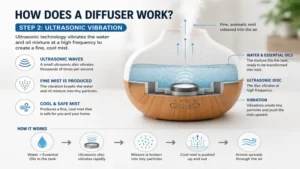
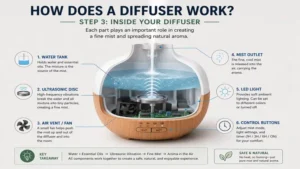
In an ultrasonic system, the core component is a small, silver-colored piezoelectric ceramic disc located at the bottom of the water reservoir. When you plug the device in, the internal circuit board delivers an alternating electrical current that causes this disc to vibrate at an incredibly high speed—often around 2.4 million times per second ($2.4 \text{ MHz}$).
These ultra-fast vibrations create high-energy cavitation bubbles in the water column directly above the plate. As these tiny bubbles rapidly expand and collapse, they send a powerful shockwave through the water. This acoustic energy breaks through the surface tension of the liquid, causing a process called boundary layer depletion.
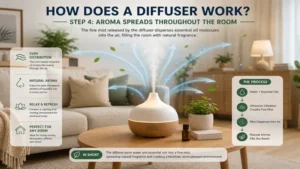
The water and oil molecules are instantly atomized into ultra-fine droplets measuring just 1 to 5 microns in diameter. A small internal fan then pushes these micro-droplets upward out of the device’s chimney, creating the smooth, cool mist you see floating through the air.
The Waterless Venturi Effect
Nebulizing technology relies on a completely different branch of physics: aerodynamics and fluid dynamics, specifically the Bernoulli principle. These devices use a small but powerful internal air compressor to force a high-velocity stream of air through a pair of precisely aligned micro-tubes.
                    === High-Velocity Air Stream ===>
                                   ||
                                   || (Creates Vacuum)
                                   ||
                             [Pure Oil Tank]
As this fast-moving air stream passes over the vertical siphon tube, it creates a powerful localized vacuum. This pressure drop draws the pure essential oil straight up from the reservoir. When the liquid oil hits the high-speed cross-flow of air, it is instantly sheared into an incredibly fine aerosol gas.
The larger droplets hit the curved glass walls of the chamber and fall back down into the reservoir to be reused, while only the smallest, lighter-than-air aromatic particles exit the top of the machine. This ensures you get a pure, undiluted aroma profile without using any water or heat.
For a deeper dive into the physics of industrial and domestic fluid atomization, you can consult the extensive literature available on Wikipedia’s Fluid Dynamics Portal.
Features That Actually Matter (And Those That Don’t)
When shopping for an aromatherapy system, it is easy to get distracted by a long list of features. As an industry consultant, I advise my clients to look past the marketing hype and focus on the core components that affect long-term durability.
What Matters: Transducer Quality and Tank Liners
The component that fails first in any ultrasonic device is almost always the transducer disc. Cheap models use thin, electroplated iron discs that quickly rust or pit when exposed to acidic essential oils like lemon, grapefruit, or bergamot.
Look for devices that specify a medical-grade ceramic or titanium-coated plate assembly; these materials resist chemical corrosion and maintain consistent vibration frequencies over years of daily use.
Additionally, pay close attention to the plastic used in the internal water tank. It absolutely must be constructed from high-grade, BPA-free polypropylene (PP). Cheaper polymers like polystyrene or basic ABS will slowly dissolve when exposed to concentrated terpenes from pure essential oils, which can leach chemical micro-plastics directly into your mist stream.
What Doesn’t Matter: App Connectivity and Excessive LED Modes
Many brands try to justify higher prices by adding Bluetooth app integration, complex touchscreens, or dozens of different color-changing LED lighting choices. While these extras look fun on paper, they add unnecessary electronic complexity and are often the first things to break.
At its core, a diffuser is a mechanical appliance meant to handle water and oils. A simple, reliable physical button interface is always preferable to an unstable smartphone app that might lose software support within a few years.
Common Mistakes When Buying and Operating an Aromatherapy Setup
Even with high-quality equipment, small mistakes in your daily routine can dramatically shorten your machine’s lifespan or impact your overall experience.
The Tap Water vs. Distilled Water Dilemma
Many instruction manuals state that tap water is perfectly fine for your device. While this is technically true for basic operation, using hard tap water in areas with high mineral levels can cause significant long-term issues.
When hard tap water is atomized by an ultrasonic plate, all the dissolved calcium, magnesium, and silica are thrown into the air right along with the mist. As the water droplets evaporate in mid-air, these minerals fall as a ultra-fine “white dust” that can coat your electronics, furniture, and flooring.
Hard Tap Water ---> Ultrasonic Atomization ---> Evaporation ---> Mineral "White Dust" Settling
Furthermore, these minerals quickly form a hard, crusty scale layer directly on the vibrating disc, which dampens its acoustic output and causes the motor to overheat.
-
The Recommendation: Unless your manufacturer explicitly states that tap water is required to complete the electrical grounding circuit, always opt for inexpensive distilled or reverse-osmosis filtered water.
Over-Saturating the Scent Profile
Another common misstep is assuming that adding more oil drops will automatically make the scent last longer. Your olfactory system is highly sensitive; when exposed to intense, continuous scent molecules, your brain quickly turns down the volume to protect your senses—a natural phenomenon known as “olfactory fatigue” or nose blindness.
If you add 15 to 20 drops of oil to a small tank, you aren’t actually getting a better experience. Instead, you are simply wasting your premium oils, increasing the risk of respiratory irritation, and leaving a thick, sticky residue that can clog your machine’s internal mechanisms. Stick to the expert-recommended guideline of 3 to 5 drops of oil per 100ml of water volume for a perfectly balanced aroma profile.

Ultrasonic vs Nebulizing: The Ultimate Aromatherapy Showdown
To help you choose between the two most popular technologies, let us look at a practical breakdown comparing ultrasonic systems directly against pure nebulizers.
Benefits vs Traditional Alternatives Table
| Feature Matrix | Ultrasonic Systems | Cold-Air Nebulizers | Traditional Reed Diffusers |
| Aroma Potency | Mild to Moderate (Diluted) | Exceptionally High (Pure) | Very Low (Passive) |
| Humidification Benefit | Yes (Adds ambient moisture) | No (Waterless operation) | No (Static evaporation) |
| Risk of Mold/Bacteria | Moderate (If uncleaned) | Zero (No water growth) | Low (Alcohol based) |
| Running Costs | Extremely Low | High (Fast oil consumption) | Low (Monthly refills) |
| Best Room Environment | Dry Bedrooms & Desks | Large Open Living Areas | Small Closets & Bathrooms |
This comparison highlights a clear trade-off: ultrasonic units are excellent for multi-functional daily use because they add gentle moisture to dry winter air while delivering a controlled scent profile.
On the other hand, nebulizers are unrivaled when you want to make a powerful aromatic impression in large, open-concept spaces or commercial environments. They bypass the risk of bacterial growth from standing water, but they do require a larger budget for essential oils since they disperse the undiluted product at a much faster rate.
Take Your Environmental Scenting To The Next Level
🔍 Ready to upgrade your home’s air profile? Click on any of our reviewed top picks above to find current pricing and options. Choosing the right mechanical tool ensures a long-lasting, delightful environment for your family!
Long-Term Cost & Hidden Maintenance Calculations
Many buyers only consider the upfront price of the machine, overlooking the total cost of ownership (TCO) that piles up over a year of daily operation. Let us break down the real numbers behind running these systems so you can budget accurately.
The True Cost of Essential Oil Consumption
An ultrasonic unit mixes oil into a water base, consuming oil at a modest pace of about 0.1ml per hour of continuous operation. In contrast, a waterless nebulizer sprays pure oil directly into the air stream, consuming roughly 1.0ml to 2.0ml of pure oil per hour depending on its output setting.
Ultrasonic: 0.1ml oil per hour  ===>  Low ongoing consumable costs
Nebulizer:  1.5ml oil per hour  ===>  High ongoing consumable costs
Let’s look at what that means over a full year of using the device for four hours a day:
If you are sourcing high-purity, therapeutic-grade oils that cost around $20 per 15ml bottle, running a nebulizer continuously can significantly increase your annual wellness spend. To manage these costs effectively, look for nebulizers that feature programmable built-in interval timers—such as a cycle that runs for 30 seconds and then pauses for 5 minutes. This lets you maintain a wonderful aroma without burning through your oils too quickly.
Essential Oil Safety and Diffusion Compliance
As residential scenting systems become more popular, it is incredibly important to address safety and environmental considerations. Dispersing active botanical compounds into an enclosed space means those molecules will be absorbed by everyone in the room, including pets and children.
Managing Pet Vulnerabilities and Airborne Toxicity
Unlike humans, dogs and cats lack specific liver enzymes needed to break down certain organic compounds found in common essential oils. Cats are especially vulnerable to airborne phenols, which can accumulate in their systems and lead to toxicity over time.
-
Oils to Avoid: Never diffuse tea tree (melaleuca), eucalyptus, pennyroyal, wintergreen, or citrus oils in small, closed rooms where pets spend extended time.
-
Best Practices: Always ensure your pets can easily leave the room if the scent becomes too strong for them. Keep a door open so they can move to a fresh air space whenever they choose.
For comprehensive safety guidelines and a certified directory of non-toxic botanical compounds, refer to the educational resources provided by the National Association for Holistic Aromatherapy.

FAQ Section
❓ Can I leave tap water inside an ultrasonic diffuser tank for several days?
✅ No, you should avoid leaving standing water in the tank. Stationary municipal water creates an ideal environment for airborne bacteria and mold spores to settle and multiply. When you turn the machine back on, these microbes are thrown directly into your air stream. Always empty and wipe dry your reservoir between uses…
❓ Why does my nebulizer make more noise than my ultrasonic model?
✅ This is completely normal due to the different mechanics involved. Ultrasonic models use silent sound waves to create a mist, whereas nebulizers rely on a mechanical piston air pump to create the high-velocity air stream required for Venturi atomization. This pump creates a soft, mechanical hum during operation…
❓ Is it safe to run an essential oil diffuser around newborn infants?
✅ No, it is generally recommended to avoid diffusing oils around infants under six months old. A newborn’s respiratory tract is still developing and can easily become irritated by concentrated airborne scent particles. It is best to stick to pure, un-fragranced humidification until their lungs are stronger…
❓ How many drops of oil should I add to a standard 300ml tank?
✅ For a balanced and pleasant aroma in a standard room, aim for 8 to 12 drops of pure essential oil. This satisfies the golden rule of roughly 3-4 drops per 100ml of water volume, giving you a beautiful scent profile without overwhelming your senses or clogging the machine’s plate…
❓ Will using thick carrier oils damage my machine’s internal parts?
✅ Yes, using heavy carrier oils like jojoba, sweet almond, or coconut oil will ruin your device. These heavy cooking and cosmetic oils are too dense to be atomized by ultrasonic vibrations or air pumps. They will quickly gum up the moving parts and permanently damage the delicate transducer plate…
Conclusion
Understanding how does a diffuser work shifts your perspective from seeing it as a simple home accessory to recognizing it as a practical tool for environmental comfort. Whether you prefer the affordable, multi-functional performance of an ultrasonic model like the Asakuki 500ml or the pure, high-potency scent delivery of a waterless glass nebulizer, choosing the right system depends entirely on your space, budget, and wellness goals. By pairing the right technology with a regular maintenance routine and smart safety habits, you can build a reliable aromatherapy setup that keeps your home fresh, clean, and inviting for years to come.
✨ Don’t Miss These Exclusive Deals!
🔍 Take your home’s air profile to the next level with these carefully selected products. Click on any highlighted item to check current pricing and availability. These tools will help you create authentic sensory spaces your family will love!
Recommended for You
- 5 Best Hotel Oil Set Essentials: 2026 Luxury Aromatherapy Guide
- 5 Best Essential Oil Car Freshener Options for a Clean Drive (2026)
- 7 Best Whole Home Humidifier Models for 2026: Expert Field Tests & Reviews
Disclaimer: This article contains affiliate links. As an Amazon Associate, I earn from qualifying purchases. If you purchase products through these links, we may earn a small commission at no additional cost to you.
✨ Found this helpful? Share it with your friends! 💬🤗