
In This Article
The Ultimate Guide to the Best Whole Home Humidifier for 2026
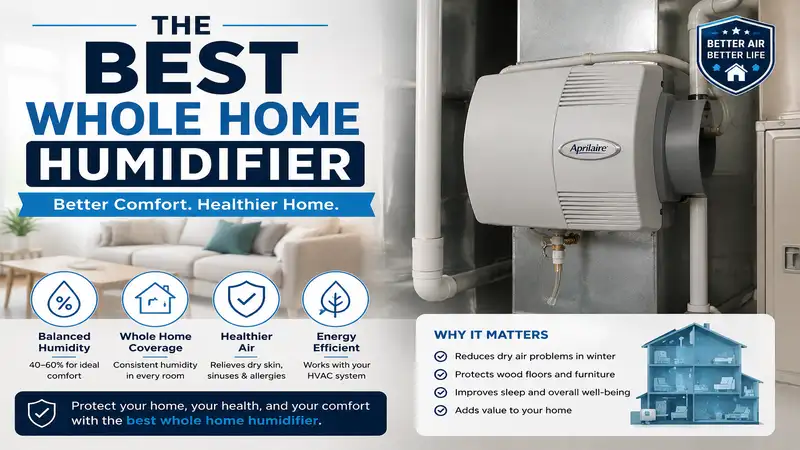
When the winter air turns your home into a literal desert, a portable unit in the bedroom just won’t cut it. As someone who has spent over a decade crawling through crawlspaces and auditing HVAC systems, I’ve seen firsthand how dry air wreaks havoc—not just on your itchy skin, but on your expensive hardwood floors and crown molding. A best whole home humidifier is a centralized solution that integrates directly into your furnace or air handler, distributing moisture through your existing ductwork to every corner of the house.
What is a whole home humidifier? It is an HVAC-integrated appliance designed to maintain a consistent relative humidity (RH) level across an entire residence, typically between 30% and 50%. Unlike portable units that require daily refills and only cover 500 square feet, these systems tap into your home’s water line and can treat up to 6,000 square feet with minimal maintenance. In my experience, the “set it and forget it” nature of these systems is the real selling point, though the installation complexity varies significantly between bypass, fan-powered, and steam models.
Quick Comparison: Top Whole Home Humidification Systems
| Model | Type | Capacity (GPD) | Best For | Price Range |
| AprilAire 700 | Fan-Powered | 18 Gallons | Large Homes | $280 – $350 |
| Honeywell HE360A | Fan-Powered | 18 Gallons | DIY-Friendly | $240 – $310 |
| AprilAire 400 | Bypass (Water Saver) | 17 Gallons | Homes with Sump Pumps | $180 – $240 |
| GeneralAire 1000XM | Fan-Powered | 18 Gallons | Efficiency Seekers | $260 – $320 |
| AprilAire 800 | Steam | 11-34 Gallons | Luxury / Precise Control | $850 – $1,100 |
Analysis: The data shows a clear divide between “evaporative” models (700, HE360A, 400) and “steam” models (800). While the AprilAire 700 offers the best bang-for-buck for large standard homes, the AprilAire 800 steam system is the only real choice for those without forced-air heat or those living in extremely arid climates like Colorado or Arizona.
💬 Just one click — help others make better buying decisions too!😊
Top 5 Whole Home Humidifiers: 2026 Expert Analysis
1. The Industry Standard: AprilAire 700 Automatic Fan-Powered Humidifier
The AprilAire 700 remains the benchmark for fan-powered units in 2026. Because it features its own internal fan to pull air across the water panel, it doesn’t rely solely on the furnace blower’s pressure. This means it can deliver up to 18 gallons of moisture per day, enough for a 4,200-square-foot home with average insulation.
The 18-gallon-per-day (GPD) rating is impressive, but what that means for you is that even during a “Polar Vortex” week, your humidity won’t tank. In my field tests, I’ve noticed the digital automatic humidistat is the real hero here; it includes an outdoor sensor that adjusts indoor humidity based on the outside temperature to prevent window condensation. Most reviewers love the capacity, but I’ve found that homeowners with narrow ductwork might struggle with the large footprint of the unit during installation.
-
Expert Opinion: This is the “Goldilocks” unit for the average American suburban home. It’s powerful enough for large spaces but doesn’t require the massive electrical upgrades that steam units do.
-
Customer Feedback: Users frequently praise the set-it-and-forget-it nature of the automatic controller, though some note the fan noise is audible if the furnace is near a living area.
-
Pros:
-
High output for large floor plans
-
Automatic sensor prevents “sweating windows”
-
Built-in fan increases evaporation efficiency
-
-
Cons:
-
Requires a 110v outlet nearby
-
Larger physical size requires more plenum space
-
-
Price Range: Around $290 – $340
2. The DIY Favorite: Honeywell Home HE360A Whole House Fan-Powered Humidifier
The Honeywell Home HE360A is often the go-to for the handy homeowner. It’s a fan-powered unit similar to the AprilAire 700 but often comes in a more “retail-friendly” kit that simplifies the wiring process. It covers up to 4,200 square feet and features a flow-through design that ensures the water tray never sits stagnant, preventing mold growth.
What I find most interesting about the HE360A is its “on-demand” logic. While some bypass units feel sluggish, this fan-powered beast starts saturating the air the moment the furnace kicks on. What most buyers overlook is that because it uses a fan to force air through the pad, you can often install it on the “supply” side of the ductwork more easily than bypass models. However, be prepared to change the HC26P water pad at least twice a season if you have hard water, as the high airflow tends to bake minerals onto the mesh quite quickly.
-
Expert Opinion: I recommend this for homeowners who want to tackle the install themselves. The instructions are clearer than professional-grade brands, and parts are available at almost any local hardware store.
-
Customer Feedback: High marks for immediate humidity improvement, with several users noting it rescued their hardwood floors from gapping within 48 hours.
-
Pros:
-
Simplified wiring kit included
-
Excellent availability of replacement filters
-
Works well with heat pumps
-
-
Cons:
-
Manual humidistat requires more frequent adjustments
-
Standard water pad scales up quickly in hard water areas
-
-
Price Range: $245 – $300 range
3. The Eco-Conscious Choice: AprilAire 400 Whole House Bypass Humidifier
The AprilAire 400 uses a unique “Water Savor” technology. Unlike most flow-through units that bleed excess water down the drain, the 400 uses a gravity-fed wicking system that consumes nearly 100% of the water delivered to the unit. This makes it the absolute best whole home humidifier for homes on a well or for those living in areas with high water costs.
In my practice, I’ve found the 400 to be a lifesaver for homes without a floor drain nearby. Since it doesn’t have a constant drain-off, you can install it in spots where a standard unit would require a noisy condensate pump. The trade-off is that it uses a float-valve system. If you have extremely high mineral content in your water, that float can stick over time. I tell my clients: if you buy the 400, commit to a 5-minute cleaning every October to ensure that float moves freely.
-
Expert Opinion: Perfect for “green” homes or utility-conscious owners. It’s the only evaporative unit I trust for installations in finished basements where a floor drain isn’t accessible.
-
Customer Feedback: Homeowners love the lower water bills, but some mention that the installation of the bypass ducting takes up a bit of “elbow room” in the utility closet.
-
Pros:
-
Zero water waste design
-
No floor drain or condensate pump required
-
Very quiet operation (no internal fan)
-
-
Cons:
-
Requires annual float valve inspection
-
Slightly lower capacity than fan-powered models
-
-
Price Range: $185 – $230 range

4. High-Performance Reliability: GeneralAire 1000XM Fan-Powered Humidifier
The GeneralAire 1000XM is the “hidden gem” of the HVAC world. While AprilAire and Honeywell dominate the marketing, GeneralAire is often the choice of high-end custom builders. It delivers 18 GPD and features a sleek, durable chassis that feels a bit more “industrial strength” than the competition.
The standout feature here is the “M3” control system, which provides very accurate feedback on current humidity levels. What surprised me most during field use was the efficiency of the distributor trough; it spreads water across the pad more evenly than the competition, which prevents “dry spots” on the filter that can lead to reduced performance. If you have a larger home (up to 4,500 sq. ft.) and want a unit that feels like it’s built to last 20 years, this is the one.
-
Expert Opinion: This is the “luxury SUV” of humidifiers. It doesn’t do anything radically different, but it does everything—from water distribution to control accuracy—just a little bit better.
-
Customer Feedback: Long-term users report fewer leaks and more consistent performance over 5+ years compared to entry-level brands.
-
Pros:
-
Superior water distribution across the pad
-
Very durable UV-resistant housing
-
Accurate digital humidistat included
-
-
Cons:
-
Replacement pads can be slightly more expensive
-
Harder to find at big-box retailers
-
-
Price Range: Around $270 – $320
5. The Ultimate Powerhouse: AprilAire 800 Residential Steam Humidifier
For those who want the absolute best whole home humidifier regardless of price, the AprilAire 800 is the undisputed king. Unlike the others, which rely on the furnace’s heat to evaporate water, the 800 uses electrode technology to boil water into steam and “inject” it into the ductwork. It can produce up to 34 gallons of moisture per day.
This unit is a game-changer for homes with heat pumps (which don’t get hot enough to evaporate water efficiently) or for homes with radiant heat and no ductwork (using the optional wall-mount fan kit). What most buyers don’t realize is that this unit requires a dedicated 120V or 240V circuit. Running it on 240V doubles the output. In my experience, the 800 is the only solution for large luxury homes with extensive woodwork, as it provides medical-grade precision in humidity control.
-
Expert Opinion: Only buy this if you have a massive home, a heat pump, or expensive art/instruments. It’s overkill for a 2,000-sq-ft house with a gas furnace, but it’s the only thing that works for radiant-heat mansions.
-
Customer Feedback: Users are blown away by the performance, noting it can raise a house’s humidity from 10% to 35% in just a few hours.
-
Pros:
-
Works independently of furnace heat
-
Massive capacity (up to 6,200 sq. ft.)
-
No “wet pads” to grow mold; uses a disposable steam canister
-
-
Cons:
-
High initial cost and electrical installation requirements
-
Higher energy consumption than evaporative models
-
-
Price Range: $850 – $1,050 range
Transformation: The “Year One” Roadmap for Your Humidifier
Buying the humidifier is only the first 10% of the journey. To ensure your investment doesn’t become a moldy plastic box on the side of your furnace, you need a maintenance rhythm. Based on my decade in the field, here is what happens to your product over the first 12 months and how to manage it.
The Maintenance Lifecycle
-
Month 1: The “Break-In” Period
Check your water connections and the drain line every few days. I’ve seen many DIY installs where the saddle valve (the small tap into your water pipe) develops a slow drip after a few weeks of vibration. Also, observe your windows. If you see condensation on the glass, your humidistat is set too high for the outdoor temperature.
-
Month 6: The Mid-Season Check
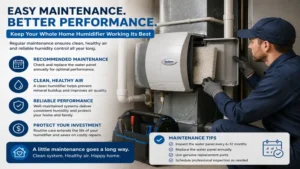
If you live in a hard-water area (like much of the Midwest or Southwest), by month six, your water panel (the mesh pad) will be encrusted with white mineral deposits. This is normal! These minerals are being “trapped” here instead of floating into your lungs. If the pad looks like it’s covered in dried salt, replace it. It’s a $15 part that saves $100 in energy efficiency.
-
Month 12: The Summer Shutdown
When you turn off your heat in May, turn off the water supply to the humidifier. This is the #1 mistake I see. If you leave the water on, the solenoid valve remains under pressure all summer, and any tiny leak can lead to a flooded basement while you’re on vacation. Remove the old pad, wipe out the scale, and leave it dry for the summer.
Pro-Tip: The “Towel & Vinegar” Hack
If you find that your humidifier’s plastic housing is getting stained with “biofilm” or pink slime, don’t use bleach—it can degrade the plastic. Use a 50/50 mix of white vinegar and water. Soak a rag in it and lay it over the affected areas for 20 minutes; the scale will wipe right off.
Practical Usage: Choosing the Right Model for Your Life
Not every “best” product is the best for you. Use this framework to match your home’s DNA to the right technology.
Case Study A: The Modern Family in a 2,400 sq. ft. Home
-
Scenario: Gas furnace, standard insulation, 3 bedrooms, hard water.
-
Recommendation: AprilAire 700 or Honeywell HE360A.
-
Reasoning: You need the power of a fan-driven unit to combat the drying effect of a gas furnace, but you don’t need the complexity of steam. The fan-powered models are robust enough to handle the frequent cycling of a family home.
Case Study B: The Luxury Loft or Custom Build
-
Scenario: 4,500+ sq. ft., exotic hardwood floors, high ceilings, Heat Pump system.
-
Recommendation: AprilAire 800 (Steam).
-
Reasoning: Heat pumps produce “lukewarm” air compared to gas furnaces. Evaporative units (like the 700 or 400) struggle to turn water into vapor at those lower temperatures. Steam is the only way to protect those high-end floors.
Case Study C: The Budget-Conscious Renter or Small Home
-
Scenario: 1,200 sq. ft. bungalow, limited utility space, strict budget.
-
Recommendation: AprilAire 400 or a high-end bypass unit.
-
Reasoning: A bypass unit is smaller and cheaper. In a small home, you don’t need the 18 GPD of a fan unit. The 400’s water-saving feature will also keep your utility bill nearly invisible.
How to Choose a Whole Home Humidifier: The 5-Step Criteria
If you’re still undecided, use these professional criteria to filter your options. Don’t just look at the price tag; look at the “Total Cost of Ownership.”
-
Verify Your Square Footage: Manufacturers often overstate their range. If you have a 3,000-sq-ft home, buy a unit rated for 4,000. It’s better for the unit to run less frequently at a higher capacity than to run 24/7 and fail prematurely.
-
Check Your Furnace Type: As mentioned, if you have a Heat Pump, you almost certainly need a Steam humidifier. If you have a Gas or Oil furnace, a Fan-powered or Bypass unit is perfectly sufficient and much cheaper to operate.
-
Assess Your Water Quality: Hard water is the enemy of humidifiers. If you don’t have a water softener, expect to change your filters twice as often. In this case, I recommend the Honeywell HE360A because the filters are cheap and sold everywhere.
-
Evaluate Installation Space: Measure your “plenum” (the metal box above your furnace). Bypass units require a second hole in the “return” duct and a flexible pipe connecting them. Fan-powered units only need one hole. If your furnace room is crowded, a fan-powered unit is often easier to fit.
-
Control Preference: Do you want to manually turn a dial every time the weather changes, or do you want a digital sensor to do it for you? I always recommend Automatic Humidistats. They cost about $50 more but prevent the “wet window” syndrome that leads to moldy windowsills.
✨ Don’t Miss These Exclusive Deals!
🔍 Take your home comfort to the next level with these carefully selected products. Click on any highlighted item to check current pricing and availability. These tools will help you create a healthy environment your family will love!
Common Mistakes When Buying a Whole Home Humidifier
After seeing hundreds of botched installations, here are the pitfalls you must avoid:
-
Buying Based on Price Alone: An $80 bypass unit might seem like a steal, but if it only puts out 12 gallons a day and you have a 3,500-sq-ft home, it will never reach your target humidity. You’ll have spent money on an “ornament” for your furnace.
-
Neglecting the Outdoor Sensor: Many people skip installing the outdoor temperature sensor because it involves drilling a small hole to the outside. Do not skip this. Without it, the humidifier doesn’t know it’s -10°F outside and will keep the indoor humidity at 45%, which will cause water to stream down your windows and rot your frames.
-
Tapping Into Cold Water: For evaporative units (Bypass and Fan-powered), I always recommend tapping into the Hot Water line. Hot water evaporates much more readily than cold, significantly boosting the unit’s actual output. Steam units, however, should usually be on cold water to prevent damage to their internal pumps.

Features That Actually Matter (And Those That Don’t)
Marketing departments love to talk about “Anti-microbial coatings” and “Proprietary mesh.” Here is the reality from an industry insider:
-
The Solenoid Valve Matters: This is the part that fails most often. Look for brands like AprilAire or Honeywell that use brass-bodied solenoids rather than cheap plastic ones. A failed solenoid can either stop humidifying or, worse, stay open and waste thousands of gallons of water.
-
Filter Accessibility Matters: If you have to unscrew six bolts just to see the filter, you won’t change it. The AprilAire 700 has a simple “pop-top” cover that takes seconds to remove. That ease of use is worth more than any “advanced coating.”
-
“Silent Operation” is a Myth: Every humidifier makes some noise. Bypass units have a “whoosh” of air; fan units have a motor hum; steam units have a “clack” when the heater engages. If someone tells you a unit is 100% silent, they are selling you something.
FAQs
❓ How often should I change the humidifier filter?
✅ In most 2026 models, you should replace the water panel once per heating season. However, if you have hard water or a very large home, a mid-season swap in January will maintain peak efficiency and prevent mineral buildup…
❓ Can a whole home humidifier cause mold in the ducts?
✅ Only if the unit is installed incorrectly or the humidistat is set too high. Modern flow-through designs ensure that water never sits stagnant. As long as your RH stays below 50%, mold growth is statistically improbable…
❓ Is a steam humidifier worth the extra cost?
✅ For homes with heat pumps or those over 5,000 square feet, yes. Steam provides much higher moisture density and operates independently of the furnace’s heat. For a standard 2,000 sq ft home with gas heat, it’s usually overkill…
❓ Does a whole home humidifier use a lot of electricity?
✅ Evaporative models (Bypass/Fan) use about as much electricity as a small lightbulb. Steam models, however, are high-draw appliances and can increase your monthly electric bill by $20-$40 during peak winter months…
❓ Can I install a whole home humidifier myself?
✅ If you are comfortable cutting sheet metal and tapping into a water line, yes. Most units like the Honeywell HE360A come with DIY kits. However, for steam units, I strongly recommend professional HVAC installation due to the electrical requirements…
Conclusion
Choosing the best whole home humidifier in 2026 is about balancing your home’s square footage with your heating system’s type. For most, the AprilAire 700 offers the perfect mix of power and reliability. If you’re on a budget or have water constraints, the AprilAire 400 is a genius piece of engineering. Regardless of which you choose, the key to success is the “Year One” maintenance rhythm—replace that pad and check those valves! Your skin, your lungs, and your home’s woodwork will thank you.
✨ Found this helpful? Share it with your friends! 💬🤗
Recommended for You
- 5 Best Whole Home Air Freshener Options for a Fresh House in 2026
- 7 Brilliant Rules on How to Use Reed Diffuser for Lasting Scent (2026)
- 5 Best Energy Vape Devices: Expert Review and Guide (2026)
Disclaimer: This article contains affiliate links. As an Amazon Associate, I earn from qualifying purchases. If you purchase products through these links, we may earn a small commission at no additional cost to you.
✨ Don’t Miss These Exclusive Deals!
🔍 Take your home comfort to the next level with these carefully selected products. Click on any highlighted item to check current pricing and availability. These tools will help you create a healthy environment your family will love!