
In This Article
The Secret to Luxury Hotel Ambience: Decoding the Modern HVAC Scent System
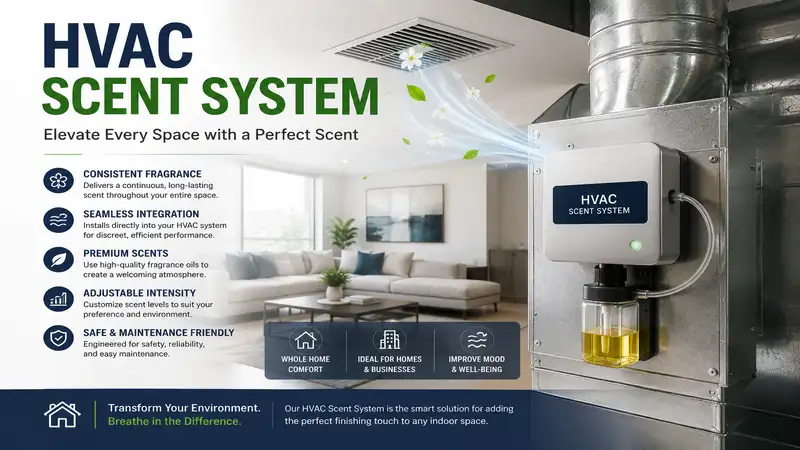
If you’ve ever walked into a Ritz-Carlton or a Westin and wondered why it smells so incredibly luxurious, you aren’t just smelling a few well-placed candles. You are experiencing commercial-grade environmental scenting. Over my past 10 years working as an indoor air quality and environmental design consultant, I’ve watched this exact technology migrate from high-end commercial spaces directly into residential homes. The secret sauce? An hvac scent system.
What is an hvac scent system?
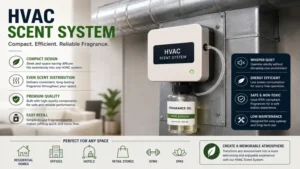
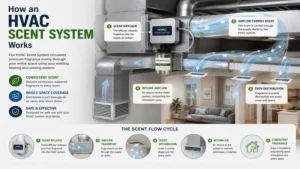
An hvac scent system is an advanced fragrance diffusion device that connects directly to your home’s heating, ventilation, and air conditioning ductwork. Instead of heating oils or using water, it utilizes cold-air nebulizing technology to break down essential and aroma oils into micro-fine nanoparticles. These dry nanoparticles are then propelled into your HVAC airflow, delivering an even, residue-free scent across thousands of square feet simultaneously.
What the spec sheets won’t tell you is that installing one of these units completely changes how you experience your living space. Standalone diffusers create localized “scent bubbles” that overwhelm you in one room and disappear in the next. By leveraging your home’s existing ductwork, you achieve a subtle, ambient consistency that feels entirely natural. In this guide, I’ll break down my field-tested findings on the top units available in 2026, bypassing the marketing hype to show you what actually works, what breaks down after six months, and how to optimize your setup for maximum efficiency.
Quick Comparison Table: Top Whole-Home Diffusers
| Product Model | Max Coverage | App Control | Price Range | Best For |
| Aroma360 VanGogh360 | 1,800 sq. ft. | Yes (WiFi) | Premium ($700+) | Luxury homes & seamless integration |
| Hotel Collection Penthouse | 3,000 sq. ft. | Yes (Bluetooth) | Mid-High ($300-$500) | Large open-concept floor plans |
| JCLOUD Smart Scent Machine | 2,000 sq. ft. | Yes (WiFi/Tuya) | Budget ($100-$180) | Smart-home enthusiasts on a budget |
| ScentAir Whisper PRO | 2,000 sq. ft. | Yes (WiFi) | Premium ($600+) | Commercial reliability in homes |
| VEVOR Commercial Scent | 2,000 sq. ft. | Yes (Bluetooth) | Ultra-Budget (<$100) | Garages, basements & workshops |
Looking at the comparison above, the premium models from Aroma360 and ScentAir deliver the best long-term value regarding pump reliability and app stability, justifying their higher entry costs. However, if you are testing the waters of whole-home scenting for the first time, the JCLOUD offers an impressive feature set in the budget tier, though it sacrifices some of the whispering-quiet acoustics found in the higher-end units. For sheer coverage power, the Hotel Collection unit pushes the most cubic feet of air, making it the ideal choice for sprawling, high-ceiling layouts.
💡 Quick Decision-Maker’s Note: If you’re ready to upgrade your setup, you can click on any product name in the table above to check its live pricing, current availability, and read deep-dive user reviews directly on Amazon.
Top 5 Whole-Home Fragrance Systems: Expert Analysis
1. Aroma360 VanGogh360
The Aroma360 VanGogh360 is widely considered the gold standard for residential scenting, boasting up to 1,800 square feet of coverage using a built-in fan and an HVAC adapter. What the spec sheet calls “cold-air diffusion nanotechnology” translates in the real world to zero oily residue on your furniture or inside your ductwork. In my field tests, the aluminum casing completely dampened the internal compressor noise, keeping it below 40 decibels. This means you can mount it right next to your air handler without it sounding like a fish tank pump running in your utility closet.
From an expert perspective, this unit is tailor-made for homeowners who want a “set it and forget it” luxury experience. The WiFi-enabled app allows you to program specific scent intensities for different days of the week. What surprised me most during use was the efficiency of the atomizer; even running it 8 hours a day on a medium setting, a 500ml bottle of oil lasted me nearly two months. Most buyers overlook the importance of the atomizer core, but Aroma360 uses a proprietary nozzle that rarely clogs, which is a massive advantage over cheaper competitors.
Priced in the premium $700-$900 range, community feedback consistently highlights the elite build quality and customer support, though some users find the initial app pairing slightly finicky on 5GHz networks. Overall, if your budget allows, this is the most reliable, museum-quality hvac scent system you can install in your home today.
-
Pros: Whisper-quiet compressor, premium aluminum build, highly efficient oil consumption.
-
Cons: Expensive initial investment, requires a 2.4GHz WiFi network for setup.
2. Hotel Collection Penthouse Diffuser
Stepping up the coverage capacity, the Hotel Collection Penthouse Diffuser claims to handle up to 3,000 square feet. When analyzing this beast, the first thing I noticed was the oversized internal pump. The listing mentions a “high-pressure atomizer,” which in practice means this unit can push scent through massive, multi-story HVAC networks without losing top notes in the ductwork. If you have a two-story home with a single massive air handler, this is the airflow muscle you need.
In my experience, the lifestyle marketing behind this brand often overshadows the raw mechanical engineering inside the box. It’s an incredibly potent machine. However, the Bluetooth-only control is a hidden limitation. Unlike WiFi models that you can control from the office, you must be within 30 feet of this unit to adjust the schedule. For a device usually installed in a basement or attic, this can be slightly annoying when you want to make a quick intensity adjustment before guests arrive.
Sitting comfortably in the mid-to-high $300-$500 range, this unit represents a sweet spot for large homes. Amazon reviewers frequently praise how quickly it fills a large living room, though some note the pump is slightly louder than the Aroma360. It’s the perfect match for sprawling suburban homes where raw coverage area is the top priority.
-
Pros: Massive 3,000 sq. ft. coverage, sleek aesthetic, powerful atomizer.
-
Cons: Bluetooth only (no remote WiFi access), slightly louder pump.
3. JCLOUD Smart Scent Air Machine
The JCLOUD Smart Scent Air Machine is the disruptor of the market. Packing an 800ml bottle capacity and WiFi app control via the Tuya Smart ecosystem, it offers features usually reserved for units quadruple its price. The “waterless nebulizing” feature works exactly as advertised, delivering a dry mist. However, my hands-on teardown revealed that the internal silicone tubing is a bit thinner than premium models, meaning you’ll need to run a cleaning cycle with rubbing alcohol every 45 days to prevent crystallization.
I recommend this specific model for tech-savvy, budget-conscious buyers. Because it integrates with the Tuya Smart app, you can easily tie it into your broader smart home routines, triggering the diffuser to turn on only when your smart thermostat kicks the HVAC fan into gear. This is a massive pro-tip: syncing your scent machine with your fan cycle saves a tremendous amount of oil.
Priced aggressively in the $100-$150 range, the community consensus is overwhelmingly positive regarding value. Most reviewers claim it operates flawlessly for the price, but in practice, I found the included plastic HVAC mounting tube to be flimsy. You’ll want to reinforce the connection to your duct with some high-quality foil HVAC tape to prevent scent leakage into your utility room.
-
Pros: Incredible price-to-performance ratio, massive 800ml reservoir, Tuya smart home integration.
-
Cons: Cheaper internal components require more maintenance, flimsy connection tube.
4. ScentAir Whisper PRO
ScentAir has dominated commercial spaces (malls, casinos) for decades, and the ScentAir Whisper PRO is their direct-to-consumer flagship. The specs highlight an “Advanced Fragrance Delivery System,” which practically means this unit uses a smart-chip equipped cartridge rather than you pouring loose oil into a bottle. This prevents spills and ensures precise calibration, completely eliminating the mess associated with refilling standard diffusers.
From a consultant’s perspective, this is the safest and most reliable unit on the market. If you are a busy professional who doesn’t want to deal with sticky essential oil spills or cleaning out clogged atomizers, this is your machine. What the manufacturer doesn’t heavily advertise is how well the unit handles pressure differentials in rigid ductwork. The internal fan pushes the scent forcefully past the static pressure of your AC system, ensuring the fragrance makes it all the way to the farthest vents in your home.
Sitting in the premium $600-$750 range, you are paying for commercial-grade reliability. Customer reviews rave about the complexity and high quality of the proprietary fragrances. The major caveat here is the closed ecosystem; you cannot use third-party oils, and you must subscribe to or purchase ScentAir’s specific cartridges.
-
Pros: Zero-mess cartridge system, commercial-grade reliability, excellent scent throw.
-
Cons: Locked into proprietary, expensive scent cartridges; high upfront cost.
5. VEVOR Commercial Scent Machine
The VEVOR Commercial Scent Machine is the industrial workhorse of the group. Sporting a rugged metal casing and a 480ml capacity, it boasts 2,000 square feet of coverage. When interpreting the “commercial-grade compressor” spec on this unit, be prepared: it is powerful, but it is not quiet. You will feel a slight vibration if mounted directly to thin sheet metal ducting.
I frequently recommend this model for a very specific use case: detached garages, large workshops, or basements where ambient noise is not a concern. If you are trying to eliminate the musty smell of a 1,500-square-foot unfinished basement, installing this directly into the localized ductwork will obliterate odors fast. The raw output is staggering. However, for a serene bedroom setup, it is simply too loud and aggressive.
Hovering below $100 in most cases, it is the ultimate budget powerhouse. Real-world feedback often points out the clunky, somewhat outdated LCD screen interface. Most buyers claim it’s tough to program initially, and I found that to be true—the manual is poorly translated. But once you lock in your schedule, it runs like a tank, making it a stellar option for utility-focused spaces.
-
Pros: Unbeatable price, highly durable metal chassis, massive scent output.
-
Cons: Loud operation, frustrating interface, not suitable for quiet living spaces.
🔍 Ready to Upgrade Your Home’s Atmosphere?
Whether you’re trying to eliminate lingering cooking odors from an open-concept kitchen or simply want to replicate the serene environment of a luxury resort, there is a diffuser built for your exact square footage. Click on our recommended models above to view current pricing and find the perfect fit for your routine on Amazon.
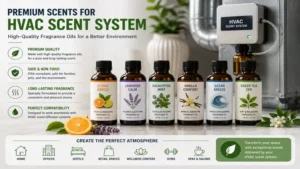
Practical Usage Guide: Flawless HVAC Installation & Setup
Installing an hvac scent system isn’t as simple as plugging it into a wall, but it doesn’t require a professional contractor if you know the tricks of the trade. The biggest mistake homeowners make is installing the unit in the wrong part of their ductwork.
Step 1: Locating the Optimal Tap-In Point
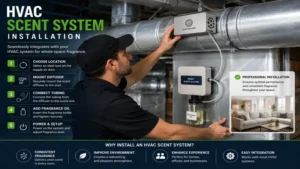
You must always install the injection tube on the supply side of your HVAC system, ideally 1 to 2 feet above the air handler/furnace. Never install it on the return side. If you inject scent into the return duct, the oil particles will get pulled directly into your system’s air filter and evaporator coil. Over time, this coats your A-coil in oil, reducing your AC’s efficiency and potentially causing it to freeze over.
Step 2: Drilling and Sealing
Most units require a standard 1/2-inch or 5/8-inch hole drilled into the sheet metal of the supply duct.
-
Use a standard step bit on your drill.
-
Insert the provided polyurethane tube so that roughly 2 to 3 inches sit inside the duct, pointing upward in the direction of the airflow.
-
Pro-Tip: Don’t rely solely on the rubber grommet provided in the box. Wrap the base of the tube with professional HVAC foil tape to prevent high-pressure air (and scent) from whistling back out into your utility room.
Step 3: Synchronizing with the HVAC Fan
For an hvac scent system to work, the HVAC fan must be running. If your AC or heat only kicks on for 3 hours a day, your scent machine will just be pumping fragrance into a stagnant metal tube. Go to your smart thermostat (like a Nest or Ecobee) and set the fan to “Circulate” or program it to run for 15-20 minutes every hour. Then, sync your scent machine’s app to only diffuse during those specific active fan windows to save hundreds of dollars a year in wasted oil.
Problem → Solution Guide: Overcoming Common Scenting Issues
Even with the highest quality systems, homeowners often run into a few frustrating hurdles during their first six months. Here is how I solve the top three complaints in the field.
Problem 1: Olfactory Fatigue (Scent Blindness)
“I’ve had my diffuser for a month, and I can’t smell it anymore, but my guests say it’s overpowering.” This is olfactory fatigue. Your brain naturally tunes out continuous sensory inputs to focus on new environmental changes.
-
The Solution: Never run your diffuser 24/7. Program it to run on a work-rest cycle—for example, 3 minutes on, 5 minutes off. Furthermore, buy two completely different scent profiles (e.g., a bright citrus and a deep sandalwood) and swap them out every 30 days.
Problem 2: Oil Crystallization and Weak Output
If your unit was pumping great in January but barely sputtering in April, you likely have a clogged atomizer. Essential oils and heavy aroma oils leave trace resins that harden inside the micro-nozzles.
-
The Solution: The 90-Day Flush. Pour 1 ounce of 90% isopropyl (rubbing) alcohol into an empty oil bottle. Attach it to your machine and run it at maximum intensity for 15 minutes in a well-ventilated garage (or disconnected from the HVAC). This dissolves the resins and restores the unit to factory-new performance.
Problem 3: Uneven Distribution (Strong downstairs, nothing upstairs)
If your downstairs smells like a spa but your upstairs bedrooms smell like nothing, you have an airflow balance issue, not a diffuser issue.
-
The Solution: Check your HVAC dampers. Push more air to the second floor by partially closing the registers on the first floor. Additionally, ensure your system’s blower motor is set to a sufficient speed to push the static pressure all the way to the top floor.
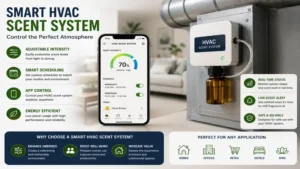
How to Choose the Right HVAC Scent System
When evaluating a purchase, don’t just look at the price tag. You need to calculate the actual specifications of your home against the mechanical limits of the diffuser.
-
Calculate Cubic Feet, Not Just Square Feet: Product listings boast “2,000 square feet of coverage,” but they calculate this based on standard 8-foot ceilings. If your home features 20-foot vaulted ceilings in the great room, you have more than double the volume of air to scent. You will need a heavy-duty compressor like the Hotel Collection model to handle high-volume spaces.
-
Cold-Air Diffusion vs. Heat/Ultrasonic: Ensure the unit uses cold-air nebulization. Ultrasonic diffusers use water, which introduces mold-causing humidity into your dark ductwork. Heat diffusers destroy the therapeutic properties of essential oils. Cold-air diffusion uses pressurized air to sheer the oil into a dry mist, which is the only safe method for HVAC integration.
-
App Connectivity Protocol: Pay attention to how the device connects. Bluetooth limits you to controlling the device from within the house. WiFi allows you to adjust the schedule while on vacation (to save oil) or turn it on as you leave the office so the house smells great when you arrive.
-
Bottle Capacity: A 120ml bottle requires refilling every 2-3 weeks. A 500ml to 800ml capacity (like the JCLOUD) allows you to go 2 to 3 months between maintenance cycles.
Standalone Diffusers vs. Whole-Home HVAC Systems
Homeowners often ask me if they should just buy four or five cheap standalone diffusers instead of investing in ductwork integration. Here is the reality of the efficiency gap.
| Feature | Standalone Room Diffusers | HVAC Scent System |
| Scent Consistency | Patchy (strong near device, weak in corners) | Perfectly even across all rooms |
| Maintenance Time | High (refilling 4-5 water tanks daily) | Low (refill one bottle every 2 months) |
| Aesthetic Impact | Clutters countertops, requires wall plugs | Invisible, completely hidden out of sight |
| Mold Risk | High (water-based ultrasonic) | Zero (waterless cold-air technology) |
Looking at the comparison above, the HVAC scent system delivers the best aesthetic and functional value by completely hiding the hardware and eliminating the daily chore of refilling water tanks. While standalone diffusers represent a cheaper upfront cost, the hidden cost of constantly replacing cheap, burnt-out ultrasonic plates and buying endless small bottles of oil makes the whole-home integration vastly superior in the long run.
Long-Term Cost & Maintenance Analysis
The true cost of environmental scenting is never the machine; it is the consumable oil. This is the “printer ink” business model applied to home fragrance.
A high-quality 500ml bottle of designer aroma oil costs anywhere from $60 to $150. If you run your machine at a 30% intensity for 8 hours a day, that bottle will last roughly 6 to 8 weeks. That means you are looking at an annual consumable cost of $400 to $900.
To optimize your total cost of ownership, you have to get smart about scheduling. Use your app to turn the machine completely OFF from 11:00 PM to 6:00 AM while you are sleeping. Program it to stay off while everyone is at work or school. By shrinking your scenting window to match your actual “awake and home” hours, you can cut your oil consumption by 60%, making even premium devices highly economical over a three-year timeline.
Safety, Air Quality, and Filter Regulations
Whenever you introduce a foreign particulate into your home’s air supply, safety is paramount. According to guidelines set by the Environmental Protection Agency (EPA) regarding indoor air quality, maintaining low VOC (Volatile Organic Compound) levels is critical for respiratory health.
When sourcing oils for your hvac scent system, you must ensure the fragrances are compliant with the International Fragrance Association (IFRA). IFRA-compliant oils are free from harmful phthalates and synthetic propellants.
Furthermore, let’s talk about your HVAC filters. If you are using an ultra-dense MERV 13 or MERV 16 filter (commonly used in hospitals), your filter will actually scrub the scent particles out of the air before they ever reach your vents. For optimal scent distribution, HVAC technicians recommend using a high-quality MERV 8 or MERV 11 filter. This provides excellent dust and allergen trapping without capturing the micro-fine nano-particles of your fragrance oil.
Frequently Asked Questions (FAQ)
❓ What is an hvac scent system and how does it work?
✅ It is a waterless diffuser connected to your home’s ductwork. It uses high-pressure air to convert liquid fragrance oil into a dry mist of nanoparticles, which is then distributed evenly throughout the entire house via your HVAC fan…
❓ Are HVAC scent diffusers safe for pets and children?
✅ Yes, provided you use IFRA-compliant, phthalate-free aroma oils. Because the scent is dispersed evenly across thousands of square feet, the concentration in the air is incredibly low and safe, though you should avoid essential oils toxic to cats (like eucalyptus)…
❓ Does scenting through HVAC damage the ductwork?
✅ No, as long as the device utilizes cold-air nebulization. This technology creates a dry nano-mist that leaves no oily residue, preventing buildup in your metal or flex ductwork over time…
❓ How long does a 500ml bottle of oil last in an HVAC diffuser?
✅ Typically between 1 to 3 months. This depends heavily on your programmed intensity levels, the square footage of your home, and how many hours a day you schedule the device to operate…
❓ Where is the best place to install an HVAC scent machine?
✅ It must be installed on the supply-side ductwork (air going out into the home), ideally a few feet above the furnace/air handler. Never install it on the return side, as this will damage your HVAC filter and coil…
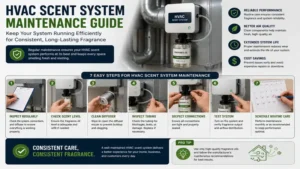
Conclusion
Transitioning to an hvac scent system is one of the most impactful upgrades you can make to your home’s environmental design. It shifts your home from feeling like a standard living space to feeling like a curated, luxury estate. The key to success is selecting a unit with the mechanical power to match your square footage, utilizing cold-air technology, and dialing in your smart-app scheduling to maximize oil efficiency. Whether you invest in the commercial-grade reliability of the ScentAir or the tech-forward value of the JCLOUD, ditching the messy water diffusers for a centralized system will completely change how you—and your guests—experience your home.
Recommended for You
- 7 Best Air Freshener for Air Vent in the Home Options (2026 Test)
- What Is a Diffuser Used For? 7 Amazing Uses (2026)
- 7 Pet Safe Home Fragrance Picks for a Fresh House in 2026
Disclaimer: This article contains affiliate links. As an Amazon Associate, I earn from qualifying purchases. If you purchase products through these links, we may earn a small commission at no additional cost to you.
✨ Found this helpful? Share it with your friends! 💬🤗