
In This Article
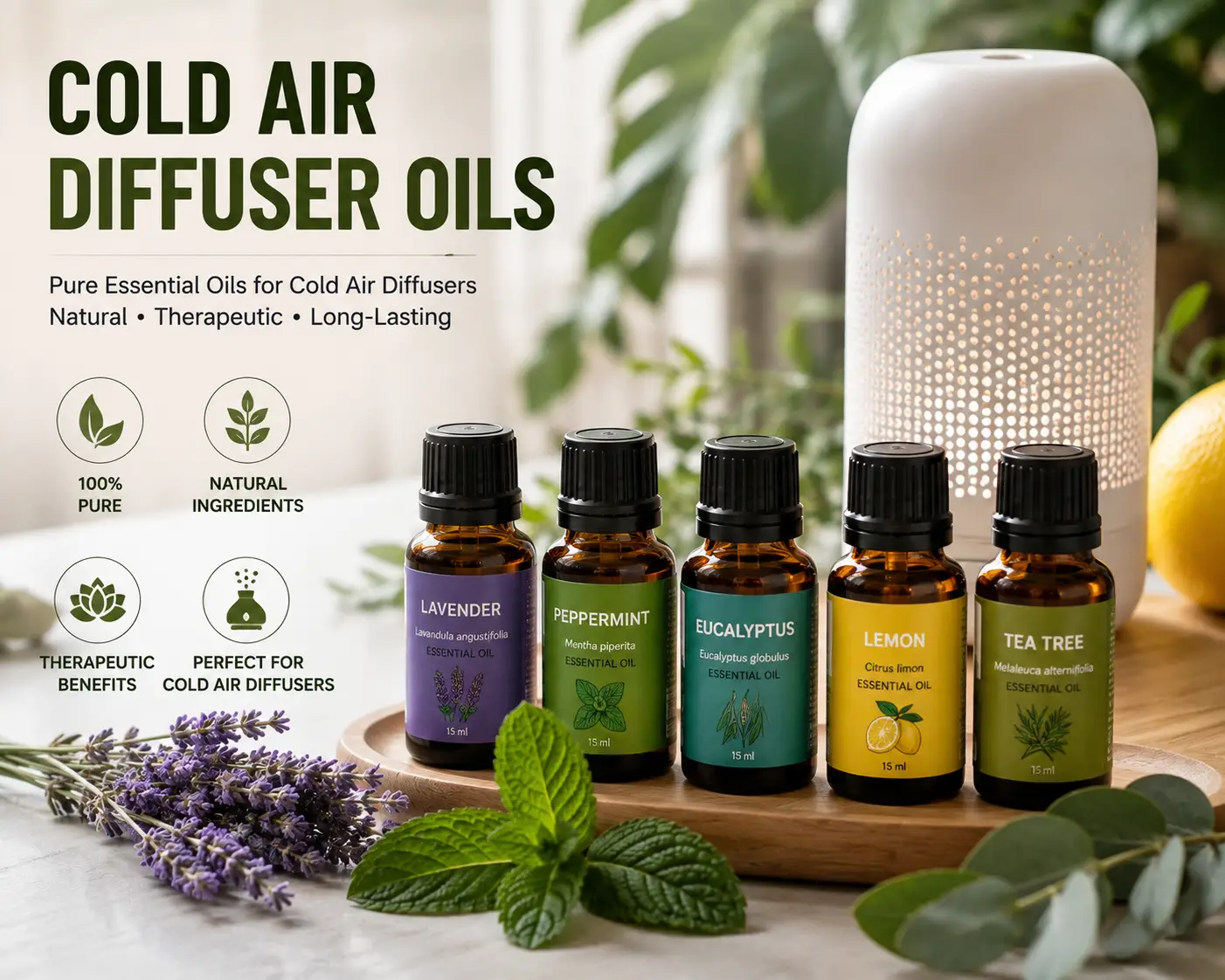
If you’ve ever poured a beautiful, syrupy sandalwood oil into a brand-new nebulizing diffuser and watched it sputter, clog, and go silent within a week, you already know that cold air diffuser oils are not interchangeable with the stuff you’d pour into a water-based humidifier. Cold air diffusers — also called nebulizing diffusers — skip the water entirely and use a jet of pressurized air to atomize pure essential oil straight from the bottle into a fine, dry mist. That’s what makes the scent so much stronger and truer to the plant than what you get from an ultrasonic machine. It’s also exactly why the wrong oil can gum up the internal glass nebulizer in a matter of days.
Choosing cold air diffuser oils well means understanding viscosity, purity, and how a specific device’s atomizer handles concentrated botanicals — not just picking whatever smells good on the shelf. In this guide, you’ll get a research-backed rundown of seven real, widely available essential oils that perform well in nebulizing hardware, an honest look at what separates a great pick from a device-killer, and practical guidance on setup, maintenance, and troubleshooting. We’ll also cover the safety and regulatory context the average product listing skips entirely, including where the science on aromatherapy actually stands according to the National Institutes of Health. Whether you’re outfitting your first waterless diffuser or replacing an oil that clogged your last one, you’ll leave with a clear shortlist and the reasoning to back it up.
Quick Comparison: Cold Air Diffuser Oils at a Glance
| Product | Oil Type | Best For | Price Range |
|---|---|---|---|
| Plant Therapy Lavender Essential Oil | Floral, single | Beginners & sleep routines | Around $8–$14 |
| NOW Essential Oils Orange Oil | Citrus, single | Budget trial size | Around $7–$12 |
| Edens Garden Eucalyptus Essential Oil | Herbaceous, single | Focus & respiratory support | Around $9–$15 |
| Rocky Mountain Oils Peppermint Essential Oil | Minty, single | Premium, eco-conscious buyers | Around $13–$19 |
| SVA Organics Orange Oil Sweet Brazilian | Citrus, single | Bulk/value daily diffusing | Around $12–$18 |
| Radha Beauty Lemon Essential Oil | Citrus, single | Large rooms & open spaces | Around $10–$16 |
| Gya Labs Ylang Ylang Essential Oil | Floral, single | Specialty mood-lift blends | Around $11–$17 |
Looking at the table, you’ll notice every entry is a single-note oil rather than a pre-diluted blend — that’s deliberate, since nebulizing diffusers work best with thin, unadulterated oils rather than viscous synergy blends that often contain resins. Plant Therapy Lavender Essential Oil and NOW Essential Oils Orange Oil sit at the accessible end for anyone testing a new device, while Rocky Mountain Oils Peppermint Essential Oil and Gya Labs Ylang Ylang Essential Oil trade a higher price range for tighter sourcing controls and third-party testing. If you’re diffusing daily, the bulk sizing on SVA Organics Orange Oil Sweet Brazilian and Radha Beauty Lemon Essential Oil works out to a lower cost per milliliter over time.
💬 One click helps you find the right oil the first time — no wasted bottles, no clogged nebulizers! 😊
Top 7 Cold Air Diffuser Oils: Expert Analysis
1. Plant Therapy Lavender Essential Oil — most forgiving oil for first-time nebulizer owners
Plant Therapy Lavender Essential Oil earns the top spot because it’s genuinely low-risk: a thin, well-behaved single oil that rarely causes buildup even in entry-level nebulizing units. Plant Therapy states the oil is 100% pure and undiluted, and the brand publishes batch-specific GC/MS lab reports for every bottle — a level of transparency that matters more with nebulizing diffusers than with water-based ones, since any adulteration or added carrier oil shows up fast as residue in the glass reservoir. In practice, that transparency means you’re not guessing whether what’s in the bottle matches the label.
Who should buy it: anyone setting up their first cold air diffuser, or households using scent primarily for winding down in the evening. Lavender’s chemistry is naturally thin enough to atomize cleanly, which is exactly why it’s the oil most manufacturers recommend for a “break-in” run on a new machine. Reviews aggregated across major retail platforms consistently describe the scent as true-to-plant rather than “perfumey,” and a recurring theme in customer feedback is that the aroma holds up well even diluted across a full-size living room — a reasonable proxy for how cleanly the oil atomizes.
Pros:
- ✅ Thin viscosity is gentle on nebulizer glass components
- ✅ Batch-specific GC/MS testing backs up purity claims
- ✅ Widely available in 10 mL, 30 mL, and 100 mL sizes
Cons:
- ❌ Lavender’s calming profile isn’t ideal for daytime focus use
- ❌ Smaller bottles run out quickly with heavy daily diffusing
Across bottle sizes, Plant Therapy Lavender Essential Oil typically falls somewhere around $8 to $14 depending on volume, and it’s a strong value pick for anyone who wants lab-backed purity without paying a premium markup.
2. NOW Essential Oils Orange Oil — cheapest reliable entry point for testing a new diffuser
NOW Essential Oils Orange Oil is the practical choice when you just want to confirm your new cold air diffuser works before investing in pricier single oils. NOW Foods markets this as a cold-pressed, 100% pure orange oil, and cold-pressed citrus oils are naturally low-viscosity — closer to water than to syrup — which is exactly the profile a nebulizer’s micro-nozzle wants to see. That thinness also means less residue building up in the glass chamber between cleanings, so you get more sessions before a maintenance rinse is needed.
Who it’s for: budget-conscious buyers, renters testing a diffuser before committing to a full collection, and anyone who wants a bright, energizing daytime scent rather than something sedating. Based on comparing spec sheets across the NOW Foods essential oil line, the company’s positioning consistently favors accessible pricing over boutique packaging, which shows up here as a straightforward bottle with no frills. What the price tag doesn’t say, but aggregated reviews reveal, is that citrus oils like this one tend to have a shorter “peak scent” window than florals or woods — expect the brightest aroma in the first pour, mellowing gradually over the bottle’s shelf life.
Pros:
- ✅ Low viscosity minimizes nebulizer clogging risk
- ✅ Among the most affordable pure single oils on the market
- ✅ Bright, universally likable citrus scent for daytime use
Cons:
- ❌ Citrus oils oxidize faster than florals once opened
- ❌ Packaging is basic compared to boutique competitors
Priced in the roughly $7 to $12 range depending on bottle size, NOW Essential Oils Orange Oil delivers solid value-for-money as a low-stakes way to learn how your specific diffuser handles citrus.
3. Edens Garden Eucalyptus Essential Oil — best for focus-driven and respiratory-support diffusing
Edens Garden Eucalyptus Essential Oil stands out for buyers who want more than ambiance — they want a specific functional effect, like clearer breathing during allergy season or a mental boost during a work block. Edens Garden publishes GC-MS batch reports and positions the brand around guidance from licensed aromatherapists on staff, which is a meaningful differentiator when you’re choosing an oil specifically for its documented aromatic compounds rather than just its scent. Eucalyptus oil is also naturally thin, steam-distilled rather than solvent-extracted in most reputable single-oil lines, which keeps it compatible with nebulizing hardware.
Who it’s for: home offices, shared workspaces, and anyone who diffuses during cold-and-flu season for the classic “clear the air” sensation associated with eucalyptus. Based on comparing the ingredient sourcing described by the brand against competitors at a similar price point, Edens Garden leans into small-batch sourcing rather than mass production, which reviewers frequently cite as the reason the scent reads as “sharper” and more true-to-plant than drugstore alternatives. What most buyers overlook is that eucalyptus is one of the stronger-smelling single oils, so it’s worth diffusing at a lower intensity setting than you’d use for a floral.
Pros:
- ✅ Naturally thin consistency suits nebulizing atomizers
- ✅ GC-MS batch testing supports purity claims
- ✅ Strong functional scent for focus and easier breathing
Cons:
- ❌ Intensity can be overpowering in small rooms
- ❌ Not recommended for households with cats (see safety section)
At roughly $9 to $15 per bottle depending on size, Edens Garden Eucalyptus Essential Oil is a fair trade for the added transparency and small-business sourcing model.
4. Rocky Mountain Oils Peppermint Essential Oil — best premium pick for eco-conscious buyers
Rocky Mountain Oils Peppermint Essential Oil earns its higher price range through a combination of rigorous supplier vetting and a genuinely differentiated sustainability story: the brand was an early mover in glass bottle recycling within the essential oil space and packages its oils in fully recycled glass. On paper, that’s a packaging detail, but it signals a company willing to invest in supply-chain practices beyond the bare minimum, which tends to correlate with more consistent sourcing of the oil itself. Peppermint is a thin, fast-atomizing oil to begin with, so it performs reliably across most nebulizing diffuser brands.
Who it’s for: buyers who prioritize sourcing transparency and environmental practices as much as scent performance, and anyone diffusing peppermint specifically for an energizing mid-afternoon pick-me-up rather than a background ambiance. Rocky Mountain Oils runs GC/MS testing across sampled batches and backs its oils with a satisfaction guarantee, which shifts some of the purity risk back onto the company rather than the buyer. Reviews aggregated on major platforms consistently mention the peppermint’s cooling, “true mint” intensity as noticeably stronger than supermarket-brand peppermint oils — a difference attributable to purity rather than marketing.
Pros:
- ✅ Naturally low-viscosity oil, safe for daily nebulizer use
- ✅ Recycled glass packaging backs up sustainability claims
- ✅ Satisfaction guarantee reduces purchase risk
Cons:
- ❌ Priced above most competitors in this roundup
- ❌ Peppermint’s intensity can overwhelm small, enclosed rooms
Expect to pay somewhere in the $13 to $19 range, positioning Rocky Mountain Oils Peppermint Essential Oil as the splurge pick for buyers who want both performance and a cleaner supply chain.
5. SVA Organics Orange Oil Sweet Brazilian — best bulk size for daily, heavy-use diffusing
SVA Organics Orange Oil Sweet Brazilian is built for the person who diffuses constantly rather than occasionally — think a small studio, salon, or home office running a nebulizer most of the day. Sold in a larger format than most single oils in this list, it lowers the cost per milliliter meaningfully compared to buying several small bottles over the same period. SVA Organics markets the oil as 100% pure and undiluted, and sweet orange oil’s naturally thin, cold-pressed consistency again makes it one of the safer citrus choices for nebulizing hardware specifically.
Who it’s for: frequent diffusers, small commercial spaces, and anyone who has already confirmed they like sweet orange as a scent and doesn’t want to keep re-ordering small bottles. Based on comparing the per-ounce cost against the smaller citrus options earlier in this list, the bulk format is where the real savings show up — you’re paying less per session over months of regular use. What the spec sheet doesn’t say, but repeat-buyer feedback suggests, is that larger bottles are worth decanting a small working amount into a dropper bottle near the diffuser, since repeatedly opening a full-size bottle accelerates oxidation.
Pros:
- ✅ Bulk sizing lowers cost per diffusing session
- ✅ Cold-pressed citrus oil atomizes cleanly in nebulizers
- ✅ 100% undiluted with no added carrier oil
Cons:
- ❌ Large bottle format isn’t ideal for occasional users
- ❌ Oxidizes faster once opened, like most citrus oils
Typically priced around $12 to $18 for the larger format, SVA Organics Orange Oil Sweet Brazilian offers the strongest long-term value-for-money of any citrus option here.
6. Radha Beauty Lemon Essential Oil — best for covering large or open-concept spaces
Radha Beauty Lemon Essential Oil is positioned by the brand as an “extra strength” formulation, and in a nebulizing diffuser, that concentration translates to noticeably better scent throw in bigger rooms compared to a standard-strength lemon oil at the same dosage. That matters because cold air diffusion already produces the strongest scent output of any home diffusion method, but open floor plans and high ceilings can still dilute the effect before it reaches every corner. A more concentrated, thin citrus oil compensates for that without requiring you to run the diffuser longer or more frequently.
Who it’s for: households with open-concept living rooms, kitchens that flow into living spaces, or anyone who found a standard lemon oil “too subtle” in a large area. Reviews aggregated for the product frequently mention the scent being detectable from farther away than competing lemon oils, which is consistent with the brand’s extra-strength positioning. Here’s what to weigh: a stronger oil also means you should start with fewer drops than you’re used to and adjust upward, rather than diffusing at your normal dosage and risking an overwhelming scent.
Pros:
- ✅ Stronger scent throw suits large or open rooms
- ✅ Thin citrus consistency is nebulizer-friendly
- ✅ Large 4 oz bottle reduces reorder frequency
Cons:
- ❌ Easy to over-dose the diffuser if you don’t adjust drop count
- ❌ Citrus scent may read as too sharp for small bedrooms
Priced roughly between $10 and $16, Radha Beauty Lemon Essential Oil is a smart pick specifically for buyers whose space is the limiting factor, not their budget.
7. Gya Labs Ylang Ylang Essential Oil — best specialty floral for mood-focused diffusing
Gya Labs Ylang Ylang Essential Oil rounds out this list as the pick for buyers who’ve already mastered the basics with lavender or citrus and want to branch into a more distinctive floral. Ylang ylang has a rich, sweet, slightly exotic profile that’s less commonly stocked than lavender or peppermint, and Gya Labs sources it as a certified organic single oil rather than a synthetic fragrance blend. Its viscosity sits on the thicker side of “nebulizer-safe” compared to citrus oils, so it’s worth diffusing in shorter sessions to avoid gradual residue buildup over time.
Who it’s for: buyers building out a more advanced oil collection, anyone specifically drawn to floral-forward mood support rather than the more clinical eucalyptus or peppermint category, and gift-buyers looking for something less generic than a lavender starter bottle. Based on comparing ylang ylang’s chemical profile against thinner single oils in this roundup, it’s genuinely one of the better-tolerated floral options for nebulizing use, though it still benefits from more frequent cleaning cycles than lavender or citrus. Reviews aggregated across retail platforms describe the scent as intense and long-lasting, with several buyers noting a little goes a long way.
Pros:
- ✅ USDA-organic-sourced floral, less common than lavender
- ✅ Long-lasting scent means fewer drops needed per session
- ✅ Free of synthetic fragrance additives
Cons:
- ❌ Slightly thicker viscosity needs more frequent cleaning
- ❌ Intense aroma isn’t ideal for scent-sensitive households
Expect a price range of roughly $11 to $17, making Gya Labs Ylang Ylang Essential Oil a reasonable step up for anyone ready to diversify beyond the basics.
Full Comparison: All 7 Cold Air Diffuser Oils
| Product | Viscosity | Scent Profile | Best For | Price Range |
|---|---|---|---|---|
| Plant Therapy Lavender Essential Oil | Thin | Calming floral | First-time diffuser owners | $8–$14 |
| NOW Essential Oils Orange Oil | Very thin | Bright citrus | Budget testing | $7–$12 |
| Edens Garden Eucalyptus Essential Oil | Thin | Sharp, herbaceous | Focus & breathing support | $9–$15 |
| Rocky Mountain Oils Peppermint Essential Oil | Very thin | Cooling mint | Premium/eco buyers | $13–$19 |
| SVA Organics Orange Oil Sweet Brazilian | Very thin | Sweet citrus | Heavy daily use | $12–$18 |
| Radha Beauty Lemon Essential Oil | Thin | Sharp citrus | Large/open rooms | $10–$16 |
| Gya Labs Ylang Ylang Essential Oil | Medium | Rich floral | Specialty/advanced users | $11–$17 |
Reading across the table, the clearest pattern is that every genuinely nebulizer-safe pick clusters in the “thin” to “very thin” viscosity range, with Gya Labs Ylang Ylang Essential Oil as the only medium-viscosity outlier worth the extra cleaning effort. If budget is your main constraint, NOW Essential Oils Orange Oil and Plant Therapy Lavender Essential Oil offer the lowest financial risk while you test your device. For buyers already confident in their setup, Rocky Mountain Oils Peppermint Essential Oil and SVA Organics Orange Oil Sweet Brazilian reward the higher spend with either sourcing transparency or long-term cost savings, respectively.
Cold Air Diffusion vs. Ultrasonic Diffusion
The core difference comes down to what’s actually going into the air. Ultrasonic diffusers vibrate a water-and-oil mixture into a fine mist, which means the oil is always diluted and partially bound to water molecules before it ever leaves the machine. Cold air nebulizing diffusers skip water entirely, using pressurized air to break pure oil into a dry, ultra-fine mist straight from the bottle. According to the National Institutes of Health’s overview of aromatherapy, essential oils are volatile compounds that lend themselves to inhalation-based delivery — and the less a delivery method interferes with that volatility, the closer the experience is to the raw plant aroma.
In practice, that translates to three real differences buyers notice: nebulizing diffusers produce a noticeably stronger, truer scent per drop of oil; they run through oil faster (typically 0.5–3 mL per hour of active diffusing, versus the much slower draw of an ultrasonic unit); and they’re pickier about which oils they can safely process, since there’s no water to buffer a thick or resinous oil from clogging the atomizer. Ultrasonic diffusers, by contrast, tolerate thicker oils and blends far more forgivingly because the water does the diluting work for you. If your priority is subtle, all-day background scent with minimal maintenance, ultrasonic is the easier path. If your priority is maximum aromatic strength and the truest possible scent profile, cold air diffusion wins — provided you stick to nebulizer-appropriate oils like the ones covered above.
What Is a Cold Air Diffuser?
A cold air diffuser (also called a nebulizing diffuser) is a device that uses a pressurized air pump to atomize pure, undiluted essential oil into a fine dry mist without water or heat. Because there’s no water dilution and no thermal degradation of the oil’s aromatic compounds, cold air diffusion is widely regarded as the strongest and most concentrated way to scent a room with essential oils at home.
The technology itself is a variation on medical nebulizers, which the National Institutes of Health has documented in the context of inhalation-based complementary health approaches. The home version simply swaps a saline solution for essential oil and dials the mist output up or down for room-filling scent rather than respiratory treatment. Most consumer units on the market today use a small glass or ceramic nebulizer chamber connected to an air pump, with settings for intensity and timed on/off cycles to manage how much oil is consumed per session.
How to Choose the Best Oils for a Cold Air Diffuser
- Check the viscosity first. Thin oils like citrus, lavender, tea tree, and peppermint atomize cleanly; thick oils like sandalwood, vetiver, and patchouli tend to clog nebulizer glass over time.
- Confirm it’s 100% pure, with no carrier oil added. Fractionated coconut oil, jojoba, or any fatty carrier will coat internal components and is never appropriate for nebulizing hardware.
- Look for third-party GC-MS batch testing. Brands that publish lab reports are giving you a way to verify purity claims instead of taking marketing copy at face value.
- Match the scent to your intended use. Citrus and peppermint suit daytime focus, while lavender and florals like ylang ylang suit evening wind-down.
- Buy bottle sizes that match your usage frequency. Heavy daily diffusers save money with bulk sizes; occasional users should stick to smaller bottles to avoid oxidized, stale oil.
- Factor in your household. Pets, young children, and pregnant or nursing household members all change which oils are appropriate — more on this in the safety section below.
- Read the aggregated reviews, not just the star rating. A 4.5-star average tells you less than a recurring theme in the written reviews about scent strength, oxidation speed, or clogging complaints.
✨ Don’t miss these carefully vetted picks! 🌿 Take your aromatherapy routine to the next level with oils chosen specifically for nebulizing compatibility. Click through to check current pricing and availability before you commit.
How to Use a Cold Air Diffuser With Essential Oils: Setup, Dosing & Maintenance
Getting started is simpler than most first-time buyers expect, but a few habits early on determine whether your device lasts years or clogs within weeks. Most nebulizing diffusers use a small glass reservoir that the oil bottle screws or drops directly into — no measuring cups, no water fill line. Start with the minimum number of drops your manufacturer recommends (often just 8–15 drops for a small reservoir), run it on the lowest intensity setting for the first session, and pay attention to how quickly the scent fills the room before deciding whether to increase intensity next time.
Maintenance is where most clogging issues actually originate, and it’s almost always preventable. After each session, especially with anything other than the thinnest citrus oils, a quick rinse of the glass nebulizer with isopropyl alcohol prevents residue from hardening between uses — hardened residue, not oil choice alone, is the most common cause of a “dead” diffuser people assume needs replacing. In the first 30 days, the most common mistakes are switching scents without rinsing the chamber between oils (which mixes and muddies aromas), overfilling the reservoir past the fill line, and running the unit continuously for hours rather than using built-in timer cycles, which both wastes oil and stresses the air pump. A simple weekly deep-clean and a switch-scent rinse habit will keep any of the seven oils above performing at their best for a long time.
Real-World Scenarios: Matching Oils to Your Life
Consider three common situations and how the reasoning above applies in practice. A remote worker running a diffuser at a desk eight hours a day needs an oil that won’t overwhelm a small room and won’t drain their budget with daily use — NOW Essential Oils Orange Oil or Edens Garden Eucalyptus Essential Oil fit that profile well, since both are affordable, thin, and functional rather than purely decorative. A new parent diffusing in a nursery for wind-down routines wants something gentle, well-documented for safety, and unlikely to overpower a small space — Plant Therapy Lavender Essential Oil is the natural fit here, provided the diffuser runs on a timer and isn’t left going unattended overnight in a room with an infant.
A small studio or salon owner running a nebulizer most of the business day has different priorities entirely: cost per session and consistent scent strength across a larger space matter more than boutique packaging. SVA Organics Orange Oil Sweet Brazilian and Radha Beauty Lemon Essential Oil both suit that higher-volume use case, with the bulk sizing keeping per-session costs down over months of continuous operation. In each scenario, the deciding factors are the same three variables that should guide any purchase: room size, frequency of use, and who else shares the space.
Troubleshooting Common Cold Air Diffuser Oil Problems
Even with a nebulizer-appropriate oil, a few recurring issues show up across owner reviews and forums. First, weak or inconsistent mist output is most often a residue problem, not a broken device — an isopropyl alcohol rinse of the glass chamber resolves it in the majority of cases. Second, a muddled or “off” scent after switching oils almost always traces back to skipping the rinse step between different oils; residual drops of a previous oil mix with the new one inside the reservoir. Third, oil running out faster than expected is usually a dosing issue rather than a device fault — nebulizers are simply more oil-hungry than ultrasonic units, consuming roughly 0.5 to 3 mL per hour of active use, so budgeting for more frequent bottle purchases from the start avoids the surprise.
A fourth common complaint — a diffuser that stops working entirely after a few months — is frequently linked to using a thick or adulterated oil early on, before the buyer understood viscosity requirements. If that’s already happened, most nebulizer chambers are replaceable parts rather than requiring a whole new unit, so check the manufacturer’s replacement parts page before assuming the device is unsalvageable. Sticking to the thin, verified-pure oils covered earlier in this guide is the single most effective way to avoid ever running into this problem in the first place.
Common Mistakes to Avoid When Buying Cold Air Diffuser Oils
The most frequent and costly mistake is buying a pre-diluted “diffuser blend” that already contains a carrier oil, assuming it’s interchangeable with a pure single oil — carrier oils are explicitly incompatible with nebulizing technology and will coat internal components. A close second is chasing the lowest possible price without checking for any purity documentation at all; a 2024 peer-reviewed analysis found a striking share of commercial lavender oils on the market were adulterated with cheaper substitutes, which is exactly the kind of risk GC-MS batch testing is meant to catch. Buyers also commonly underestimate how much oil a nebulizer actually consumes, budgeting for occasional use and then running out mid-month during heavy diffusing.
Another overlooked mistake is ignoring bottle size relative to usage frequency — a large bulk bottle sitting mostly unused will oxidize and lose potency long before it’s finished, while an occasional user buying tiny bottles repeatedly pays a premium per milliliter. Finally, many first-time buyers skip reading aggregated review themes in favor of the star rating alone, missing recurring complaints about a specific oil’s viscosity or scent longevity that would have changed their decision.
Long-Term Cost and Maintenance: What Cold Air Diffusion Really Costs
Cold air diffusion is more oil-intensive than most buyers expect going in, which changes the real total cost of ownership compared to an ultrasonic setup. At an average consumption of roughly 0.5 to 3 mL per hour of active diffusing, a household running a nebulizer for two to three hours daily can go through a 10–15 mL bottle in under two weeks with heavier settings, or stretch it closer to a month on lower intensity and shorter sessions. That’s a meaningfully faster burn rate than an ultrasonic diffuser sipping the same size bottle over several months, and it’s the single biggest ongoing cost variable buyers underestimate.
The upside is that the device itself typically has low maintenance costs beyond routine cleaning supplies — isopropyl alcohol and occasional glass-chamber replacement parts are inexpensive relative to the unit price. Bulk-sized oils like SVA Organics Orange Oil Sweet Brazilian meaningfully lower the cost per session for frequent users, while occasional users are better served sticking with smaller bottles from options like NOW Essential Oils Orange Oil to avoid paying for oxidized, half-used stock. Budgeting for oil replenishment as a recurring monthly cost, rather than a one-time purchase, gives a more honest picture of what cold air diffusion costs over a year of regular use.
Safety, Regulations, and Standards for Essential Oils
Essential oils used in home diffusers aren’t regulated by the FDA as drugs, and manufacturers cannot legally make disease-treatment claims about them — any product implying it can cure or prevent a medical condition is overstepping regulatory boundaries. That said, according to the National Institutes of Health’s National Center for Complementary and Integrative Health, inhaled aromatherapy with common oils like lavender is generally considered possibly safe for most adults, though it can occasionally cause headache or coughing in sensitive individuals. The same caution applies across other popular diffuser oils; NIH’s fact sheet on peppermint oil, for instance, notes it’s considered possibly safe when diffused but explicitly warns against applying it near the face of infants or young children.
Households with pets need extra care, since cats in particular lack certain liver enzymes needed to metabolize many essential oil compounds efficiently, making strong or prolonged diffusing in enclosed spaces with cats a genuine concern — running the diffuser in a well-ventilated area the animal can leave freely is the safer approach. A broader academic review on aromatherapy’s role in complementary and integrative health reinforces that while inhalation aromatherapy is generally considered low-risk for healthy adults, individual sensitivities, pregnancy, and certain medical conditions all warrant a conversation with a healthcare provider before regular use. Practically speaking, that means starting with shorter sessions, ensuring rooms have airflow, and paying attention to how anyone in the household — including pets — responds the first few times a new oil is diffused.
Features That Actually Matter (and Ones That Don’t)
Cutting through the marketing language on essential oil listings, a few features genuinely predict performance in a nebulizing diffuser, and several common selling points don’t. Viscosity and purity documentation matter enormously — they’re the two biggest predictors of whether an oil will atomize cleanly or gradually clog your device. Bottle size relative to your actual usage frequency matters too, since it directly determines whether you’re getting fresh oil or paying for something that’s oxidized on the shelf.
On the other hand, elaborate packaging, “therapeutic grade” claims (a marketing term with no legal or industry-standard definition in the United States), and exotic-sounding blend names add little to actual diffuser performance. A oil’s country-of-origin story can be a nice-to-have for buyers who care about sourcing transparency, but it doesn’t change how the oil behaves inside a nebulizer chamber — viscosity and purity do that. When comparing listings, prioritize GC-MS testing availability and clear labeling of “100% pure, undiluted” over persuasive copywriting.
Frequently Asked Questions
❓ Can you use any essential oil in a cold air diffuser?
❓ How often should I clean a nebulizing diffuser?
❓ Are cold air diffuser oils safe around pets?
❓ Why does my cold air diffuser use so much oil?
❓ What's the difference between cold air diffuser oils and regular essential oils?
Conclusion
Choosing the right cold air diffuser oils comes down to a short list of things that actually matter: viscosity thin enough for your specific nebulizer, verified purity you can confirm through GC-MS testing rather than marketing language, and a bottle size that matches how often you’ll actually use it. Among the seven picks covered here, Plant Therapy Lavender Essential Oil and NOW Essential Oils Orange Oil are the safest starting points for anyone new to nebulizing diffusion, while Rocky Mountain Oils Peppermint Essential Oil rewards buyers who want the strongest sourcing transparency money can buy. If you’re diffusing daily rather than occasionally, SVA Organics Orange Oil Sweet Brazilian and Radha Beauty Lemon Essential Oil deliver the best long-term value, and Edens Garden Eucalyptus Essential Oil or Gya Labs Ylang Ylang Essential Oil are worth exploring once you’ve got the basics down.
Whichever oil you choose, the habits matter as much as the product: rinse the chamber regularly, dose conservatively at first, and keep pets and small children in mind when deciding how and where to run your diffuser. Do that, and a quality cold air diffuser paired with the right oil will reward you with a stronger, truer aromatherapy experience than any water-based alternative can match.
✨ Ready to upgrade your aromatherapy setup? 🌸 Browse the picks above and click through to check today’s availability and pricing before your next diffusing session!
Recommended for You
- Aromatherapy Car Diffuser: 7 Best Picks for a Calmer Commute (2026)
- Black Diffuser: 7 Best Picks for a Sleek Home in 2026
- 7 Best Smelling Essential Oil Blends of 2026 (Reviewed & Compared)
Disclaimer: This post contains affiliate links. As an Amazon Associate, I earn from qualifying purchases made through these links, at no additional cost to you.
✨ Found this article helpful? Share it with someone who needs it! 💬🤗