
In This Article
How Do Oil Diffusers Work? The Science Behind Your Favorite Scent Gadget
Heads up: this post contains affiliate links. If you buy through them, we may earn a small commission at no extra cost to you.
You drop a few beads of lavender oil into a little tank of water, press a button, and within minutes your living room smells like a spa in Provence. It feels a bit like magic. So how do oil diffusers work, exactly — and why does a $20 gadget sometimes seem to outperform one that costs five times as much?
Here’s the short version: an oil diffuser is any device that breaks essential oil into tiny airborne particles (or vapor) so the scent spreads through a room. How it does that — high-frequency vibration, pressurized air, gentle heat, or a simple fan — changes everything: how strong the aroma is, how much oil you burn through, how noisy the device is, and how much cleaning you’re signing up for.
Understanding how do oil diffusers work isn’t just trivia. It’s the single most useful thing you can know before you buy one. A nebulizing diffuser in a small bedroom can be overwhelming; a tiny ultrasonic unit in an open-plan living room can feel like it’s doing nothing at all. Most disappointing purchases come from matching the wrong technology to the wrong space.
In this guide, you’ll get a plain-English breakdown of every major diffuser technology, a close analytical look at seven real models available on amazon.com (from budget ultrasonic units to a hand-blown glass nebulizer), side-by-side comparison tables, a first-30-days setup guide, troubleshooting fixes, and honest safety context — including what the research does and doesn’t say, and what pet owners need to know. No fake testimonials, no invented test results: just specs, aggregated customer sentiment, and careful reasoning so you can make a confident call.
What Is an Oil Diffuser? (The 50-Word Answer)
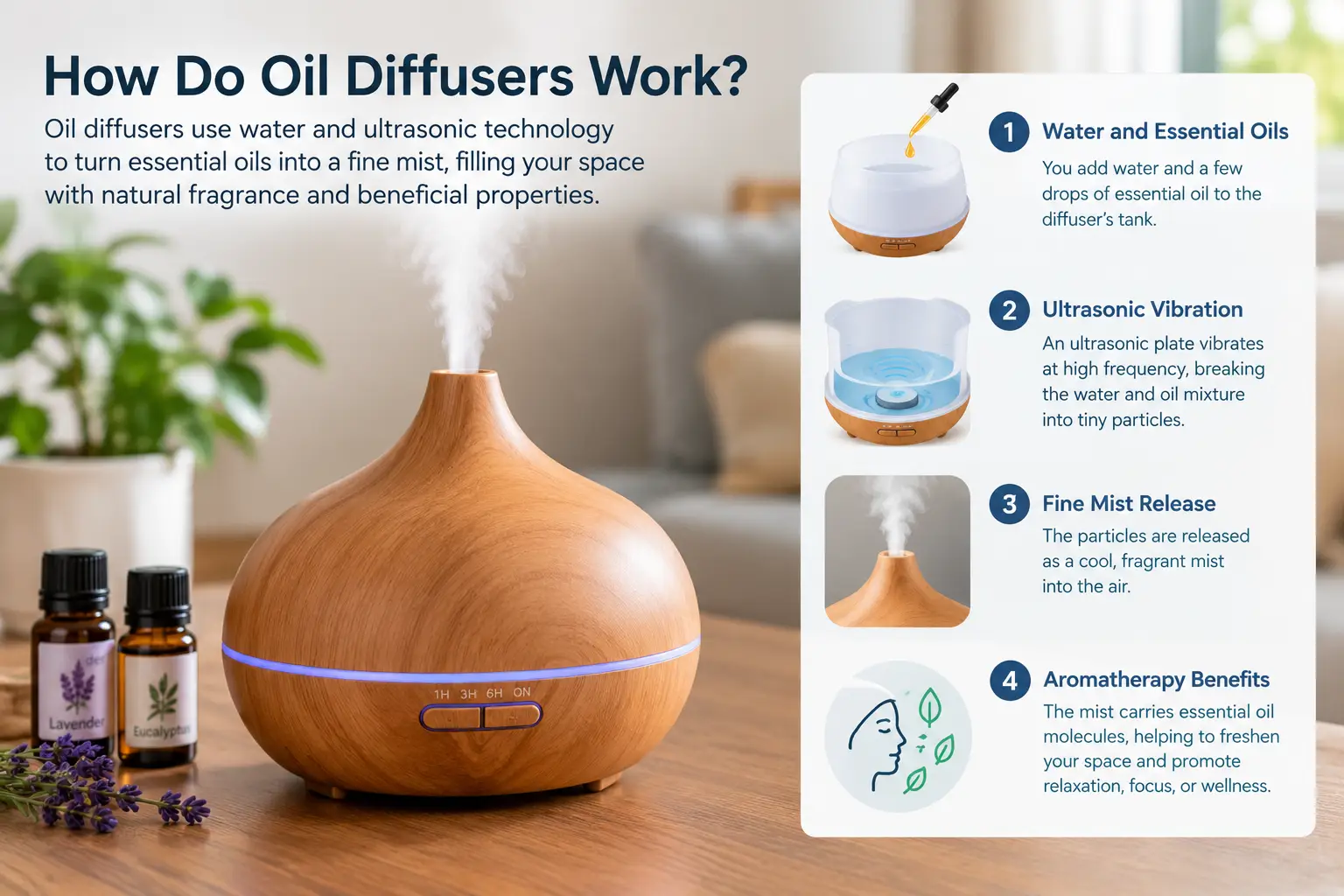
An oil diffuser is a device that disperses essential oil into the air as a fine mist, micro-droplets, or vapor. Ultrasonic models vibrate a water-and-oil mix into cool mist; nebulizers use pressurized air to atomize pure oil; heat and evaporative models warm the oil or blow air across it until it evaporates.
That’s the snippet answer. The longer answer is that oil diffusers belong to a broader family of scenting devices that people have used for centuries — the aroma lamp article on Wikipedia traces the lineage from simple candle-heated oil burners to today’s ultrasonic and nebulizing machines. What changed in the last two decades is precision. Modern diffusers let you control intensity, run time, and on/off cycles, and many shut themselves off automatically when the water runs low.
Why does the mechanism matter so much? Because essential oils are volatile compounds — mixtures of dozens of aromatic molecules that evaporate at different rates. Heat speeds evaporation but can change the character of the scent (the lighter, brighter top notes vanish first). Water dilutes the output, which is gentler but weaker. Pure-oil atomization delivers the full, concentrated aroma, but it consumes oil quickly. Each approach is a trade-off between intensity, oil economy, noise, and maintenance, and once you see those trade-offs clearly, choosing the right diffuser becomes surprisingly easy.
Quick Comparison: 7 Oil Diffusers at a Glance
| Diffuser | Technology | Capacity / Coverage | Price Range | Best For |
|---|---|---|---|---|
| InnoGear 150ml Ultrasonic Diffuser | Ultrasonic (water + oil) | 150ml | Under $25 | InnoGear 150ml Ultrasonic Diffuser — first-time buyers, desks |
| Pure Enrichment PureSpa Natural | Ultrasonic | 200ml / up to 250 sq ft | $25–$40 | Pure Enrichment PureSpa Natural — bedrooms, nurseries |
| ASAKUKI 500ml Premium Diffuser | Ultrasonic | 500ml / ~350 sq ft | $25–$45 | ASAKUKI 500ml Premium Diffuser — all-night runtime |
| ASAKUKI Smart WiFi 700ml Diffuser | Ultrasonic + Wi-Fi | 700ml / up to 450 sq ft | $35–$55 | ASAKUKI Smart WiFi 700ml Diffuser — smart-home users |
| Vitruvi Stone Diffuser | Ultrasonic | 90ml listed / up to 500 sq ft | $80–$120 | Vitruvi Stone Diffuser — design-first rooms |
| Vitruvi Air Waterless Diffuser | Cold-air waterless | Cartridge / up to 1,500 sq ft | $100–$160 | Vitruvi Air Waterless Diffuser — whole-home, low-maintenance scent |
| Organic Aromas Raindrop 2.0 | Nebulizing (pure oil) | Glass reservoir / up to 800 sq ft | $100–$160 | Organic Aromas Raindrop 2.0 — maximum scent intensity |
Prices are approximate ranges at the time of writing and change frequently — check the current price on Amazon.
Looking at the table, the dividing line isn’t really price — it’s technology. The four ultrasonic budget and mid-range picks (InnoGear 150ml Ultrasonic Diffuser, Pure Enrichment PureSpa Natural, ASAKUKI 500ml Premium Diffuser, and ASAKUKI Smart WiFi 700ml Diffuser) all create a soft, humidifying mist, and the main difference is tank size, which translates directly into how many hours you get between refills. The two premium waterless options (Vitruvi Air Waterless Diffuser and Organic Aromas Raindrop 2.0) cover far bigger spaces, but you pay for that reach both upfront and in ongoing oil or cartridge costs.
💬 One click helps other shoppers make an informed choice too! 😊
Top 7 Oil Diffusers: Expert Analysis for 2026
Every pick below is a real product listed on amazon.com. The commentary is based on manufacturer spec sheets, brand documentation, and aggregated customer review themes — not invented hands-on tests.
1. InnoGear 150ml Ultrasonic Diffuser — the no-risk starter pick
If you just want to find out whether diffusing is for you, the InnoGear 150ml Ultrasonic Diffuser is the lowest-stakes way to do it. It uses a 2.4MHz ultrasonic plate — meaning the disk under the water vibrates about 2.4 million times per second — which shatters the water-and-oil mixture into a cool, fine mist rather than boiling it. In practice, that’s why the outside never gets hot and why oils keep their fresh top notes.
The 150ml tank is palm-sized. InnoGear’s listings describe roughly 5–6 hours of continuous mist or about 9–11 hours in intermittent mode (30 seconds on, 30 seconds off). Translation: intermittent mode covers a full night’s sleep, while continuous mode is better for a quick evening scent boost. The unit shuts off automatically when the water runs dry, which is the one safety feature you should never compromise on.
Who is it for? Students, desk workers, and anyone scenting a small bedroom or office. It is not a living-room solution — a tank this small simply can’t push enough mist to fill a large, open space. Detailed aggregated review data for this specific variant was hard to verify independently, so we’re leaning on the spec sheet and InnoGear’s one-year warranty here rather than on claims about owner satisfaction.
Pros:
- ✅ Very low entry price for trying aromatherapy
- ✅ Intermittent mode stretches a small tank overnight
- ✅ Waterless auto shut-off for peace of mind
Cons:
- ❌ Too small to scent large or open rooms
- ❌ Needs refilling daily with regular use
At typically under $25, the value-for-money verdict is simple: it’s the cheapest honest answer to “will I actually use a diffuser?”
2. Pure Enrichment PureSpa Natural — quiet workhorse for bedrooms
The Pure Enrichment PureSpa Natural is built around one idea: run quietly for a long time in a medium-sized room. Pure Enrichment rates it for up to 10 hours of aroma coverage in rooms up to 250 square feet, from a 200ml tank.
That 250-square-foot figure is worth pausing on. It’s roughly a 15-by-16-foot bedroom — so this is a bedroom or home-office diffuser, not a whole-floor one. The brand recommends just 3–5 drops of oil per fill, which is a quiet advantage: a small bottle of lavender lasts a surprisingly long time. The wood-grain accent and soft color-changing light make it look more like décor than a gadget, and the light can be switched off if you’re sensitive to glow at night.
The analytical case for the Pure Enrichment PureSpa Natural is its warranty. Pure Enrichment backs it with a two-year warranty, which is double what many budget ultrasonic brands offer. Ultrasonic plates are the component most likely to wear out, so a longer warranty is effectively cheap insurance on the part that fails first.
Aggregated owner comments on Pure Enrichment’s own site lean positive about the brand’s durability across its PureSpa line, but we couldn’t independently verify a detailed Amazon review breakdown for this exact model — treat that as encouraging rather than conclusive.
Pros:
- ✅ Long run time for a 200ml tank
- ✅ Needs only a few drops per session
- ✅ Two-year warranty covers the failure-prone parts
Cons:
- ❌ Coverage tops out around 250 square feet
- ❌ No remote or app control
Expect it in the $25–$40 range — solid value if a longer warranty matters more to you than extra features.
3. ASAKUKI 500ml Premium Diffuser — best all-night runtime per dollar
The ASAKUKI 500ml Premium Diffuser (model 100-DF001) is the popular “big tank, fair price” option. ASAKUKI rates it for up to 16 hours of run time from 500ml, at a claimed 23 dB — about the level of a soft whisper.
That 23 dB spec is the number light sleepers should care about. Most people won’t hear it over a ceiling fan. Paired with timer settings (continuous, 1, 2, or 3 hours per the brand’s manual) and a remote control, you can start it from bed and let it shut itself off. The 12-watt draw means running it nightly costs pennies a month.
Here’s what most buyers overlook: a bigger tank dilutes your oil more. ASAKUKI’s own FAQ acknowledges that the 500ml model can smell weaker than a 100ml model with the same number of drops, and suggests roughly 5–8 drops instead. If you’ve read reviews calling a large-tank diffuser “weak,” this dilution math is usually the reason.
Aggregated review sentiment focuses on reliability and quiet operation, with owners praising that it nails the basics — steady mist, dependable timer, a remote — rather than piling on gimmicks. The brand notes it suits rooms up to roughly 350 square feet.
Pros:
- ✅ Up to 16 hours of mist per fill
- ✅ Whisper-quiet rating suits light sleepers
- ✅ Remote control and auto shut-off included
Cons:
- ❌ Needs more oil drops than small tanks
- ❌ Plastic body looks less premium than ceramic
At roughly $25–$45, the ASAKUKI 500ml Premium Diffuser is arguably the best runtime-per-dollar pick in this lineup.
4. ASAKUKI Smart WiFi 700ml Diffuser — scheduling for smart homes
The ASAKUKI Smart WiFi 700ml Diffuser takes the same ultrasonic formula and adds app and voice control. Its 700ml tank is rated for up to 20 hours, and ASAKUKI positions it for rooms up to about 450 square feet.
The real upgrade isn’t capacity — it’s scheduling. Through the Tuya Smart app, you can set specific on/off times, so the diffuser can switch on 20 minutes before your alarm or right before you get home from work. It also works with Alexa and Google Assistant. What the spec sheet says in the fine print matters here: it supports only 2.4GHz Wi-Fi, not 5GHz, and it doesn’t work with hub-based home-automation systems. If your router broadcasts a combined network, you may have to adjust router settings during setup.
Who is it for? People already living in the Alexa or Google ecosystem, or anyone who forgets to turn devices on and off. If you never touch your phone for home tasks, the Wi-Fi is wasted money — the ASAKUKI 500ml Premium Diffuser does the same job for less.
Aggregated owner feedback generally values the app control and large capacity, while some reviewers note it sits at the higher end of the ultrasonic price range. Physical buttons still work without Wi-Fi, which is a nice fallback.
Pros:
- ✅ App scheduling automates your scent routine
- ✅ Huge 700ml tank for up to 20 hours
- ✅ Works with Alexa and Google Assistant
Cons:
- ❌ Supports 2.4GHz Wi-Fi networks only
- ❌ Smart features add cost you may not use
In the $35–$55 range, it’s good value if — and only if — you’ll actually use the scheduling.
5. Vitruvi Stone Diffuser — ultrasonic that doubles as décor
The Vitruvi Stone Diffuser is the design-lover’s ultrasonic diffuser: a matte ceramic cover that reads more like pottery than electronics. Vitruvi rates it for rooms up to 500 square feet, with two run-time settings — 4 hours continuous or 8 hours intermittent.
The spec sheet reveals something interesting. Vitruvi lists misting output at about 1 fluid ounce per hour on continuous mode and 0.40 fluid ounces per hour on intermittent mode. The Amazon listing advertises 90ml capacity, while Vitruvi’s own product page puts water capacity at 70ml — likely the difference between total tank volume and the actual fill line. Either way, it’s a small tank, which is why the brand recommends a generous 20–30 drops of oil. That’s a much stronger oil-to-water ratio than budget models, and it explains why a small ceramic unit can still scent a sizable room.
Honest analysis: you’re paying substantially for the ceramic shell and the brand. Functionally, it’s still an ultrasonic diffuser, and some reviewers have noted it’s too small for large rooms. It also has four light settings, including a flickering “candlelight” mode, and auto shut-off when time is up or water runs out.
Aggregated sentiment praises the elegant design and consistent scent; the recurring caveat is capacity and price.
Pros:
- ✅ Beautiful matte ceramic finish
- ✅ Strong scent for its compact size
- ✅ Candlelight mode adds cozy ambiance
Cons:
- ❌ Small tank limits continuous run time
- ❌ Uses more oil per fill than budget models
Typically in the $80–$120 range, it’s worth it if the diffuser will sit somewhere visible.
6. Vitruvi Air Waterless Diffuser — whole-home scent, zero water
The Vitruvi Air Waterless Diffuser works differently from everything above. Instead of water, it uses what Vitruvi calls cold-air diffusion: micro-vibrations and an air pump turn a sealed scent cartridge into an ultra-dry micro-mist. Vitruvi rates a single cartridge for up to 30 days and coverage up to 1,500 square feet, with five adjustable scent strengths.
What does that mean in practice? No daily refills, no mineral dust, no tank to scrub. Vitruvi states no cleaning is required beyond wiping the wick when changing scents. For busy households, that’s a real quality-of-life upgrade.
The trade-off is lock-in. The Vitruvi Air Waterless Diffuser works only with Vitruvi’s Air Scent Refills — you can’t pour in the essential oils you already own. That makes it closer to a subscription than a one-time purchase, and cartridge costs should be part of your budget math (see the cost section below).
Aggregated owner reviews are enthusiastic about how far the scent carries, but several reviewers mention running it only an hour or two at a time because it can become overwhelming, and at least one reviewer said they preferred going back to a water-based diffuser. Complaints about replacement-part shipping costs also appear.
Pros:
- ✅ Covers up to 1,500 square feet
- ✅ No water, no refilling, minimal cleaning
- ✅ Five strength settings for fine-tuning
Cons:
- ❌ Only works with proprietary scent cartridges
- ❌ Can overpower small rooms on high settings
Expect roughly $100–$160 for the unit — good value for large homes, less so for a single bedroom.
7. Organic Aromas Raindrop 2.0 — the strongest pure-oil scent
The Organic Aromas Raindrop 2.0 is a true nebulizing diffuser, and it’s the clearest answer to “how do oil diffusers work without water?” It uses Bernoulli’s principle: a small pump pushes air across a narrow tube, creating a low-pressure zone that draws undiluted essential oil upward and shatters it into micro-droplets. No water, no heat.
Because nothing dilutes the oil, the aroma is dramatically stronger than any ultrasonic unit. Organic Aromas rates coverage at up to 800 square feet. The build — plantation hardwood base and hand-blown borosilicate glass reservoir — looks like a lab instrument turned into art. The downside of that power is appetite: nebulizers burn through oil much faster, so budget accordingly.
Noise is the other honest consideration. Independent reviews place nebulizer pump noise around 30–45 dB — a low hum similar to a quiet refrigerator. Fine in a living room, potentially distracting in a silent bedroom.
Aggregated review sentiment is split in a telling way: owners widely praise the design and strong, long-lasting aroma even in large spaces, but a meaningful number report clogging, occasional electrical problems, and cleaning challenges. Regular rinsing with isopropyl alcohol, as Organic Aromas recommends, is non-negotiable.
Pros:
- ✅ Most intense aroma in this lineup
- ✅ No water, heat, or plastic reservoir
- ✅ Stunning glass-and-wood craftsmanship
Cons:
- ❌ Consumes essential oil noticeably faster
- ❌ Clogging reports mean regular cleaning is required
Usually in the $100–$160 range, it’s excellent value for serious aromatherapy fans who want potency above all.
✨ Don’t miss the right diffuser for your space!
🔍 Take your home aromatherapy to the next level with this carefully curated lineup. Click a highlighted diffuser to check current pricing and availability. These picks will help you create a calmer, fresher-smelling home the whole family will enjoy!
How Does an Essential Oil Diffuser Work? The 5 Technologies Explained
Now that you’ve seen the products, let’s go deeper into the mechanics. There are five main ways a device can move essential oil into your air, and understanding how does an essential oil diffuser work at the component level explains every spec on every listing.
Ultrasonic Diffusers (Water + Oil)
Under the water sits a piezoelectric ceramic disk. When electricity hits it, it vibrates at ultrasonic frequencies — the InnoGear 150ml Ultrasonic Diffuser and ASAKUKI 500ml Premium Diffuser both run at 2.4MHz. Those vibrations create tiny pressure waves that break the water surface into a fog of micro-droplets, each carrying a trace of oil. A small fan pushes the fog out of the top.
Nebulizing Diffusers (Pure Oil)
No water at all. An air pump forces a jet of air past a thin tube dipped into the oil. The fast-moving air creates low pressure (Bernoulli’s principle), sucking oil up and shattering it against a glass surface into micro-particles. The Organic Aromas Raindrop 2.0 is the classic example.
Waterless Cold-Air Diffusers
A hybrid approach: sealed cartridges, a wick, and an air pump produce a dry micro-mist. The Vitruvi Air Waterless Diffuser belongs here. It’s cleaner and more convenient than nebulizing, but it typically requires proprietary refills.
Heat and Evaporative Diffusers
Heat diffusers warm oil on a plate; evaporative models blow air across an oil-soaked pad. Both are simple and quiet, but heat alters the scent profile, and evaporation releases lighter molecules first, so the aroma changes over time.
| Technology | Uses Water? | Scent Strength | Oil Use | Noise | Best For |
|---|---|---|---|---|---|
| Ultrasonic | Yes | Light–moderate | Low | Very quiet | Bedrooms, everyday use (e.g., ASAKUKI 500ml Premium Diffuser) |
| Nebulizing | No | Very strong | High | Low hum | Large rooms, therapy-level scent (e.g., Organic Aromas Raindrop 2.0) |
| Cold-air waterless | No | Strong, adjustable | Moderate (cartridges) | Quiet | Whole-home scenting (e.g., Vitruvi Air Waterless Diffuser) |
| Heat | Sometimes | Mild | Low | Silent | Budget, small spaces |
| Evaporative / passive | No | Mild, fades | Low | Silent/fan | Cars, closets, desks |
The table makes one pattern clear: scent strength and oil consumption move together. The moment you remove water from the equation, the aroma gets stronger — and your oil budget grows with it. That’s why ultrasonic units remain the default choice for most households, while nebulizing and cold-air models make the most sense for larger spaces or people who want intensity over economy.
Ultrasonic Diffuser vs Nebulizing Diffuser: Which Should You Buy?
This is the decision most shoppers actually face, so let’s put the ultrasonic diffuser and the nebulizing diffuser side by side in plain terms.
Scent character. An ultrasonic diffuser produces a soft, humid mist where oil is heavily diluted — think “pleasant background fragrance.” A nebulizing diffuser produces a concentrated aroma where you notice the oil’s full profile. If you want the room to smell like eucalyptus, not “a hint of eucalyptus,” nebulizing wins.
Humidity. Ultrasonic models add a little moisture to the air, which many people appreciate in dry winter months. Nebulizers add none. In a humid climate, that’s an advantage; in a dry apartment with forced-air heat, the ultrasonic model does double duty.
Running costs. A typical ultrasonic session uses a handful of drops. A nebulizer can go through a meaningful portion of a small oil bottle in a single week of heavy use. Over a year, the nebulizer’s oil bill can exceed the cost of the device.
Maintenance. Ultrasonic tanks need regular rinsing and occasional descaling. Nebulizers need alcohol flushes to prevent clogging — reviews of the Organic Aromas Raindrop 2.0 show what happens when that’s skipped.
Noise and light. Ultrasonic units are nearly silent; nebulizers hum. Both often include LEDs you can switch off.
The verdict: Choose ultrasonic (like the ASAKUKI 500ml Premium Diffuser or Vitruvi Stone Diffuser) for bedrooms, nightly use, and budget-friendly oil consumption. Choose nebulizing (like the Organic Aromas Raindrop 2.0) for living rooms, open-plan spaces, and anyone who values potency. If you want nebulizer-level reach without cleaning, the Vitruvi Air Waterless Diffuser splits the difference — at the cost of cartridge lock-in.
How to Choose the Best Essential Oil Diffuser (7 Steps)
Picking the best essential oil diffuser comes down to seven practical steps:
- Measure your room. Multiply length by width. Under 250 sq ft suits compact ultrasonic units; 400+ sq ft calls for large tanks, nebulizers, or cold-air models.
- Decide on scent strength. Background ambiance favors ultrasonic; strong, therapy-style aroma favors nebulizing.
- Match tank size to schedule. Overnight use needs at least 8 hours of intermittent mist — roughly 150ml or more.
- Check the noise rating. For bedrooms, look for about 25 dB or lower; nebulizer hums are better for living spaces.
- Confirm auto shut-off. A waterless or low-oil shut-off prevents damage and is a baseline safety feature.
- Calculate ongoing costs. Factor in oil, cartridges, or distilled water — not just the sticker price.
- Consider cleaning time honestly. If you won’t clean weekly, avoid nebulizers and lean toward cartridge-based or simple ultrasonic designs.
Follow these in order and you’ll eliminate most of the options on Amazon before you even look at colors or lights — which is exactly how it should be.
Getting Started: Your First 30 Days With a Diffuser
A diffuser is simple, but the first month is when most people either fall in love with theirs or shove it in a closet. Here’s a practical roadmap.
Day 1: Setup Done Right
Place the diffuser on a stable, flat, water-safe surface at least a couple of feet off the floor, away from electronics and wood furniture that could get damp. Central placement spreads scent more evenly than tucking it into a corner. Fill with room-temperature water only to the max line — overfilling is the most common reason ultrasonic units “stop misting.”
Week 1: Start Low
Begin with 3–5 drops in a small tank (or the low end of your brand’s recommendation). Your nose adapts quickly, so the urge to add more drops is strong — resist it for a week. Use intermittent mode; it stretches runtime and reduces “scent fatigue.”
Weeks 2–3: Build a Routine
Try pairing scents with times of day: citrus in the morning, lavender or cedarwood at night. Smart models like the ASAKUKI Smart WiFi 700ml Diffuser can automate this with schedules. Empty leftover water daily — standing water is where film and odors start.
Week 4: First Deep Clean
Once a week, wipe the tank and ultrasonic plate with a cotton swab dipped in a little white vinegar or rubbing alcohol (check your manual first). Vitruvi recommends a monthly deep clean for the Vitruvi Stone Diffuser; nebulizers like the Organic Aromas Raindrop 2.0 benefit from weekly alcohol rinses.
Common First-Month Mistakes
- Using hot water (can damage components and doesn’t help scent)
- Adding carrier or fragrance oils that gum up the plate
- Running continuous mode 24/7 in a small closed room
Which Diffuser Fits Your Life? Three Real-World Scenarios
Specs only matter in context. Here are three common buyer profiles and the reasoning behind each match.
Scenario 1: The College Student in a 120-Square-Foot Dorm
Budget: under $25. Use: evenings and overnight, 5–7 days a week.
A small room means even a modest diffuser can saturate the space quickly — overpowering a roommate is a bigger risk than weak scent. The InnoGear 150ml Ultrasonic Diffuser fits: intermittent mode runs through the night, the price is low, and it fits on a crowded desk. Keep drops to three or four, and always ask the roommate first.
Scenario 2: The Remote Worker With a 300-Square-Foot Home Office
Budget: $30–$55. Use: 8–10 hours a day, weekdays.
Long workdays need a big tank and quiet operation so calls aren’t interrupted. The ASAKUKI 500ml Premium Diffuser covers the space and runs up to 16 hours. If you’d like the diffuser to start at 8:45 a.m. without thinking about it, step up to the ASAKUKI Smart WiFi 700ml Diffuser and schedule it in the app.
Scenario 3: The Family in a 1,200-Square-Foot Open-Plan Home
Budget: $100–$160. Use: afternoons and evenings, with guests often over.
Open layouts defeat small ultrasonic units. The Vitruvi Air Waterless Diffuser covers the whole area with minimal maintenance — ideal when nobody wants another chore. If the family already owns a collection of essential oils, the Organic Aromas Raindrop 2.0 uses those oils directly. With pets at home, read the safety section below before choosing either.
Troubleshooting: Common Diffuser Problems and Fixes
Even good diffusers misbehave. Here are the most common problems and what usually fixes them.
Problem 1: No mist, but the light is on. Usually the water level is too high or too low, triggering the sensor, or the ultrasonic plate is coated with residue. Adjust to the fill line and clean the plate gently with a cotton swab and rubbing alcohol.
Problem 2: “I can’t smell anything.” Often it’s olfactory fatigue — your brain tunes out constant smells. Step out for 10 minutes and return. If it’s truly weak, your tank may be too large for your drop count (the ASAKUKI 500ml Premium Diffuser FAQ addresses exactly this), or the room is too big for the model.
Problem 3: White dust on nearby furniture. That’s minerals from hard tap water sprayed into the air. Switch to distilled water — more on why in the safety section.
Problem 4: Nebulizer sputters or stops. Thick oils (like vetiver or sandalwood) or residue can clog the atomizer. Flush the glass with isopropyl alcohol and avoid undiluted heavy oils, a known pain point in Organic Aromas Raindrop 2.0 reviews.
Problem 5: Scent is overwhelming. Reduce drops, switch to intermittent mode, or lower the strength setting — Vitruvi Air Waterless Diffuser owners frequently limit sessions to an hour or two for this reason.
Are Oil Diffusers Safe? Safety, Regulations, and Standards
Diffusers are generally low-risk household devices, but “natural” doesn’t automatically mean harmless. Here’s what the evidence and US guidance actually say.
Health Claims: Keep Expectations Realistic
The National Institutes of Health’s National Center for Complementary and Integrative Health notes that aromatherapy is sometimes used for insomnia and other concerns, but rigorous research is limited, so benefits remain uncertain. In other words, enjoy your diffuser for mood and ambiance — but don’t treat it as medical treatment. People with asthma or respiratory sensitivities should talk to a doctor before diffusing regularly.
Water Quality and “White Dust”
Ultrasonic diffusers work like tiny ultrasonic humidifiers, so the same water advice applies. The EPA’s fact sheet on home humidifiers explains that ultrasonic devices can disperse minerals from tap water into the air and suggests distilled water if white dust appears or you want to minimize exposure. Regular cleaning also limits microbial growth in the tank.
Electrical Certifications
Look for a UL or ETL listing on the power adapter — these indicate independent electrical safety testing to US standards. Wi-Fi models such as the ASAKUKI Smart WiFi 700ml Diffuser should carry FCC compliance for radio emissions. Auto shut-off is not legally required, but every pick in this guide includes it, and you shouldn’t buy a model without it.
Pets, Kids, and Birds
Cats are especially sensitive to many essential oils, and birds are sensitive to airborne particles. See the pet section below and the FAQ.
Long-Term Cost and Maintenance: The Real Price of Diffusing
The sticker price is only the opening bid. Here’s how the total cost of ownership shakes out over roughly a year of regular evening use.
| Diffuser | Upfront | Ongoing Consumables | Maintenance Effort | Best For |
|---|---|---|---|---|
| InnoGear 150ml Ultrasonic Diffuser | Under $25 | Low (few drops/session) | Weekly wipe | InnoGear 150ml Ultrasonic Diffuser — lowest total cost |
| Pure Enrichment PureSpa Natural | $25–$40 | Low (3–5 drops) | Weekly wipe | Pure Enrichment PureSpa Natural — warranty-backed value |
| ASAKUKI 500ml Premium Diffuser | $25–$45 | Low–moderate (5–8 drops) | Weekly wipe | ASAKUKI 500ml Premium Diffuser — long runtime value |
| ASAKUKI Smart WiFi 700ml Diffuser | $35–$55 | Low–moderate | Weekly wipe | ASAKUKI Smart WiFi 700ml Diffuser — automation value |
| Vitruvi Stone Diffuser | $80–$120 | Moderate (20–30 drops) | Monthly deep clean | Vitruvi Stone Diffuser — design value |
| Vitruvi Air Waterless Diffuser | $100–$160 | Proprietary cartridges | Minimal | Vitruvi Air Waterless Diffuser — time savings |
| Organic Aromas Raindrop 2.0 | $100–$160 | High (pure oil) | Weekly alcohol rinse | Organic Aromas Raindrop 2.0 — intensity per dollar |
The pattern here is counterintuitive: the cheapest diffusers are cheapest to run, too, because they stretch every drop with water. The Vitruvi Stone Diffuser sits in the middle — pricey upfront and oil-hungrier than budget units because of its high recommended drop count. The nebulizer and cold-air models deliver the most scent per room, but their true cost lives in the consumables, so estimate your weekly usage before committing.
A few maintenance habits extend any diffuser’s life: use distilled water in ultrasonic models (it slows mineral buildup on the plate), empty tanks after each use, and store the unit dry. Replacing a $20 diffuser every couple of years is normal; a well-maintained premium unit should last considerably longer.
Oil Diffusers vs Candles, Plug-Ins, and Reed Diffusers
Why use an electric diffuser at all? It helps to compare it against the traditional alternatives most people already own.
| Method | Open Flame? | Scent Control | Ongoing Cost | Best For |
|---|---|---|---|---|
| Ultrasonic/nebulizing diffuser | No | Timers, strength settings | Oils or cartridges | Controllable daily scent (ASAKUKI 500ml Premium Diffuser, Organic Aromas Raindrop 2.0) |
| Scented candle | Yes | None once lit | Replace candles | Short, cozy sessions |
| Plug-in air freshener | No | Minimal | Refills | Hallways, bathrooms |
| Reed diffuser | No | Very little | Oil refills | Small rooms, zero power |
| Aerosol spray | No | Momentary | Frequent cans | Quick odor masking |
The standout advantage of electric diffusers is control: timers, intermittent modes, and auto shut-off let you decide exactly how much scent enters the room, and none of them involve an open flame. Candles still win on ambiance, and reed diffusers win on simplicity, but neither lets you turn the scent off when guests arrive or schedule it around your day.
Features That Actually Matter (and Ones That Don’t)
Diffuser listings are crowded with features. Some change your daily experience; others are marketing.
Features Worth Paying For
- Auto shut-off: protects the ultrasonic plate and prevents dry-running. Non-negotiable.
- Intermittent mode: roughly doubles run time and reduces scent fatigue — arguably the most underrated feature.
- Timers: 1-, 2-, or 3-hour settings (as on the ASAKUKI 500ml Premium Diffuser) let you diffuse while falling asleep without running all night.
- Light off switch: essential for bedrooms.
- Warranty length: the Pure Enrichment PureSpa Natural‘s two-year coverage beats a flashier feature list.
Features That Rarely Matter
- Seven-color light shows: fun for a week, then usually switched off.
- “5-in-1” labels: usually just means diffuser, humidifier, night-light, timer, and auto-off — features most models already share.
- Huge claimed coverage on tiny tanks: compare coverage claims against tank size and drop recommendations; physics doesn’t bend for marketing copy.
Features That Depend on You
App control, like on the ASAKUKI Smart WiFi 700ml Diffuser, is excellent if you use schedules, pointless if you don’t. Premium materials, like the Vitruvi Stone Diffuser‘s ceramic, matter only if the diffuser lives on display.
Common Mistakes to Avoid When Buying an Oil Diffuser
- Buying for the photo, not the room size. A beautiful 100ml diffuser in a 600-square-foot room will disappoint. Match coverage first, looks second.
- Ignoring oil and cartridge costs. Nebulizers and cartridge systems can cost more to run each year than they cost to buy.
- Choosing a nebulizer for a bedroom. Pump hum and scent intensity make them better suited to living spaces.
- Skipping the auto shut-off check. Cheap no-name units sometimes omit it — don’t gamble.
- Assuming “therapeutic grade” means anything regulated. It’s a marketing term, not a federal standard. Focus on reputable oil sellers with clear sourcing.
- Forgetting about pets. If you have cats or birds, your diffuser choice (and oil choice) should start there — the ASPCA’s guidance on essential oils and pets recommends avoiding diffusers in homes with birds and using them only briefly in areas cats and dogs can leave.
- Using any oil in a proprietary system. The Vitruvi Air Waterless Diffuser accepts only Vitruvi refills; pouring in regular oil won’t work.
Oil Diffusers for Pet Owners and Families
Households with pets or small children need a slightly different playbook.
For pets, the core principle from animal poison-control experts is exposure control. Diffuse for short periods in rooms your pet can leave, never in a closed room with an animal confined inside. Cats groom oil droplets off their fur, which is why concentrated nebulizing output deserves extra caution in cat homes. Oils commonly flagged as risky for pets include tea tree, eucalyptus, peppermint, cinnamon, pine, and wintergreen. Bird owners should skip diffusers entirely.
For kids, place the diffuser where it can’t be knocked over — water and concentrated oil on a toddler’s hands is a bigger practical risk than the mist itself. Ultrasonic models with low drop counts, such as the Pure Enrichment PureSpa Natural, are the gentlest choice for family spaces. Keep oil bottles out of reach; swallowing essential oils can be dangerous.
A good rule: if anyone in the house — human or animal — coughs, sneezes, or seems uncomfortable when the diffuser runs, turn it off, air out the room, and reassess.
Frequently Asked Questions
❓ Can I put essential oils in a regular humidifier instead of a diffuser?
❓ How long should you run an oil diffuser at a time?
❓ Do oil diffusers purify the air?
❓ Is it cheaper to buy a nebulizing or ultrasonic diffuser long term?
❓ Can I leave an oil diffuser on while I sleep?
Conclusion: Now You Know How Oil Diffusers Work — Choose Accordingly
So, how do oil diffusers work? Ultrasonic models vibrate water and oil into a gentle cool mist; nebulizers use pressurized air to atomize pure oil; cold-air waterless models turn sealed cartridges into a dry micro-mist; heat and evaporative designs simply help oil evaporate. Once you understand those mechanisms, the right purchase becomes obvious.
For most people, an ultrasonic diffuser is the sweet spot. The InnoGear 150ml Ultrasonic Diffuser is a painless experiment, the Pure Enrichment PureSpa Natural is a warranty-backed bedroom workhorse, and the ASAKUKI 500ml Premium Diffuser delivers the most runtime per dollar. Smart-home fans will get real value from the ASAKUKI Smart WiFi 700ml Diffuser‘s scheduling, while the Vitruvi Stone Diffuser earns its price when it’s on display.
If you need to scent a large space, the Vitruvi Air Waterless Diffuser trades flexibility for convenience, and the Organic Aromas Raindrop 2.0 delivers the most powerful, pure aroma — provided you’re ready for the oil budget and the cleaning routine.
Whichever you choose, start with fewer drops than you think, use distilled water in ultrasonic models, clean regularly, and keep pets and kids in mind. A diffuser is a small purchase that shapes how your home feels every single day.
🌿 Ready to transform how your home smells?
🛒 Pick the diffuser that fits your room, your routine, and your budget — click any highlighted product above to check current pricing and availability on Amazon. Your calmer, fresher space is just one click away!
Recommended for You
- Essential Oil Shower Diffuser: 7 Best Picks That Actually Work in 2026
- Glass Diffuser Bottles: 7 Best Picks That Actually Work in 2026
- Electric Aromatherapy Diffuser: 7 Best Picks Worth It in 2026
Disclaimer: This post contains affiliate links. As an Amazon Associate, I earn from qualifying purchases made through these links, at no additional cost to you.
✨ Found this article helpful? Share it with someone who needs it! 💬🤗