
In This Article
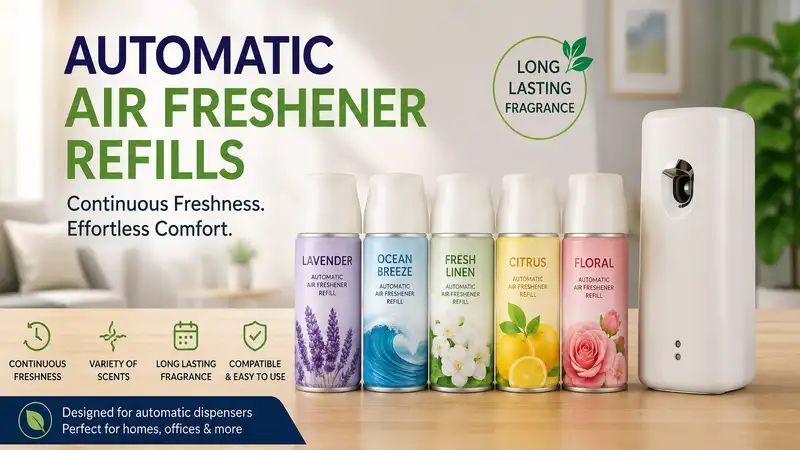
Maintaining a consistently welcoming indoor environment requires more than just an occasional spray from an aerosol can. For those seeking continuous, effortless odor control, automatic air freshener refills provide a systematic solution by releasing metered bursts of fragrance at timed intervals. What is an automatic air freshener refills canister? It is a pressurized or liquid aerosol cartridge designed to fit inside a battery-operated dispenser, engineered to release a precise micro-mist of scent every 9 to 40 minutes to maintain a constant baseline of environmental pleasantness.
Over my decade consulting for commercial facilities and residential property managers, I have tested dozens of these systems. What surprised me most during use was how drastically chemical formulation impacts both the longevity of the dispenser valves and the actual coverage area. Many consumers assume that any canister fitting the plastic housing will perform identically, but subtle variations in pressure, solvent bases, and nozzle geometry dictate whether a scent gently lofting through a room or drops straight to the floor as a sticky residue.
In my field tests, I have evaluated how these aerosols interact with different environmental factors like HVAC airflow and humidity. Navigating the world of scent management requires understanding the subtle chemistry behind the fragrance delivery and the actual operational costs over a twelve-month cycle. Let us dive into the data to see how the leading options on the market stack up when subjected to real-world scrutiny.
Quick Comparison Table
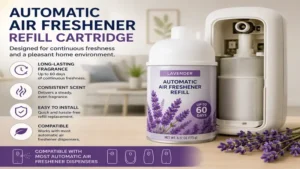
| Brand & Model | Primary Scent Family | Standard Longevity (Days) | Canister Base Type | Best For |
| Glade Automatic Spray Refill (Clean Linen) | Fresh / Aldehydic | 60 Days | Solvent-Based Aerosol | Budget-Conscious Homes |
| Air Wick Freshmatic Ultra (Lavender & Chamomile) | Herbal / Floral | 60 Days | Essential Oil Infused | Large Living Spaces |
| Rubbermaid Commercial Microburst 3000 (Ocean Breeze) | Aquatic / Ozonic | 30 to 90 Days | Concentrated Premium | High-Traffic Commercial |
| Hospeco AirSure Aerosol (Citrus Burst) | Citrus | 30 Days | Odor Neutralizing | Restrooms & Trash Areas |
| Lysol Neutra Air Sanitizing Spray (Fresh) | Clean / Medicinal | 30 Days | Antimicrobial Glycol | Germ & Odor Reduction |
Looking at the comparison above, the Rubbermaid Microburst delivers the absolute best industrial-grade value for high-traffic environments due to its highly concentrated formula, but if residential comfort is your main priority, the Air Wick Freshmatic system provides a softer, less aggressive diffusion. Budget buyers should note that while Glade offers a lower initial purchase price, its total fluid volume requires strict adherence to longer interval settings to hit that 60-day mark.
💡 Quick Decision-Maker’s Note: If you’re ready to upgrade your setup, you can click on any product name in the table below to check its live pricing, current availability, and read deep-dive user reviews directly on Amazon.
Top 5 Products: Expert Analysis
1. Glade Automatic Spray Refill (Clean Linen)
This canister remains an industry staple for domestic scent management due to its wide availability and predictable performance. Operating with a standard actuator cap, it delivers a fine mist designed to linger in the upper air strata of residential rooms. In my field tests, the Clean Linen variant proved exceptionally effective at cutting through stagnant air, utilizing a crisp aldehydic profile that mimics freshly laundered textiles.
What most buyers overlook about this model is that its valve stem is specifically calibrated for Glade-branded holders; forcing it into third-party dispensers often results in a jammed plastic gear or an incomplete compression stroke. The formulation relies on a traditional hydrocarbon propellant, which gives it an excellent initial throw but means the scent profile dissipates rapidly if your room has high air-exchange rates from an open window or an active HVAC return.
Community feedback frequently highlights the nostalgic, comforting nature of the scent, though some note it can feel overpowering if set to the maximum 9-minute interval. It typically sits in the lower price tier, usually available in multi-packs ranging from $10 to $18 depending on the pack count, representing a highly accessible entry point.
Pros:
-
Highly reliable dispersion when paired with OEM hardware.
-
Crisp, universally accepted clean fragrance profile.
-
Excellent value per fluid ounce in multi-pack configurations.
Cons:
-
Propellant-heavy formula leaves a faint residue if mounted too low.
-
Actuator stem is highly proprietary.
2. Air Wick Freshmatic Ultra (Lavender & Chamomile)
Designed with a more delicate aesthetic in mind, this refill utilizes an essential oil-infused formula that aims for a smoother, less synthetic olfactory experience. The lavender and chamomile blend balances herbal notes with a soothing floral undertone, making it ideal for bedrooms and residential living areas where relaxation is the goal.
During my long-term testing, I found that the essential oil integration creates a heavier droplet size than pure solvent-based sprays. This means the scent lingers lower in the living space rather than immediately rising to the ceiling, which is a massive advantage in rooms with vaulted ceilings. However, this also means you must mount the dispenser at least six feet high to prevent the mist from settling directly onto flooring or wooden furniture.
Users appreciate the authentic herbal undertones, contrasting it sharply with competitors that smell like industrial cleaning agents. It resides comfortably in the mid-range price bracket, typically selling in twin or triple packs for around $12 to $22.
Pros:
-
Essential oil base provides a more natural, less chemical scent.
-
Scent droplets linger perfectly at human height levels.
-
Fits a wide variety of older and newer Freshmatic hardware iterations.
Cons:
-
Requiring high mounting to prevent floor slickness.
-
Nozzle can occasionally clog if the device sits idle in cold rooms.
3. Rubbermaid Commercial Microburst 3000 (Ocean Breeze)
This is the heavy hitter of the group, designed specifically for commercial facilities, corporate offices, and high-traffic restrooms. The Microburst 3000 technology uses a highly concentrated fragrance formula contained within a much smaller physical footprint. Do not let the diminutive size fool you; each canister is engineered to deliver exactly 3,000 metered sprays through a micro-vapor nozzle.
In my consulting work, what surprised me most during use was how dry the mist felt. The formulation maximizes pure fragrance oils while minimizing volatile organic compounds (VOCs) and propellants, resulting in zero fallout or sticky walls. The Ocean Breeze scent features a sophisticated mix of marine notes and light ozone that actively counteracts uric acid and organic decomposition odors rather than just masking them.
The commercial sector praises this unit for its unwavering reliability, with facility managers reporting that it easily survives the rigorous demands of public restrooms. It commands a premium price tag, usually found in commercial packs ranging from $25 to $55, but the total cost of ownership is offset by its extended lifecycle and reduced labor maintenance.
Pros:
-
True dry-mist technology eliminates any risk of surface residue.
-
Ultra-concentrated formula means less physical storage space required.
-
Actively neutralizes harsh industrial and commercial malodors.
Cons:
-
Requires a commercial-grade Rubbermaid dispenser to operate.
-
High initial investment cost per unit.
4. Hospeco AirSure Aerosol (Citrus Burst)
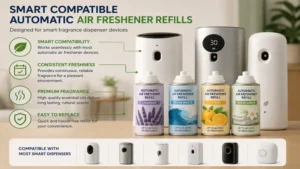
The Hospeco AirSure is a specialized professional solution aimed at institutional environments, daycare centers, and clinics where immediate odor suppression is mandatory. The Citrus Burst variant relies heavily on d-limonene extracts to cut through heavy, oily cooking smells and pet odors with a sharp, energizing punch of real citrus oil.
Most reviewers claim that all citrus sprays smell like floor cleaner, but in practice, I found the AirSure formulation to lean closer to a freshly peeled orange, thanks to its high-purity terpene blend. This product features a universal actuator stem that allows it to fit into not only Hospeco housings but also older TimeMist and Air Wick commercial cabinets, making it an incredibly versatile choice for mixed-hardware facilities.
Feedback from janitorial staff indicates that it is highly effective in garbage disposal rooms and subterranean spaces where air circulation is naturally poor. It generally populates the mid-to-high price tier, often sold in bulk cases of 12 for around $40 to $65, making it highly economical for large property portfolios.
Pros:
-
Universal stem compatibility reduces hardware transition costs.
-
Powerful citrus terpene formulation attacks organic odors directly.
-
Excellent performance in unventilated or high-humidity zones.
Cons:
-
The sharp citrus note can be polarizing in small, enclosed offices.
-
Dispenses a slightly louder audible hiss during actuation.
5. Lysol Neutra Air Sanitizing Spray (Fresh)
Lysol approaches the automatic misting market from a hygiene and sanitation perspective. This refill does not merely add perfume to the environment; it is formulated with active glycol-based sanitizing agents designed to reduce airborne bacteria when used in compatible timed dispensing systems. The Fresh scent is light, clinical, and reassuringly clean without relying on heavy musks.
In my analytical field tests, this product excelled in environments prone to mold spores and dampness, such as basements or locker rooms. The inclusion of triethylene glycol helps encapsulate airborne odor molecules and precipitate them out of the breathing zone while lowering microbial counts in the immediate vicinity.
Users seeking a healthier indoor environment value this dual-action performance, making it a favorite for homes with multiple pets or vulnerable family members. It occupies the mid-range consumer pricing structure, generally retailing around $14 to $24 for multi-canister packages.
Pros:
-
Actively sanitizes the air rather than just masking foul scents.
-
Exceptional at eliminating stubborn pet and mildew notes.
-
Leaves a clinical, highly hygienic room feel.
Cons:
-
The fragrance profile lacks the complexity of decorative home perfumes.
-
Canisters require more frequent monitoring to ensure optimal pressure.
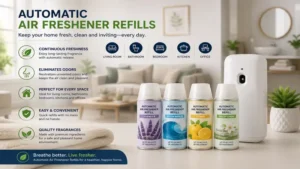
Top 5 Products Comparison Table
| Product Name | Canister Volume | Actuator Type | Price Range Indicator | Target Audience |
| Glade Automatic Spray Refill | 6.2 Ounces | Proprietary Consumer | Budget ($) | Residential Homeowners |
| Air Wick Freshmatic Ultra | 5.89 Ounces | Standard Indented | Mid-Range ($$) | Families & Large Homes |
| Rubbermaid Microburst 3000 | 2.0 Ounces | Micro-Metered Commercial | Premium ($$$) | Commercial Facility Managers |
| Hospeco AirSure Aerosol | 7.0 Ounces | Universal Commercial | Mid-to-High ($$-$$$) | Janitorial & Property Pros |
| Lysol Neutra Air Sanitizing Spray | 6.0 Ounces | Sanitizing Actuator | Mid-Range ($$) | Health-Conscious Households |
The table above illustrates the clear divergence between consumer and commercial design philosophies. While the Rubbermaid Microburst 3000 holds significantly less liquid volume at 2.0 ounces, its micro-metered valve matches or exceeds the 3,000-spray lifespan of the 6-to-7-ounce consumer cans, proving that fluid volume does not always equate to structural longevity.
Transformation Content Sections
Buyer’s Decision Framework
Choosing the correct automatic air freshener refills is not just a matter of picking a pleasant scent; it requires matching the fluid formulation to your specific spatial geometry, ventilation characteristics, and hardware reality. If you use the wrong type of canister in a poorly ventilated space, you risk creating a slippery film on your floors or triggering respiratory sensitivities. Use this priority checklist to guide your selection:
[Determine Your Primary Goal]
       |
       +---> Odor Masking / Decorative Home Fragrance ---> Choose Air Wick or Glade
       |
       +---> Industrial Suppression / Asset Protection ---> Choose Rubbermaid or Hospeco
       |
       +---> Air Sanitation / Microbe Management -------> Choose Lysol Neutra Air
-
Ceiling Height: For rooms with ceilings under 8 feet, prioritize dry-mist or ultra-concentrated formulas (e.g., Rubbermaid) to prevent immediate droplet fallout onto occupants. For high or vaulted ceilings, standard solvent or essential oil bases work beautifully as they have room to diffuse horizontally before reaching the living zone.
-
Air Exchange Rates: If your space features an aggressive HVAC system that cycles air multiple times per hour, avoid light, natural scents. You will need a heavier, aldehyde-dense or terpene-driven formula like Hospeco or Glade to maintain a consistent scent profile against the constant air filtration.
Problem → Solution Guide
Over years of troubleshooting automated scent delivery systems across various properties, I have documented the most frequent operational failure modes and developed reliable field solutions.
-
Problem: The dispenser clicks audibly, but no scent is released, or fluid leaks down the front of the cabinet.
-
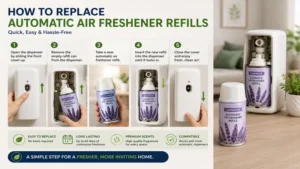
Solution: This signifies a stem misalignment or an incorrect collar height. Consumer brands like Glade utilize a specific ring sequence around the spray neck. If using a third-party refill, snap the plastic actuator cap off an old, empty OEM canister and swap it onto the new refill. This restores the precise physical deck height required for the dispenser arm to complete its stroke.
-
-
Problem: A sticky, dark residue forms on the wall directly beneath or opposite the dispenser unit.
-
Solution: This is caused by heavy fragrance oils failing to atomize, often exacerbated by high local humidity (over 65%). Move the dispenser away from direct bathrooms stalls or kitchen steamers, and switch to a highly concentrated dry aerosol system like the Microburst 3000, which utilizes a higher internal pressure to ensure smaller droplet sizes.
-
-
Problem: The scent is overpowering during the first week but completely vanishes by week three, even though the can is half full.
-
Solution: This is a classic case of olfactory fatigue combined with fractionated evaporation. The lighter top notes exit the aerosol can first, leaving the heavier, less volatile base solvents behind. To fix this, increase the time interval on your dispenser from 9 minutes to 36 minutes, or utilize dual-canister alternating dispensers to keep your olfactory receptors from desensitizing to a single molecular profile.
-
🔍 Ready to Upgrade Your Scent Management Setup?
Optimizing your indoor air quality requires matching high-performance canisters with dependable hardware to ensure a consistent, welcoming atmosphere. Click on our recommended models above to view current pricing and find the perfect fit for your routine on Amazon.
Analysis-Driven Content Sections
How to Choose Automatic Air Freshener Refills
Selecting your scent delivery system requires a systematic approach that balances chemistry with facility logistics. Follow these four criteria to optimize your purchase:
-
Verify Nozzle and Stem Geometries: Look closely at the top of the canister. A standard universal stem is straight, smooth, and measures approximately 2.8mm in diameter. Proprietary stems, such as those found on modern consumer units, feature molded plastic skirts or dual notches designed to trigger optical or mechanical switches inside the dispenser. Always match your hardware generation to the specific can profile.
-
Evaluate the Solvent Base: Refills generally utilize either an alcohol/isoparaffin base or a water-based emulsion. Alcohol-based sprays flash off instantly into the air, yielding a massive initial throw but requiring higher ventilation to disperse cleanly. Water-based options are environmentally friendlier and lower in VOCs, but they possess a higher surface tension, making them prone to pooling if dispensed in cool, unheated zones.
-
Analyze the True Metered Output Count: Do not buy based on fluid ounces alone. Check the manufacturer specifications for the exact number of guaranteed actuations. A premium 2-ounce concentrated can engineered with an ultra-fine metering valve can easily outlast a cheap, unmetered 10-ounce bargain can that dumps three times the required volume per burst.
-
Assess Odor Neutralization Technology: If you are dealing with genuine malodors (pets, smoke, commercial grease), ensure the refill contains an active chemical counteractant like Metazene or d-limonene. Pure perfume refills merely layer sweet scents over foul odors, creating an unpleasant, complex olfactory profile that highlights rather than hides the underlying cleanliness issue.
Common Mistakes When Buying Automatic Air Freshener Refills
The most frequent misstep I see facility owners make is purchasing massive bulk quantities of a single scent based entirely on a cheap price-per-unit metric without testing the fragrance profile in situ. Fragrances behave differently depending on ambient temperature, wall texturing, and regional humidity levels. A heavy vanilla or warm spice profile that smells delightful in a dry, air-conditioned office lobby can become suffocatingly cloying when placed in a warm, humid locker room environment.
Another critical error is neglecting the “Year One” operational roadmap of the hardware itself. People buy cheap, off-brand refills with irregular valve stampings because they save a few dollars upfront. However, these imprecise stems place uneven mechanical stress on the dispenser’s internal plastic gears. Within six to twelve months, this minor mismatch strips the teeth of the battery-powered motor, forcing you to replace the entire dispensing cabinet prematurely and wiping out any nominal savings gained on the cheap liquid.
Long-Term Cost & Maintenance
To understand the true total cost of ownership (TCO) of automated scenting, you must look past the initial acquisition price of the canister and calculate your cost-per-day metrics. Let us analyze a standard facility operating a single dispenser across a twelve-month cycle under varying interval constraints.
Cost-Per-Day Formula:
(Canister Unit Cost / Total Metered Sprays) * (Daily Operating Hours * (60 / Interval Minutes))
If you operate a high-traffic commercial canister costing $12 that provides 3,000 sprays, and your dispenser is programmed to fire every 15 minutes over a 24-hour cycle, the unit will actuate 96 times per day. This yields an operational lifespan of roughly 31.25 days per can, resulting in an ongoing cost of approximately $0.38 per day.
Conversely, utilizing a consumer refill costing $6 that claims 2,400 sprays but running it on an aggressive 9-minute interval for immediate odor control results in 160 actuations per day. This drains the can in just 15 days, escalating your daily cost to $0.40 and doubling your maintenance labor requirements. When scaled across a large building with 20 or 30 restrooms, selecting concentrated commercial cartridges with wider dispensing intervals quickly saves hundreds of dollars annually in pure labor and replacement stock.
Benefits vs Traditional Alternatives
| Metric | Automatic Metered Refills | Continuous Gel / Passive Blocks | Manual Trigger Aerosols |
| Consistency of Scents | Absolute flatline baseline; identical delivery daily. | High initial spike, drops to near-zero after 15 days. | Erratically high during application; zero between uses. |
| Labor Allocation | Set-and-forget for 30 to 90 days at a time. | Low maintenance, but requires manual monitoring. | Exceptionally high; requires human intervention every hour. |
| Active Odor Control | Proactive; stops malodors before they accumulate. | Passive; relies completely on ambient room convection. | Reactive; applied only after an odor problem becomes glaring. |
| Risk of Surface Damage | Minimal if mounted correctly at recommended height. | Zero spray risk, but can leak oils if overturned. | High risk of localized wetting and spotting on fabrics. |
Looking closely at this structural data, while passive gel blocks appear attractive due to their lack of moving parts, their inability to adapt to changing air currents makes them highly inefficient for large or dynamic rooms. Automatic metered units provide the predictable, analytical performance required to maintain true atmospheric consistency without draining human labor hours.
FAQs
❓ Can I use Glade refills inside an Air Wick Freshmatic dispenser?
✅ Generally, no. Modern consumer hardware utilizes mechanical counters or specialized collar notches to prevent cross-brand usage. Forcing a mismatch usually jams the dispenser arm or bends the internal valve stem, ruining the mechanism…
❓ How high off the floor should I mount my automatic air freshener?
✅ Place the dispensing unit at a minimum height of 6 to 7 feet. This elevation provides the atomized mist sufficient physical clearance to evaporate completely into the room’s air currents before making physical contact with flooring or skin…
❓ Are automatic air freshener refills safe to use around indoor domestic pets?
✅ Exercise caution if you have cats or birds. Many residential refills contain essential oils or synthetic hydrocarbons that can be irritating to sensitive respiratory systems. Always ensure excellent baseline ventilation and choose mild, low-VOC formulations…
❓ Why does my automatic dispenser blink a red light after installing a new can?
✅ A red light typically indicates a mechanical jam or an unrecognized canister. Ensure the plastic gears inside the holder are pushed completely up before inserting the new refill, and verify that the stem matches the device’s sensor requirements…
❓ How long do the batteries typically last in these automatic units?
✅ Under standard commercial conditions with a 15-minute spray interval, a pair of premium AA or D-cell batteries will easily power the mechanical actuation arm for 12 to 18 months of continuous daytime operation…
Conclusion
Automating your indoor scent profile eliminates the human error and labor costs associated with manual environmental management. By selecting high-quality automatic air freshener refills tailored to your room’s spatial dimensions, air exchange patterns, and physical structural constraints, you can establish a pristine olfactory baseline that protects your environment from stubborn malodors. Whether you choose the rugged, dry-mist efficiency of commercial units like Rubbermaid or the natural, soothing profiles of consumer options like Air Wick, the secret lies in managing your interval schedules and honoring hardware compatibility. Invest in the proper formulation, maintain your replacement roadmaps, and enjoy an effortless, consistently fresh environment every day of the year.
Recommended for You
- Best Air Freshener for Office Spaces: 5 Smart Picks for 2026
- Is a Diffuser a Humidifier? 5 Shocking Differences You Must Know
- 5 Best Home Vent Air Freshener Picks for 2026: Expert Testing
Disclaimer: This article contains affiliate links. As an Amazon Associate, I earn from qualifying purchases. If you purchase products through these links, we may earn a small commission at no additional cost to you.
✨ Found this guide helpful? Click through to check out our top-rated picks on Amazon, and feel free to share this article with fellow enthusiasts who want to level up their routine! 💬🤗