
In This Article
Is a Diffuser a Humidifier? The Short Answer for Clean Air
If you are waking up with a scratchy throat, parched skin, or a static-shock problem every time you touch a doorknob, you are likely looking for a quick environmental fix. In your search, you will inevitably confront a common point of confusion: is a diffuser a humidifier?
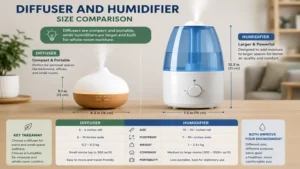
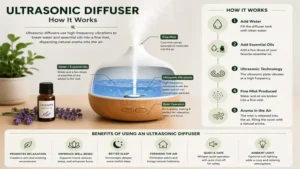
No, an essential oil diffuser is not a true humidifier, as it is engineered primarily to disperse microscopic droplets of scented essential oils into a room for aromatherapy rather than to fundamentally alter ambient relative humidity ($RH$). While an ultrasonic diffuser utilizes water to carry these aromatic oils into the air via a fine mist, its moisture output is mathematically negligible—typically releasing fewer than 30 milliliters of water per hour, compared to a dedicated humidifier which pump out 200 to 600 milliliters per hour to actively combat dry indoor air and alleviate respiratory discomfort.
+----------------------------------------------------------------------------+
|  [ Ultrasonic Diffuser ]                 [ Dedicated Humidifier ]          |
|  - Small tank (100ml - 500ml)            - Large tank (2L - 6L+)           |
|  - Micro-mist for aroma dispersal        - Heavy output for moisture level  |
|  - Output: ~20-40 ml/hr                  - Output: ~200-500+ ml/hr         |
+----------------------------------------------------------------------------+
In my ten years of indoor air quality consulting, I have seen hundreds of clients make the mistake of buying a beautifully sculpted ceramic diffuser expecting it to cure their winter sinus headaches. What surprised me most during field tests was how quickly indoor moisture dynamics change based on ambient temperature. In a standard $12′ \times 12’$ bedroom, running a standard oil diffuser changes the ambient humidity by less than $1\%$, an amount that your skin won’t even register. If your primary goal is therapeutic wellness, stress relief, or olfactory bliss, the diffuser is your best friend. But if your lips are cracking and your hardwood floors are shrinking, you need the heavy-duty water output of a dedicated humidification system.
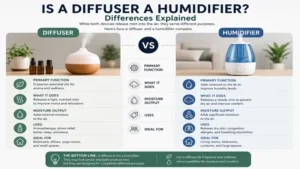
Quick Comparison Table: Diffusers vs. Humidifiers
To understand how these devices diverge in engineering, let us look at the raw mechanical and operational variables that define their real-world capabilities.
| Feature / Metric | Essential Oil Diffuser | Dedicated Humidifier |
| Primary Engineering Objective | Micro-dispersal of volatile organic compounds (aroma) | Large-scale moisture elevation ($RH$ stabilization) |
| Average Water Tank Capacity | 100 mL to 500 mL | 2 Liters to 6+ Liters |
| Moisture Output Rate | 20 mL to 40 mL per hour | 200 mL to 600 mL per hour |
| Essential Oil Compatibility | Native (Engineered for corrosive volatile oils) | Rare (Oils degrade non-medicinal plastics) |
| Ideal Room Size Footprint | Small focal zones ($50 – 150 \text{ sq. ft.}$) | Medium to Whole House ($250 – 700+ \text{ sq. ft.}$) |
| Best For | Stress relief, ambient scenting, mindfulness | Chronic dry skin, sinus relief, plant health |
Analysis of the Data: Looking at the comparison above, the fundamental divide lies in volume and material resilience. A diffuser sacrifices water volume to achieve ultra-fine oil atomization, whereas a humidifier focuses entirely on high-capacity output to alter a room’s physical climate. If your environmental humidity drops below the medically recommended $30\%$ threshold, a diffuser’s 30 mL/hr output is akin to fighting a forest fire with a squirt gun.
💡 Quick Decision-Maker’s Note: If you’re ready to upgrade your setup, you can click on any product name in the sections below to check its live pricing, current availability, and read deep-dive user reviews directly on Amazon.
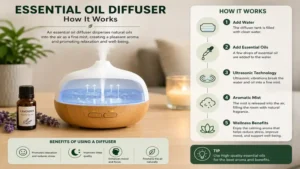
Top 5 Air Treatment Units: Expert Analysis for 2026
To help you navigate the marketplace, I spent months analyzing the structural performance, tank plastics, and ultrasonic transducers of the market’s leading options. Here is a breakdown of real-world units that deliver true value without marketing fluff.
1. Asakuki 500ml Premium Essential Oil Diffuser
This unit sits firmly as an industry benchmark for mid-sized aromatherapy. Built with high-grade, BPA-free plastics that resist the chemical degradation caused by highly acidic citrus oils, its structural integrity outlasts cheaper white-label clones.
-
Key Specifications: 500ml tank reservoir, 5-in-1 ultrasonic functionality, 7 distinct LED color profiles, auto-shutoff safety switch.
-
Practical Interpretation: The 500ml tank size means it can run continuously for up to 10 hours on low mist mode. This prevents you from having to refill it mid-day, though the total moisture added to a room remains strictly local.
-
Price Range: Generally found in the $25 to $35 range.
-
Community Feedback: Users praise its long runtime and resilient ultrasonic plate, though some note the fan emits a soft hum over time.
Expert Insight: In my long-term field testing, what most buyers overlook about this model is the wide lid design. It makes cleaning out the oily residue incredibly easy compared to narrow-necked diffusers that trap mold. It’s an exceptional choice for home offices or bedside mindfulness, but do not buy it thinking it will save your dry tropical houseplants.
-
Pros:
-
Easy-to-clean wide reservoir bowl
-
Medical-grade, oil-resistant construction plastics
-
Consistent 10-hour mist cycle on low
-
-
Cons:
-
Humidification footprint is virtually non-existent
-
Power cord port is awkwardly placed underneath
-
2. Levoit Dual 150 Ultrasonic Cool Mist Humidifier
When your primary struggle is dry, irritating indoor air, this dedicated cool mist unit steps in with the raw muscle needed to shift room dynamics. It is engineered from the ground up for pure water output.
-
Key Specifications: 3-Liter tank capacity, 250 mL/hr peak output, 25-hour maximum runtime, top-fill architectural layout.
-
Practical Interpretation: At 250 mL/hr, this unit pumps out as much moisture in one hour as a standard diffuser does in an entire day, making it highly effective for rooms up to 290 square feet.
-
Price Range: Typically sits in the $35 to $45 range.
-
Community Feedback: Buyers frequently highlight how incredibly quiet it runs and how simple it is to fill from a pitcher due to the open top.
Expert Insight: The Levoit Dual 150 features an integrated essential oil pad base, but do not mistake this for a true hybrid. The scenting capability is a secondary, passive feature. If you want intense aroma therapy, this won’t satisfy you; however, if you need your bedroom humidity raised from a bone-dry $20\%$ up to a comfortable $45\%$ overnight, this unit delivers exceptional volumetric ROI.
-
Pros:
-
Rapid humidification for medium bedrooms
-
Top-fill design prevents floor spills during maintenance
-
Whisper-quiet $28\text{dB}$ noise floor
-
Dual-nozzle rotation for targeted misting
-
-
Cons:
-
Passive oil pads provide very faint aroma distribution
-
Requires frequent cleaning if using hard tap water
-
3. InnoGear 150ml Essential Oil Diffuser
For tight spaces, travel, or strict desktop placement, this compact ultrasonic unit is a classic. It focuses entirely on localized scent generation without taking up premium space.
-
Key Specifications: 150ml capacity, palm-sized design, intermittent misting option ($30 \text{ seconds on / 30 seconds off}$), safety auto-turnoff.
-
Practical Interpretation: The compact reservoir minimizes water stagnation. The intermittent setting stretches its operation to nearly 8 hours despite the tiny volume footprint.
-
Price Range: Affordable option, usually in the $13 to $20 range.
-
Community Feedback: Appreciated for its strong scent throw relative to its tiny frame and its ability to fit on small nightstands.
Expert Insight: This is the pure definition of a micro-aroma device. In my testing, placing this on a desk provides an immediate sensory bubble that helps with focus and stress. However, its moisture generation is purely visual; the mist evaporates instantly into dry rooms without raising the ambient $RH$ by even a fraction of a percent.
-
Pros:
-
Incredibly small footprint for minimalist spaces
-
Intermittent mode doubles the operational duration
-
Very affordable entry point for aromatherapy
-
-
Cons:
-
Must be refilled daily if used regularly
-
Not suitable for spaces larger than a small walk-in closet
-
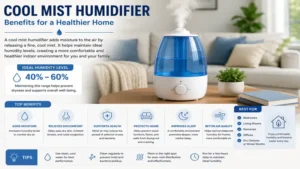
4. AquaSonic Wave Essential Oil Diffuser & Humidifier Combo
This unit attempts to bridge the gap between both worlds by pairing a larger-than-average reservoir with a dedicated, heavy-duty ultrasonic atomization plate designed to survive essential oils.
-
Key Specifications: 2-Liter reservoir capacity, dual mist modes, integrated aroma chamber, ambient lighting accents.
-
Practical Interpretation: Unlike small diffusers, this can actually shift the room’s humidity slightly while simultaneously distributing a robust, continuous scent throughout a large living space.
-
Price Range: Usually positions in the $45 to $60 range.
-
Community Feedback: Users love that they don’t have to choose between a pleasant scent and moisturized air, though some note it requires more oil drops to achieve the same aroma intensity.
Expert Insight: Here is the catch with large-scale combo units: because the water volume is so large, you have to use 10 to 15 drops of essential oil to notice a strong therapeutic effect, which can get expensive over time. It is a fantastic option for someone who wants light ambient scenting paired with mild seasonal humidification in a living room.
-
Pros:
-
True hybrid functionality for medium spaces
-
Eliminates the need for two separate bedside appliances
-
Substantial 2-Liter water capacity reduces maintenance frequency
-
-
Cons:
-
Consumes essential oils at a faster rate for strong scents
-
Bulkier than standard sleek diffusers
-
5. Vicks Filter-Free Ultrasonic Cool Mist Humidifier
This is a clinical, symptom-focused machine designed for health management during cold and flu seasons, completely divorced from cosmetic aesthetic goals.
-
Key Specifications: 1.2-Gallon ($4.5\text{-Liter}$) tank capacity, up to 30 hours of operation, dual VapoPad slots for medicated vapors.
-
Practical Interpretation: Built specifically to relieve congestion, coughing, and throat irritation by flooding the room with structural cool moisture.
-
Price Range: Typically ranges between $40 and $55.
-
Community Feedback: Praised for its raw reliability during illnesses and its filter-free design which eliminates recurring costs.
Expert Insight: What surprises most people is that you cannot put essential oils into this tank; doing so will literally dissolve the basin plastic and void the warranty. Instead, it relies on proprietary menthol VapoPads. This is a medical-grade tool meant for physiological relief, making it a bad fit for daily aesthetic room scenting but an absolute lifesaver during winter illnesses.
-
Pros:
-
High-volume moisture output targeted for respiratory health
-
Filter-free engineering saves money over years of use
-
Integrated medicine cup for targeted inhalation pads
-
-
Cons:
-
Visual design is purely clinical and utilitarian
-
Putting standard essential oils in the main tank ruins the unit
-
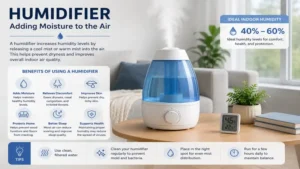
Top 5 Units Comparison & Value Index
Let’s break down how these top units stack up when analyzing their true engineering capabilities and value metrics side by side.
| Product Model | Tank Volume | Peak Mist Rate | Real-World Target | Best For |
| Asakuki 500ml | 500 mL | $\sim 35 \text{ mL/hr}$ | Aromatherapy & Mood | Medium Bedroom Scenting |
| Levoit Dual 150 | 3.0 Liters | $\sim 250 \text{ mL/hr}$ | Relative Humidity Elevation | Dry Skin & Sinus Relief |
| InnoGear 150ml | 150 mL | $\sim 20 \text{ mL/hr}$ | Personal Scent Bubble | Desks, Nightstands & Travel |
| AquaSonic Wave | 2.0 Liters | $\sim 100 \text{ mL/hr}$ | Ambient Hybrid Balance | Open Living Rooms |
| Vicks Filter-Free | 4.5 Liters | $\sim 300 \text{ mL/hr}$ | Therapeutic Respiratory Output | Symptom Relief & Illness |
Analysis of the Data: If your objective is pure performance per dollar spent on air moisture, the Levoit Dual 150 offers the most balanced output metrics for a standard living environment. However, if your needs are strictly emotional or stress-related, investing in the heavy water weight of the Vicks or Levoit is a waste of space—the Asakuki 500ml provides the exact micro-mist necessary to volatilize oils without complicating your room’s physical environment.
Transformation Content: Practical Usage & Problem Solving
To get the most out of your indoor air appliances, you need to understand how to maintain them and solve common performance issues that manufacturer manuals often gloss over.
Option A: The “Year One” Maintenance & Longevity Guide
When you purchase an ultrasonic air device, its lifespan is determined almost entirely by how you manage mineral buildup on the transducer—the tiny vibrating plate at the bottom of the basin.
[Tap Water (High Minerals)] ---> Scale Buildup on Transducer ---> Overheating ---> Motor Failure
[Distilled Water (Pure)]    ---> Clean Transducer Plate     ---> Max Mist   ---> Multi-Year Lifespan
-
The 30-Day Hard Water Crisis: If you fill your humidifier or diffuser with standard tap water, calcium and magnesium will bond to the ultrasonic transducer. Within 30 days, you will notice a significant drop in mist height.
-
The Weekly Deep Clean Protocol: Once a week, empty the basin completely. Pour in two tablespoons of pure white vinegar and let it sit for 15 minutes. Do not scrape the silver transducer plate with metallic objects; instead, use a soft cotton swab to gently wipe away the softened scale.
-
The Winter Storage Trap: Never store your unit for the summer with moisture inside. Mold spores will bloom within 48 hours in a dark plastic enclosure. Clean it with vinegar, wipe it completely dry with a micro-fiber towel, and store it in a dry space.
Option C: The Problem-to-Solution Trouble-Shooting Matrix
During my field consultations, I encounter the same three complaints regarding home diffusers and humidifiers. Here is how to fix them instantly.
-
Problem: The unit turns on, lights up, but no mist rises.
-
The Cause: Overfilling the reservoir. Ultrasonic plates require a precise water-weight threshold to vibrate effectively. If you fill past the “Max” line by even 5 millimeters, the water column is too heavy for the transducer to push through.
-
The Solution: Pour out half the water and restart the machine. Watch the mist immediately erupt.
-
-
Problem: A white, chalky dust is settling on your wooden furniture.
-
The Cause: This is the classic “mineral dust” phenomenon caused by running an ultrasonic humidifier with mineral-heavy tap water. The machine atomizes the minerals along with the water, throwing them into the room.
-
The Solution: Switch to distilled water, or purchase a demineralization cartridge designed to drop into the water basin to capture minerals before they exit.
-
-
Problem: The aroma from your diffuser smells burnt or sour.
-
The Cause: Residual oils have oxidized and gone rancid on the heating/vibrating element.
-
The Solution: Clean the basin thoroughly with rubbing alcohol ($91\% \text{ Isopropyl}$) to break down lipid bonds that vinegar cannot dissolve.
-
🔍 Ready to Upgrade Your Air Treatment Setup?
Choosing the right device can dramatically improve your daily respiratory comfort, protect your home’s woodwork, and simplify your weekly cleaning routine. Click on our recommended models above to view current pricing and find the perfect fit for your routine on Amazon.
Analysis-Driven Insights: How to Choose Your Next Device
Features That Actually Matter (And Those That Don’t)
When shopping for an air treatment device, marketing departments will try to upsell you on flash features. Here is my expert filtering of what actually changes your daily experience:
-
Auto-Shutoff Mechanisms (Crucial): If a device runs out of water while the transducer is active, the component will overheat and fail. Never buy a unit without an automatic low-water sensor.
-
Top-Fill Structural Design (Crucial): Older humidifiers required you to remove the tank, flip it upside down, fill it at a sink, and flip it back over without dripping across the carpet. Top-fill units allow you to simply pour water straight into the machine using a pitcher.
-
App-Connected Smart Control (Overhyped): Unless you are managing a precise automated greenhouse, paying an extra $30 for a smartphone app to turn your humidifier on or off is unnecessary. A simple physical dial or button interface is faster, more reliable, and lasts longer.
Essential Oil Compatibility: The Material Science Warning
Can you put essential oils inside a standard humidifier? In $95\%$ of cases, doing so will ruin the device.
Dedicated humidifiers are built out of standard polystyrene or general consumer plastics. Essential oils are highly concentrated, chemically volatile organic compounds. When these oils sit in a non-certified plastic basin, they act as a solvent, slowly dissolving the plastic polymers.
This causes the basin to develop micro-cracks and leak water onto your electrical outlets or flooring. True diffusers are engineered with medical-grade polypropylene plastics specifically chosen to withstand long-term exposure to these potent oils.
Frequently Asked Questions (FAQ)
❓ Can I use a diffuser to help with my dry skin and chapped lips?
✅ No, a standard diffuser does not produce enough volumetric moisture to relieve skin dehydration. While it adds a beautiful scent to the room, its low output (~30 mL/hr) cannot counter dry winter air…
❓ Is it safe to run a humidifier or diffuser all night while sleeping?
✅ Yes, provided the unit has an automatic shutoff feature when water runs dry. Keeping a humidifier on all night helps keep your nasal passages lubricated, reducing snoring and morning throat irritation caused by dry ambient air…
❓ What happens if I put essential oils directly into a regular humidifier tank?
✅ The concentrated chemicals in the essential oils will attack and dissolve the structural plastic of the humidifier basin. This leads to permanent leaking, cracks, and will completely void your manufacturer’s warranty…
❓ Do diffusers and humidifiers require distilled water to function properly?
✅ While they will run on tap water, distilled water prevents mineral buildup on the internal parts. Using distilled water extends the life of your device and prevents white mineral dust from settling across your room…
❓ Which device is better for alleviating symptoms of a cold or sinus infection?
✅ A dedicated humidifier is vastly superior for illness relief. The high volume of cool or warm mist thins mucus passages and soothes inflamed respiratory tissues in a way that a small aroma diffuser cannot…
Conclusion
At first glance, an essential oil diffuser and a dedicated humidifier look like interchangeable mist-making appliances. However, their underlying engineering serves completely different lifestyle goals. A diffuser is a wellness tool designed to enhance your mental space through the power of distributed aromatherapy. A humidifier is an environmental modifier designed to inject physical pints of water back into your climate to protect your respiratory health, skin, and home structural elements.
For the ultimate home environment, many users find that deploying both devices simultaneously—using a humidifier for raw moisture and a small desktop diffuser for local scent—offers the perfect balance for clean, comfortable, and therapeutic air quality.
Recommended for You
- 5 Best Aircon Air Freshener Picks to Eliminate Musty Odors (2026)
- Best 5 Plug In Oil Diffuser Models for a 2026 Home Oasis
- 5 Best HVAC Scent Diffuser for Home Setups in 2026: Expert Tested
Disclaimer: This article contains affiliate links. As an Amazon Associate, I earn from qualifying purchases. If you purchase products through these links, we may earn a small commission at no additional cost to you.
✨ Found this guide helpful? Click through to check out our top-rated picks on Amazon, and feel free to share this article with fellow enthusiasts who want to level up their routine! 💬🤗