
In This Article
As an Amazon Associate I earn from qualifying purchases. Links in this article may be affiliate links. How we choose products
A 2,000-square-foot house with one furnace and a thermostat fan set to Auto is a different job for an hvac scent machine than a dining room with its own air handler and a front door that opens all evening. Both jobs are sold under the same phrase, whole-space scenting, yet the units differ in tank size, in how they tie into ductwork and in how long a refill lasts. For 2027, the five units below cover a budget house, an app-scheduled home, a smaller loft, a restaurant or shop, and a hotel-style lobby.
Maker manuals, retailer listings, owner reviews and forum threads supply the figures, and each claim carries its source. Two facts hold for every unit: scent travels only while air moves through the ducts, and a tank rated for a month or a year depends entirely on the intensity setting. A forced-air home is well served by the Nēbu Whole House HVAC Scent Diffuser, the VEVOR HVAC Scent Diffuser 180ML is the cheap way in, and a dining room or shop is better matched to the Aroma Retail Scent Machine Pro. The Aroma360 VanGogh360 and Aroma360 Museum360 cover the small-home and lobby ends.
Fan runtime, zones, oil and coverage ratings decide the right hvac scent machine
Fan runtime comes first. Hotel Collection’s setup page says the thermostat fan must be on for fragrance to circulate, and that the fan can run without any heating or cooling. Nēbu’s page states the same condition: scent moves only while the HVAC fan runs. A poster on the Tiger Droppings forum describes the units as potent yet noticeable only when the HVAC moves air. A house whose fan runs only when the furnace calls for heat therefore gets scent in bursts, which is why Aroma Retail’s guide tells owners with a cycling fan to add an air switch.
Coverage ratings are ceilings. Aroma360’s commercial guide rates its units from 600 square feet to 6,000 and says ceiling height, airflow and traffic matter as much as floor area. Its home guide rates the VanGogh360 at 1,800 square feet yet suggests it for a 2,500-square-foot loft, so the lower number is the safer one to plan around. Forum posters on Tiger Droppings report mixed results: one ran about three app-controlled units on low for roughly 3,200 square feet, another said a single unit covered 4,000 square feet and was strong enough that a spouse turned it off, and a third called a unit parked near an air intake on low very subtle. Each is a single report, and together they show that placement and setting count as much as the rating.
Zones are the third filter. Aroma Retail’s store page says a home or business with several air handlers needs one machine per handler, and Aroma360’s commercial guide gives the same one-diffuser-per-zone rule, adding that one unit cannot scent a whole building unless the zones share a return plenum, which the guide calls rare.
Oil compatibility splits the makers. Aroma360 warns that incompatible oils can clog the atomizer and says to use its own cold-air oils, while Aroma Retail says its machine accepts all fragrance oils. Both statements are maker claims, so the manual for the exact unit decides which oil goes in the tank.
Air quality belongs on the shortlist too. The EPA’s page on volatile organic compounds lists air fresheners among household sources of these compounds, which is one reason every maker tells buyers to start low.
How the five units compare on coverage, tank and controls
| Pick | Listed coverage | Oil tank | Duct hookup | Standout detail |
|---|---|---|---|---|
| VEVOR HVAC Scent Diffuser 180ML | 2,000 sq ft | 180 ml | HVAC-labeled unit | 45 dB, 5 W |
| Nēbu Whole House HVAC Scent Diffuser | 3,000 sq ft on HVAC; 1,500 standalone | 200 ml | Hose and fittings included | 20 levels, 5 weekly schedules |
| Aroma360 VanGogh360 | 1,800 sq ft | 500 ml bottle | Tubing included; standalone possible | Maker support and oil line |
| Aroma Retail Scent Machine Pro | 10,000 sq ft | 27 oz (800 ml) | HVAC hose and adapter included | 9 levels, 5 events, Wi-Fi app |
| Aroma360 Museum360 | 3,000 sq ft | 500 ml bottle | HVAC only | Lobby use listed by the maker |
Tank size and coverage do not move together. The Aroma Retail Scent Machine Pro carries four times the Nēbu Whole House HVAC Scent Diffuser tank for more than three times the listed coverage, while the VEVOR HVAC Scent Diffuser 180ML has the smallest tank in the group. A small tank is not a flaw by itself, only a shorter wait between refills, and the intensity setting moves that wait more than the tank does.
Five units matched to a budget house, a smart home, a loft, a dining room and a lobby
1. VEVOR HVAC Scent Diffuser 180ML — budget coverage for a modest house
Entry-level money buys a 180 ml tank and a 2,000-square-foot rating. Newegg’s listing for item model A311 shows around $70 to $90 through a third-party seller, and the spec table lists a stainless steel and glass body, 45 dB of noise, a 5-watt draw and an atomization rate from 0.05 to 1.01 grams per hour.
Those last figures decide how long a tank lasts. Sample calculation, assuming fragrance oil weighs about 0.9 grams per milliliter: 180 ml is roughly 162 grams, which is about 160 hours at the top rate, or around 20 days at eight hours a day, and far longer at low settings. At 5 watts around the clock, the unit draws about 0.12 kilowatt-hours a day.
The 850 ml VEVOR sold at Lowe’s is a different product with a 5,000-square-foot rating, so match the model number on the Amazon page before ordering. Thewearify’s affiliate roundup lists the 180 ml version among its budget-minded options. The Newegg spec table says nothing about duct fittings or an app, while the Nēbu and Aroma Retail kits both list a hose, so confirm the hose and connector are in the box.
Pros:
- Lowest entry cost among the five units
- 45 dB rating and a 5-watt draw
Cons:
- The spec table names no app or duct hardware
- The smallest tank of the five at 180 ml
2. Nēbu Whole House HVAC Scent Diffuser — app schedules for a forced-air home
Scheduling is the reason to look at this one. The maker lists up to five weekly schedules set by day in a Bluetooth app, 20 intensity levels and a keypad on the unit, with a 200 ml tank and a 3,000-square-foot rating when installed in the HVAC system. Without ductwork it drops to 1,500 square feet as a standalone in an open room.
The kit includes fittings and a hose that connect to the ductwork or plenum, and the maker’s FAQ puts installation at about 20 to 30 minutes without a technician. It needs a standard outlet near the duct and a central forced-air system. The maker also offers a 180-day return window with free U.S. returns.
Running cost is where the maker’s own pages disagree. One section says a bottle lasts about 45 days at medium intensity, another says the unit uses about 200 ml a month, and a setup tip mentions 250 ml lasting up to 45 days. With a 200 ml tank, plan on a refill every month or six weeks. Price pages disagree as well, showing sale prices from around $225 to $315 against a much higher crossed-out figure, so confirm the number at checkout. Check the current price on Amazon.com.
3. Aroma360 VanGogh360 — smaller homes with a standalone fallback
Coverage is the limit here: 1,800 square feet, per the maker. What it adds is flexibility, since Aroma360’s guide describes it as working either standalone or tied into HVAC, with a 500 ml oil bottle and a plug for any standard 110-volt outlet. For a loft or a two-bedroom home, that means the machine can sit on a shelf near the return grille first and move into the ducts later.
Aroma360’s guide says most homeowners finish the duct hookup in under an hour and advises starting on low intensity, then allowing a few days to adjust. Upkeep is part of the deal: the guide recommends checking oil weekly or every other week, cleaning the tubing every two to three months, and flushing with isopropyl alcohol when switching scents so fragrances do not mix. Its troubleshooting advice for a weak scent is to raise intensity or check the oil, and for a dead unit to check the outlet and connections.
The maker’s home FAQ estimates oil spending at $30 to $80 a month, a range that depends on intensity and hours. Check the current price on Amazon.com.
4. Aroma Retail Scent Machine Pro — dining rooms, shops and large floors
A restaurant owner or shopkeeper looking at the Aroma Retail Scent Machine Pro is buying the largest rating in this group: up to 10,000 square feet, with a 27-ounce bottle, a Wi-Fi app and a kit that includes an HVAC hose and adapter. The maker rates it at 0 dB when ported into HVAC and 45 dB from nine feet away as a freestanding unit. Between Sam’s Club and the maker’s own store, pages show prices from roughly $580 to $800.
The control scheme explains the price. Nine intensity levels run from L1 (3 seconds of spraying, 160 seconds of pause) to L9 (80 seconds on, 20 off), and five Events set the days and hours, with Event 1 overriding Event 2 and so on. The default is Level 3, spraying 15 seconds then pausing 60, from 8:30 a.m. to 8:30 p.m. Aroma Retail’s guide says a bottle lasts about a year at L1 and about two weeks at L9 when run 12 hours a day.
Owner feedback is split on cost and software. One Sam’s Club reviewer who has used it for several years says the oil runs out faster than the page’s estimate and cost about $200 per quarter for a 4,000-square-foot store, and another reports the app crashing when opening the schedule, which the brand says it is improving. A listing with 215 reviews shows about 4.0 out of 5, while a separate listing shows 4.8 from four ratings, so the larger count is the steadier guide.
Pros:
- Largest coverage rating and tank of the five
- Nine intensity levels and five schedulable Events
- Hose and adapter included for duct hookup
Cons:
- Oil can run through faster than the estimate at higher levels
- App reliability complaints from at least one reviewer
5. Aroma360 Museum360 — lobby and multi-floor HVAC coverage
Hotel lobbies appear in the maker’s own list of uses for the Aroma360 Museum360, which is built to connect to HVAC only and is rated for up to 3,000 square feet with a 500 ml oil bottle. Without a duct to tap, it is the wrong choice, because nothing in the maker’s material describes a freestanding mode.
Cost expectations are spelled out in Aroma360’s commercial guide: oil for this unit runs about $70 to $179 a month at six to eight hours a day, electricity about $2 to $5, and HVAC integration anywhere from $0 to $1,500 depending on the building. The same guide says commercial integration usually needs a professional and permits in most jurisdictions, and that one unit cannot cover several zones unless they share a return plenum.
An owner with one air handler and a single lobby fits this machine neatly; a building with a separate handler per floor needs one unit per handler, and the oil bills multiply accordingly.
How to install an HVAC scent diffuser on a forced-air system
Makers’ instructions agree on the outline, even where they differ on the details.
- Find the air handler and check the thermostat fan setting. The fan needs to be on for scent to move, and Aroma Retail says to connect to ventilation only if the fan runs constantly during operation, otherwise adding an air switch.
- Turn the HVAC off before touching the duct. Hotel Collection’s setup guide lists this as the first step, along with choosing a location.
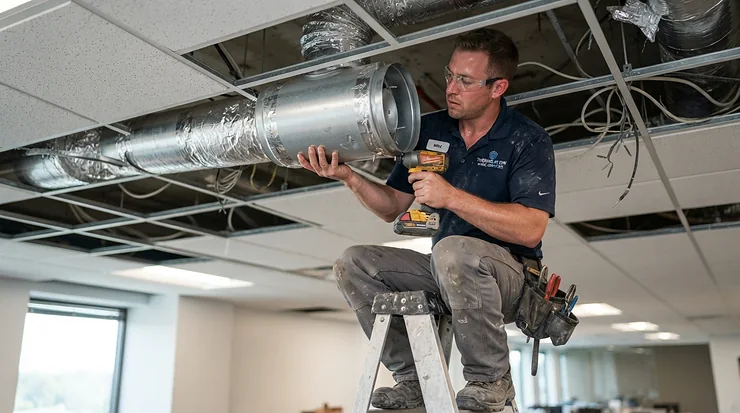
- Pick the tap point. Aroma Retail ranks the duct between the heating and cooling unit and the room delivery first, then the duct between intake and fan, then inside the intake between filter and fan. Hotel Collection says to place the tubing on the supply side, after the return and filter.
- Mount the unit upright near the duct and within reach of a standard outlet. Aroma Retail warns that oil spills if the machine is tilted.
- Make the hole. Aroma Retail calls for a half-inch hole with a grommet, and Hotel Collection says to use a screwdriver for a small hole but names no size.
- Fit the HVAC connector in place of the unit’s nozzle, then cut the tubing to length. Aroma Retail says to keep it to four feet or less, sloping upward toward the duct; Nēbu says to avoid loops that trap condensation; Hotel Collection says the tubing should enter at 90 degrees and run straight.
- Insert no more than an inch of tubing into the duct, per Hotel Collection, and seal it with HVAC tape.
- Restore power, run the machine on low, and check that the fan is cycling when the diffuser sprays.
Makers disagree on one point. Aroma360’s home guide describes connecting to the return duct with included tubing, while Hotel Collection and Aroma Retail point to the supply side or between filter and fan. Follow the manual that ships with the exact unit, and ask an HVAC installer when the system is a split, window or multi-zone type, since Hotel Collection says those can be harder to connect.
How to connect an HVAC scent diffuser to the duct and the app
The duct connection is mechanical, and the app connection is a separate job with its own pitfalls. For the Aroma Retail machine, the guide gives a sequence:
- Create an account in the app and choose Add a device.
- On the machine, press MENU, scroll to Wi-Fi Reset and confirm, then look for the antenna symbol.
- Join the machine’s own AROMA network in the phone’s Wi-Fi settings, return to the app and tap Next.
- Select the home Wi-Fi, enter the password, then switch the phone back to its regular network.
- Keep the phone and the machine on the same network for the first settings change; remote control works afterward.
The guide also notes that app settings override machine settings, so resetting Events at the machine does not undo an app schedule, and that the scatter fan should be turned off once the unit is ported into ductwork. The Nēbu Whole House HVAC Scent Diffuser offers a Bluetooth app or a keypad, which gives a fallback when the phone link drops.
Bluetooth reliability varies by brand. Desertcart reviewers of the JCLOUD Smart Scent Air Machine Pro, a 500 ml, 4,500-square-foot unit, report inconsistent Bluetooth control, an app that failed to connect for one buyer, and confusing device names because several brands appear to share the same software. Treat those reports as a reason to read the app’s name on the box before downloading anything.
How to use an HVAC scent diffuser day to day without wasting oil
Start on the lowest setting. Aroma360 advises low intensity for the first days, and the Tiger Droppings posters who ran units on low in a house found them subtle to potent depending on placement. Raise one level at a time.
Match the schedule to the fan. Aroma360’s guide says to run diffusion while heating or cooling cycles run, and Hotel Collection notes that warm air makes scent slightly stronger. One Desertcart buyer reports running a unit from 5 p.m. to midnight and noticing the whole house smell the moment it kicked on, which suits an evening routine.
Shut the machine down with the HVAC. Hotel Collection says to turn the diffuser off or unplug it when the system is fully off.
Watch for buildup. A ShopSavvy review summary for a 3,500-square-foot smart scent machine flags that running it continuously before winter heating may leave oil residue in the ducts and produce scented smoke when the heat starts. If the nozzle whistles or clogs, Aroma Retail’s guide says to rinse the bottle with rubbing alcohol, then run the machine on alcohol for a few cycles.
What does interval mean on scent machines?
Interval is the repeating cycle of work time, when the machine atomizes oil, and pause time, when it rests. Brands split that cycle differently, so the same word can mean different things.
- Aroma Retail uses nine Levels. L1 sprays for 3 seconds then pauses 160, under 2 percent of the time; L9 sprays 80 seconds then pauses 20, 80 percent of the time.
- ScentAir’s help page describes Low as 40-second runs totaling 10 minutes per hour, Medium as 1 minute 20 seconds totaling 20 minutes, and High as 2 minutes totaling 30 minutes.
- Mood Media’s Scent Splash manual gives work times of 3 to 10 seconds and pause times of 2 to 15 minutes.
- Aroma360’s Mini360 manual allows work times from 5 to 300 seconds and recommends 15 seconds as the lowest, so the diffuser has time to pull oil.
On Mood Media’s ScentWave, the manual uses AUTO INTERVAL for fan timing instead: 15, 60 or 180 seconds on and off, with a default of 60 and 60, and a suggestion to start there and adjust after an hour. The same manual warns that Continuous mode drastically shortens cartridge and system life. Mood Media’s support page repeats the point for cartridge machines run more than 10 hours a day.
Intervals interact with the fan. A long pause on a system whose fan cycles off with the thermostat can drop all the work time into still air, which is the situation Aroma Retail’s air switch addresses.
Restaurant scent machines: matching a commercial scent machine to the dining room
The hardware for a restaurant is the same cold-air nebulizer sold for homes, and the differences are the zone, the fragrance and the oversight. A dining room with its own air handler counts as its own zone, so Aroma Retail’s one-machine-per-handler rule applies, and Aroma360’s guide lists separate dining-room HVAC among its multi-zone examples. Where no ductwork can be tapped, the guide recommends a standalone unit within 3 to 5 feet of the return air grille.
Fragrance choice carries more weight than in a home. Mood Media’s restaurant page talks about custom fragrances that fit the brand and the aromas already in the room, and Aromatech pitches food-scent systems as a way to promote food sales. Both are seller claims, and neither is a measured result. A kitchen already fills the dining room with its own smells, so the sensible reading is a light scent at a low interval that avoids competing with the menu.
A scent marketing machine is this same hardware sold with a program. Mood Media describes scent marketing as the strategic use of custom fragrances to influence mood, perception and behavior in a commercial space, and ScentAir says cost depends on the space, the diffusion system, the number of locations and the length of the agreement. Aroma360 puts equipment at $200 to $2,000 retail, with oil as the main recurring cost, and warns never to scent clinical areas.
Lobby HVAC scent cartridges versus a refillable oil tank
Cartridge systems and refillable tanks answer different questions. A tank lets the owner buy oil when needed. A cartridge system hands refills, scent library and often installation to a vendor.
ScentAir’s Stream is a representative cartridge system: its page says the unit releases fragrance through existing HVAC, covers over 3,000 square feet, uses easy-change cartridges, comes with a full-service warranty and is installed by ScentAir, with cartridge replacement customized to the space and settings. ScentBeat’s HVAC model, per a Ferguson listing, is aimed at hotel lobbies, retail stores, building entrances and health care facilities, includes an anti-tampering SafeLock and works only with ScentBeat 850 ml cartridges.
The trade is control against convenience. A proprietary cartridge locks the buyer into one supplier’s scents, while a refillable tank such as the Aroma360 Museum360 or Aroma Retail Scent Machine Pro accepts oils chosen by the owner, within each maker’s compatibility warnings. Cartridge programs push the work of ordering, swapping and scent selection to the vendor, which suits a property manager with no one to check oil levels.
Roof-mounted air handlers add a wrinkle: a Fineeng article on Prolitec installations notes that liquid fragrance in the cartridges must be kept from freezing. Cold entrances dilute scent fastest, so a lobby by a revolving door may need a higher setting than the same lobby’s corridor.
Duct, filter and fragrance concerns worth weighing first
Not every home should put fragrance through its ducts. An Environmental Health Perspectives report from 2011 noted that the Consumer Product Safety Commission does not require manufacturers to disclose ingredients on air fresheners, including fragrances, which means the oil’s contents are the maker’s word.
Forum posters on Tiger Droppings raised their own worries: one warned that essential oils can discolor paint near vents and that chemical scents may shorten coil life, another that liquid in the airflow could clog the filter, and a third that heavily scented homes give them migraines. Each is one poster’s claim and none is documented in a manual.
Fire risk comes up in a different setting. A Hunker article on a viral hack of dabbing oils on felt pads inside ducts cites critics who warn that flammable materials in heat ducts are a hazard, and it recommends a proper diffuser instead. Aroma360 draws the same line from the machine side, saying some heated fragrance oils can be flammable and that cold-air units add no heat.
A sensible order of operations: ask the HVAC installer whether the system’s warranty has conditions, start at the lowest setting, keep the unit away from bedrooms if anyone is sensitive, and consult a doctor or vet when asthma or pets are in the picture.
Oil cost, install time and interval settings in short answers
How much does it cost to run an HVAC scent machine?
Can you install an HVAC scent diffuser yourself?
Does an HVAC scent machine work when the fan is off?
What does interval mean on scent machines?
Are HVAC scent machines safe for people with sensitivities?
Pick the hvac scent machine that matches your air handler
Start with the air handler. A forced-air home with the fan on a schedule suits the Nēbu Whole House HVAC Scent Diffuser, a modest budget points to the VEVOR HVAC Scent Diffuser 180ML, and a loft under 1,800 square feet can take the Aroma360 VanGogh360 in either mode. A dining room or shop moves the choice to the Aroma Retail Scent Machine Pro, a duct-fed lobby to the Aroma360 Museum360, and cartridge services such as ScentAir’s suit owners who want a vendor to handle refills.
Whatever the building, the right hvac scent machine is the one whose hose route, fan schedule and interval setting fit the air handler it will serve. Spotted one you like? Take a closer look at its listing before you decide.
Recommended for You
- 7 Best hvac scent diffuser Systems of 2026: Scent Your Whole Home
- 5 Best HVAC Scent Diffuser for Home Setups in 2026
- Commercial Scent Machines: 7 Best Picks Compared (2026)
A straight hose, a fan that runs on schedule and a low first setting matter more than any coverage number on the box.