
In This Article
Introduction: Why Your Business Smells Like Something (Whether You Planned It or Not)
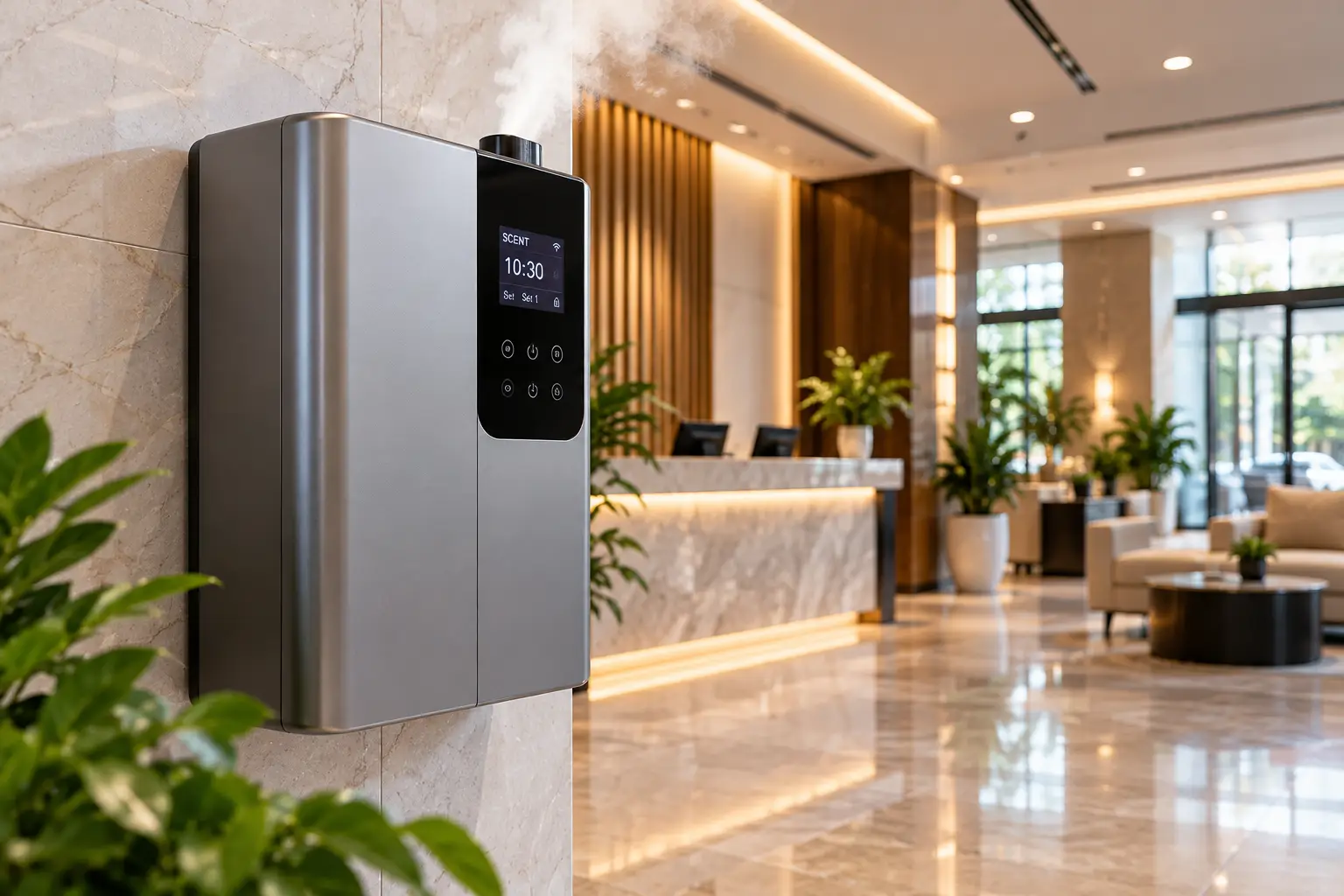
Walk into a boutique hotel lobby and you notice the scent before you notice the furniture. That’s not luck. It’s a commercial scent machine quietly doing its job behind a panel or tucked into the ductwork. Meanwhile, the gym down the street smells like… well, a gym. Every space communicates through smell, and the only question is whether you control the message.
What Is a Commercial Scent Machine?
A commercial scent machine is an electric diffuser that turns fragrance oil into a dry, ultra-fine mist using cold-air (nebulizing) technology, then spreads it evenly across a large space, either standing alone or connected to an HVAC system. Unlike candles or plug-ins, it runs on programmable schedules and adjustable intensity.
Businesses aren’t buying these on a whim. According to Shopify’s overview of scent marketing, the commercial scent marketing machine market is valued at roughly $825 million and is projected to grow at around 8% a year through 2033. Hotels, retailers, dental offices, gyms, and car dealerships have all figured out that ambient scenting shapes how long people linger and how they remember a visit.
The catch? The market is crowded. You’ll find enterprise systems that cost as much as a used car sitting next to $100 units from brands you’ve never heard of, all promising “6,000 sq ft coverage.” This guide cuts through that. We compared real spec sheets, read through aggregated customer feedback, and translated the marketing numbers into what they mean for an actual lobby, retail floor, or office suite. You’ll also find setup guidance, troubleshooting fixes, and a frank look at running costs, because the machine is only half the bill.
Quick Comparison: The 7 Best Commercial Scent Machines at a Glance
| Product | Claimed Coverage | Oil Capacity | Control | Price Range | Best For |
|---|---|---|---|---|---|
| AromaTech AromaPro BT | Up to 4,000 sq ft | 500 ml | Bluetooth app | $650–$950 | AromaTech AromaPro BT: established brands wanting proven reliability |
| Revesien HVAC Scent Diffuser | Up to 6,000 sq ft | 1,000 ml | WiFi + touchscreen | $130–$250 | Revesien HVAC Scent Diffuser: large spaces on a budget |
| ZORALM HVAC Scent Diffuser Pro | Up to 6,000 sq ft | 1,000 ml | WiFi app | Around $240 | ZORALM HVAC Scent Diffuser Pro: buyers who want oils in the box |
| Aromadd G-Air 1500ml | Up to 4,000 sq ft | 1,500 ml | Bluetooth/WiFi + touchscreen | $200–$400 | Aromadd G-Air 1500ml: lobbies that want a visible design piece |
| FYNTRA HVAC Diffuser | Up to 5,500 sq ft | 500 ml | WiFi + Bluetooth | $100–$250 | FYNTRA HVAC Diffuser: managers who adjust settings remotely |
| Aromadd Dual-Scent 2000 Sq Ft Diffuser | 1,500–2,000 sq ft | 2 × 200 ml | App + button | Around $100 | Aromadd Dual-Scent 2000 Sq Ft Diffuser: seasonal scent rotation |
| Airversa Smart Scent Air Machine | Up to 2,000 sq ft | Varies by kit | App | Under $150 | Airversa Smart Scent Air Machine: small shops and studios |
Looking at the table, the first thing that jumps out is how little price tracks with claimed coverage. The Revesien HVAC Scent Diffuser and ZORALM HVAC Scent Diffuser Pro promise 50% more square footage than the AromaTech AromaPro BT at a fraction of the cost, but those figures are manufacturer claims, and budget brands tend to rate generously. Treat coverage as a ceiling, not a guarantee, and use oil capacity plus control features as your more reliable tie-breakers.
💬 One click helps other shoppers make an informed choice too! 😊
Top 7 Commercial Scent Machines: Expert Analysis
1. AromaTech AromaPro BT — the pro-grade benchmark
The AromaTech AromaPro BT is the machine budget brands quietly benchmark against, from a company that has built scenting systems since 2009.
It uses nebulizing cold-air diffusion rated for 500 to 4,000 sq ft, holds a 500 ml bottle, and now adds Bluetooth scheduling and intensity control. In practice, that 500 ml reservoir means a mid-sized boutique running eight to ten hours a day at moderate intensity can go weeks between refills. It mounts on a wall, stands freely, or connects to HVAC, and runs on 110–240V, so a franchise operating internationally can standardize on one model.
Based on comparing the specs, this is the pick for businesses where scent is part of the brand, think boutique hotels and high-end retail, and where a dead diffuser on a Saturday is unacceptable. The trade-off is lock-in: AromaTech states the unit is designed to accept only its own bottles, so your ongoing oil spend runs through one supplier.
Aggregated feedback on AromaTech’s own store is strongly positive, with recurring praise for quiet running; keep in mind that brand-hosted reviews tend to skew favorable.
Pros:
- ✅ Established brand with long commercial track record
- ✅ Three install options: wall, standalone, or HVAC
- ✅ Dual-voltage power suits multi-location operators
Cons:
- ❌ Proprietary bottles limit your oil choices
- ❌ Costs several times more than generic rivals
At roughly $650–$950 depending on promotions (check current price, since Amazon listings may differ), it’s an investment that pays off mainly for brand-sensitive businesses.
2. Revesien HVAC Scent Diffuser — biggest tank for the money
The Revesien HVAC Scent Diffuser delivers the kind of reservoir size you’d normally pay much more for.
It pairs a 1,000 ml tank with a claimed 6,000 sq ft coverage, WiFi app control, an onboard touchscreen, and a corrosion-resistant metal housing. That tank size is the real story: double the AromaPro’s capacity means fewer refill visits, which matters when the person refilling it is a busy shift manager, not a dedicated facilities team. The metal shell also tolerates humid spots like spa locker rooms better than plastic units.
Here’s what to weigh: the 6,000 sq ft figure assumes HVAC distribution and open airflow. Standing alone in a single room, expect far less reach. It’s a strong fit for gyms, salons, and mid-sized offices that want long run times without enterprise pricing.
We couldn’t verify a large independent review base for this model; third-party roundups consistently highlight its capacity and app control, but long-term reliability data is thin, so register the warranty on day one.
Pros:
- ✅ 1,000 ml tank stretches time between refills
- ✅ WiFi plus touchscreen gives flexible control
- ✅ Metal housing handles humid environments well
Cons:
- ❌ Coverage claim depends heavily on HVAC airflow
- ❌ Limited long-term reliability data available
In the $130–$250 range at the time of writing, it offers outstanding capacity per dollar.
3. ZORALM HVAC Scent Diffuser Pro — kit with oils included
The ZORALM HVAC Scent Diffuser Pro removes the “what do I put in it?” problem by shipping with two 100 ml oils.
Specs mirror the Revesien closely: 1,000 ml tank, cold-air diffusion, WiFi app, a claimed 6,000 sq ft, and an HVAC tube in the box. The differentiator is a built-in fan that pushes mist outward instead of relying only on pump pressure. On paper, that means better reach when the unit stands alone, since the fan does some of the work your ductwork would otherwise do.
Who’s it for? A new business owner testing scent marketing for the first time. Having two oils included lets you trial a pair of scents for a few weeks each before committing to bulk fragrance orders. It’s also a sensible pick for event venues that rearrange rooms often.
The review base is modest, around a hundred ratings on listings we found, averaging in the low four-star range at the time of research, so it’s promising but not yet battle-tested at scale.
Pros:
- ✅ Two starter oils let you test scents immediately
- ✅ Built-in fan improves standalone dispersion
- ✅ HVAC tubing included for duct connection
Cons:
- ❌ Smaller review base than established brands
- ❌ Included oils may not suit every brand identity
At around $240 (prices may vary), the bundled oils make it solid value for first-time buyers.
4. Aromadd G-Air 1500ml — floor-standing lobby statement
The Aromadd G-Air 1500ml is the one you show off rather than hide.
It’s a 25.6-inch floor-standing tower holding 1,500 ml of oil, rated for 4,000 sq ft, drawing about 15W at 12V, with noise around 45 dBA according to its manual. Translation: it sips electricity like an LED bulb, and 45 dBA is roughly a quiet library, fine for a lobby but noticeable in a silent therapy room. The 1,500 ml reservoir is the largest in this roundup, which suits venues running scent 12+ hours a day.
What most buyers overlook: at nearly 13 pounds, it’s stable but not something you move daily. Plan its spot near the entrance airflow path, not in a dead corner. This is a natural fit for hotel lobbies, showrooms, and upscale salons where décor matters.
The limited reviews we found flag app pairing as the main friction point (password setup confused at least one buyer), while praising responsive customer service once contacted.
Pros:
- ✅ Largest oil capacity in this roundup
- ✅ Attractive tower design doubles as décor
- ✅ Low power draw keeps electricity costs negligible
Cons:
- ❌ Initial app pairing can be confusing
- ❌ Audible hum in very quiet rooms
Generally in the $200–$400 bracket at the time of writing (check current price), it’s good value for image-conscious spaces.
5. FYNTRA HVAC Diffuser — dual WiFi and Bluetooth control
The FYNTRA HVAC Diffuser earns its spot through connectivity flexibility and a longer-than-usual warranty.
It offers both WiFi and Bluetooth, seven mist levels, a 500 ml tank, a claimed 5,500 sq ft, and a two-year warranty. Seven intensity steps matter more than they sound: commercial scenting fails most often from too much fragrance, not too little, and finer control lets you dial in “noticeable but not overwhelming.” WiFi means a regional manager can adjust settings at three locations from a phone; Bluetooth is the backup when the store’s network is locked down.
Based on comparing the specs, this suits multi-location small businesses and property managers. The 500 ml tank is average, so heavy-use venues will refill more often than with the 1,000 ml options above.
We couldn’t verify a substantial independent review history for this model, so we can’t speak to aggregated owner sentiment; the two-year warranty is the most concrete reliability signal available, and it’s longer than many budget competitors offer.
Pros:
- ✅ WiFi and Bluetooth cover different network setups
- ✅ Seven intensity levels enable precise tuning
- ✅ Two-year warranty beats most budget rivals
Cons:
- ❌ 500 ml tank needs more frequent refills
- ❌ Little verified owner feedback to date
It sits in the $100–$250 class typical of generic HVAC diffusers; check the current price for solid mid-tier value.
6. Aromadd Dual-Scent 2000 Sq Ft Diffuser — two scents, one machine
The Aromadd Dual-Scent 2000 Sq Ft Diffuser solves a problem most single-bottle units ignore: rotation.
It holds two separate 200 ml bottles with dual nozzles, covers about 1,500–2,000 sq ft, and supports app scheduling. Important fine print: the manufacturer notes you switch scents with a physical button, not from the app, and both nozzles can’t spray simultaneously. Practically, that means you can’t schedule “citrus mornings, vanilla evenings” automatically; someone has to press the button.
Even so, here’s why it matters: retailers swapping between a signature scent and a seasonal one (pumpkin spice in fall, anyone?) avoid draining and cleaning a single reservoir each time. It also reduces scent-blending contamination. Best for boutiques, small cafés, and studios under 2,000 sq ft.
Reviews are few (a couple dozen on listings we found) but average in the high-four-star range, with buyers generally pleased by the sleek finish.
Pros:
- ✅ Two reservoirs make seasonal rotation painless
- ✅ Compact design fits counters and shelves
- ✅ Affordable entry into app-controlled scenting
Cons:
- ❌ Scent switching requires a manual button press
- ❌ Modest coverage for larger floor plans
Around $100 at the time of writing, it’s excellent value for small, scent-rotating spaces.
7. Airversa Smart Scent Air Machine — easiest entry for small shops
The Airversa Smart Scent Air Machine is the low-risk way to find out whether scent marketing works for your business.
It’s a waterless, cold-air diffuser rated for up to 2,000 sq ft, with app-based scheduling and HVAC compatibility. Waterless matters: unlike ultrasonic units, it doesn’t dilute oil with water, so you avoid humidity buildup and the mineral dust that tap water can leave on shelves and merchandise. Scheduling means it only runs during business hours, which stretches oil supply.
Honest analysis: this is a small-business tool, not a hotel solution. A 900 sq ft yoga studio, a dental waiting room, or a single-room boutique will get full value. Ask it to scent a 5,000 sq ft open warehouse store and you’ll be disappointed.
We couldn’t verify a large body of independent reviews; third-party roundups consistently describe it as suited to home, commercial, and hospitality use within its rated footprint.
Pros:
- ✅ Waterless design protects merchandise from moisture
- ✅ App scheduling limits oil waste after hours
- ✅ Low entry cost for testing scent marketing
Cons:
- ❌ Undersized for large retail floors
- ❌ Thin independent review history
Typically under $150 (check current price), it’s the smartest low-commitment starter.
Detailed Comparison of the Top 7
| Product | Tier | HVAC Ready | Standout Spec | Main Limitation | Best For |
|---|---|---|---|---|---|
| AromaTech AromaPro BT | High-end | Yes | Dual-voltage, proven brand | Proprietary bottles | AromaTech AromaPro BT: brand-led hotels/retail |
| Revesien HVAC Scent Diffuser | Mid | Yes | 1,000 ml metal build | Thin reliability data | Revesien HVAC Scent Diffuser: gyms, spas |
| ZORALM HVAC Scent Diffuser Pro | Mid | Yes | Built-in fan + 2 oils | Smaller review base | ZORALM HVAC Scent Diffuser Pro: first-timers |
| Aromadd G-Air 1500ml | Upper-mid | Yes | 1,500 ml tower | App pairing friction | Aromadd G-Air 1500ml: lobbies, showrooms |
| FYNTRA HVAC Diffuser | Mid | Yes | 7 levels, 2-yr warranty | 500 ml tank | FYNTRA HVAC Diffuser: multi-location owners |
| Aromadd Dual-Scent 2000 Sq Ft Diffuser | Entry | Limited | Two reservoirs | Manual scent switch | Aromadd Dual-Scent 2000 Sq Ft Diffuser: seasonal boutiques |
| Airversa Smart Scent Air Machine | Entry | Yes | Waterless, compact | 2,000 sq ft ceiling | Airversa Smart Scent Air Machine: small studios |
The pattern here is clear: you’re trading verified reliability for capacity. The AromaTech AromaPro BT is the only pick with a long, documented commercial history, while the Revesien HVAC Scent Diffuser and ZORALM HVAC Scent Diffuser Pro give you twice the tank for a fraction of the price with less proof behind them. If downtime would genuinely hurt your brand, pay for track record; if you’re testing the waters, a budget unit plus a spare is often cheaper than one premium machine.
✨ Don’t miss the right fit for your space!
🔍 Take your business atmosphere to the next level with this carefully curated lineup. Click a highlighted product name to check current pricing and availability. The right pick will help you create a space customers remember and want to come back to!
How to Set Up a Commercial Scent Machine: Your First 30 Days
Buying the machine is the easy part. Getting the scent right takes a few weeks of calibration. Here’s a practical rollout plan.
Week 1: Start low, start short. 🔋 Set intensity to the lowest or second-lowest level, with a work/pause cycle that leans heavily toward pause (many apps let you set something like 30 seconds on, 3 minutes off). Run it only during business hours. Your staff will go “nose-blind” within an hour, so don’t trust their judgment; ask a friend who hasn’t been inside to walk in cold.
Week 2: Find placement, not power. If customers can’t smell it, resist cranking intensity. Move the unit first. Standalone machines work best near the entrance airflow path, at roughly chest height or higher, away from exterior doors that dump the scent outside. For HVAC setups, the standard approach is connecting to the return air side so the system mixes fragrance before distribution, but have your HVAC technician confirm placement.
Week 3: Adjust by time of day. Busy periods with doors opening constantly may need slightly higher output; quiet afternoons need less. Use the scheduling feature to create two or three daily profiles.
Week 4: Lock in your maintenance rhythm. ⚡ Note how many days a full reservoir lasts at your settings. That number becomes your refill schedule and your oil budget.
Common first-month mistakes: using thick, resinous oils that clog nozzles; filling a dual-voltage machine with the wrong adapter; and switching scents weekly before customers can associate any one scent with your brand. Consistency is the entire point of scent branding, so pick one signature scent and live with it for at least a season.
Which Commercial Scent Machine Fits Your Business? Three Real-World Scenarios
Specs only make sense in context, so here are three common business profiles matched to the best picks.
🏨 Scenario 1: The 40-room boutique hotel
Budget: $1,000–$2,000 for equipment. Space: a 2,500 sq ft lobby plus a corridor system on central HVAC. Use: 18 hours a day, every day.
This is where the AromaTech AromaPro BT earns its price. The hotel’s signature scent is part of its guest experience, and a machine failure means guests notice the absence. Connecting to the lobby’s HVAC return and pairing it with a decorative Aromadd G-Air 1500ml near the front desk creates a layered effect: a consistent base scent plus a visible “wow” moment at check-in.
💪 Scenario 2: The 3,500 sq ft independent gym
Budget: under $300. Space: one open floor, single-zone HVAC. Use: 5 a.m. to 10 p.m.
Gyms need odor management more than luxury. The Revesien HVAC Scent Diffuser fits well: the 1,000 ml tank survives long operating hours, and the metal housing handles locker-room humidity. A clean, invigorating scent like peppermint or eucalyptus works better here than heavy florals. Schedule higher output during peak 5–8 p.m. traffic.
🛍️ Scenario 3: The 900 sq ft gift boutique
Budget: around $100–$150. Space: single room, window unit or mini-split. Use: retail hours, six days a week.
The Aromadd Dual-Scent 2000 Sq Ft Diffuser is the standout. A signature scent runs most of the year, while the second reservoir holds a holiday blend for November and December. If the owner just wants to test whether scent affects sales before committing, the Airversa Smart Scent Air Machine is an equally sensible starter.
Troubleshooting a Scent Machine for Business: Problems and Fixes
Even good machines misbehave. These are the issues that come up most in aggregated owner feedback across this category, with practical fixes.
Problem 1: “I can’t smell anything after a few days.” Usually this is olfactory fatigue, not machine failure. Your nose adapts. Check by stepping outside for 10 minutes and walking back in, or watch the nozzle for visible micro-mist. If the mist is absent, move to Problem 2.
Problem 2: Weak or no mist output. The nozzle is likely clogged. Thick or resin-heavy oils (some vanillas and woody blends) are common culprits. Run a nozzle-cleaning cycle with isopropyl alcohol if your manufacturer permits it, and switch to oils formulated specifically for nebulizing diffusers.
Problem 3: Scent too strong near the unit, absent elsewhere. This is a placement and airflow issue. Raise the machine, move it into a natural air path, or, for multi-room spaces, consider HVAC integration. Units with built-in fans like the ZORALM HVAC Scent Diffuser Pro help here.
Problem 4: App won’t connect. Commercial WiFi networks often block new devices or use 5 GHz bands that budget diffusers can’t see. Try a 2.4 GHz guest network, or fall back to Bluetooth on dual-mode units like the FYNTRA HVAC Diffuser. Check the manual for the default pairing password before contacting support.
Problem 5: Customer or staff complaints. Lower intensity immediately and lengthen pause intervals. Some people are genuinely fragrance-sensitive, and an unhappy employee is a bigger cost than a slightly subtler scent.
How to Choose a Commercial Scent Machine
Follow these seven steps to narrow your options quickly:
- Measure your actual square footage and ceiling height. Coverage ratings assume standard ceilings; a warehouse with 20-foot ceilings has far more air volume to fill.
- Decide standalone vs HVAC. If your central air reaches every room you want scented, HVAC integration gives the most even result; otherwise, place standalone units zone by zone.
- Discount coverage claims by roughly a third for standalone use. Manufacturer numbers usually assume ideal airflow, so buy one size up.
- Prioritize oil capacity for long operating hours. A 1,000 ml tank isn’t a luxury in a 16-hour-a-day business; it’s a labor saver.
- Check connectivity against your network. Confirm 2.4 GHz WiFi support or Bluetooth backup before buying.
- Investigate oil compatibility. Proprietary-bottle systems limit your fragrance options and fix your ongoing costs.
- Weigh warranty and support. In a commercial setting, a replacement in three days beats a better spec sheet.
One more consideration that rarely appears on product pages: indoor air quality. The EPA notes that air fresheners are among the household sources of volatile organic compounds (VOCs) and recommends providing plenty of fresh air when using such products. For a commercial scent diffuser, that translates into a simple rule: choose the lowest intensity that achieves the effect, and make sure your ventilation is doing its job.
Commercial Scent Diffuser vs Plug-Ins, Candles, and Ultrasonic Diffusers
Plenty of small businesses start with plug-in air fresheners or a reed diffuser by the register. So is a dedicated commercial scent diffuser really worth the jump? Here’s how the options stack up.
| Option | Coverage | Control | Upkeep | Best For |
|---|---|---|---|---|
| Commercial scent machine (nebulizing) | 1,500–6,000+ sq ft | Scheduling, intensity | Refill every few weeks | Businesses treating scent as branding |
| Plug-in air fresheners | Single small room | Minimal | Frequent cartridge swaps | Restrooms, closets |
| Candles | Small area | None | Constant supervision | Rarely appropriate in business |
| Ultrasonic diffusers | Single room | Basic timer | Daily water refills | Home-style treatment rooms |
The table shows why businesses outgrow plug-ins: they can’t schedule, can’t scale, and multiply into a maintenance chore once you need a dozen of them. Candles introduce open flame, which many commercial leases and fire codes discourage. Ultrasonic units dilute oil in water, adding humidity and requiring daily refills, which is a poor fit for anything bigger than a single treatment room.
Nebulizing machines like the Airversa Smart Scent Air Machine or the Revesien HVAC Scent Diffuser atomize undiluted oil instead. Because nothing is heated or watered down, the fragrance profile stays closer to what the perfumer designed, and output stays consistent across the day. The trade-off is oil consumption: nebulizers use concentrated oil, so your fragrance budget becomes a real line item. That’s exactly why scheduling matters so much.
HVAC Scent Diffuser vs Standalone Units: Which Installation Wins?
Many buyers assume HVAC integration is always the “pro” choice. It isn’t, necessarily. It depends on your building.
An HVAC scent diffuser connects to your ductwork, typically via a small tube into the return air side, so the air handler distributes fragrance through every vent it serves. The advantage is uniformity: one machine, one scent level, every room. It’s also invisible, which suits upscale environments. Units like the AromaTech AromaPro BT, ZORALM HVAC Scent Diffuser Pro, and FYNTRA HVAC Diffuser ship with tubing designed for this.
But HVAC scenting has real limitations. When the system isn’t running (mild spring days, for example), fragrance distribution stalls. Multi-zone commercial systems may need one diffuser per zone. Some landlords restrict tenant modifications to building HVAC, so check your lease first. And because scent travels everywhere the ducts go, you can’t keep the break room unscented if it shares an air handler.
Standalone placement is simpler. No technician, no lease questions, and you control exactly where the scent concentrates, which is ideal for an entrance “scent moment.” Floor towers like the Aromadd G-Air 1500ml are designed specifically for this role.
The practical verdict: for single-zone spaces under about 2,000 sq ft, standalone is usually enough. For multi-room offices or hotels with central air, HVAC integration delivers more consistent results. Many larger venues combine both: HVAC for the base layer, a standalone unit at the entrance for impact.
Long-Term Cost and Maintenance
The sticker price is the smallest number you’ll pay over a scent machine’s life. Fragrance oil is the real ongoing cost, so here’s how to think about total cost of ownership.
| Product | Upfront Cost | Ongoing Oil Flexibility | Refill Frequency | Value Verdict | Best For |
|---|---|---|---|---|---|
| AromaTech AromaPro BT | $650–$950 | Locked to brand bottles | Moderate (500 ml) | Premium, predictable | AromaTech AromaPro BT: fixed-budget brands |
| Revesien HVAC Scent Diffuser | $130–$250 | Open (any compatible oil) | Low (1,000 ml) | Excellent | Revesien HVAC Scent Diffuser: cost-focused operators |
| Aromadd G-Air 1500ml | $200–$400 | Open | Lowest (1,500 ml) | Very good | Aromadd G-Air 1500ml: long daily hours |
| Airversa Smart Scent Air Machine | Under $150 | Open | Higher (smaller tank) | Good starter | Airversa Smart Scent Air Machine: testing scent marketing |
The key insight: open-oil machines let you shop around for fragrance, which over two or three years can save more than the entire price difference between budget and premium units. On the other hand, the AromaTech AromaPro BT gives you a single, consistent oil supplier, which some multi-location brands actually prefer for scent consistency. Electricity is a rounding error; a 15W unit like the Aromadd G-Air 1500ml running 12 hours a day uses roughly 5.5 kWh a month.
Maintenance schedule worth following:
- ✅ Weekly: wipe the nozzle area and check mist output visually.
- ✅ Every refill: confirm the bottle is seated straight and snug to avoid leaks.
- ✅ Monthly: run a cleaning cycle if the manufacturer allows one, especially after switching scents.
- ✅ Annually: inspect HVAC tubing for cracks and verify your warranty status.
Budget about 10 minutes a week. Skip it, and clogged nozzles will cost you far more in weak performance.
Features That Actually Matter (and Ones That Don’t)
Product listings for any HVAC scent diffuser are packed with features. Some genuinely change your experience; others are marketing garnish.
Features that matter ✅
Scheduling with multiple daily profiles. This is the single biggest money-saver. Running scent only during open hours, and at different strengths for rush periods, cuts oil consumption dramatically.
Fine intensity control. Units with many steps, like the seven levels on the FYNTRA HVAC Diffuser, let you land on “pleasant” instead of jumping from “faint” to “overwhelming.”
Reservoir size matched to your hours. For businesses open 12+ hours, a 1,000 ml or larger tank is a genuine labor saver.
Lockable or tamper-resistant housing. In public-facing spaces, curious customers (and kids) will open things. Some units include locking doors.
Warranty length. A two-year warranty tells you more about expected durability than any “premium” adjective.
Features that matter less ❌
Exact coverage numbers. As covered above, treat them as optimistic ceilings.
Ambient LED lighting. Nice in a home; mostly irrelevant behind a reception desk.
Voice-assistant compatibility. Rarely used in commercial settings where schedules are set once and left alone.
“Nano-particle” marketing language. Nearly every nebulizing machine atomizes oil into fine particles. It’s the baseline, not a differentiator.
The bottom line: spend your money on control and capacity, not on lighting and buzzwords.
Safety, Regulations, and Indoor Air Quality
Scenting a public space carries responsibilities that home use doesn’t. Here’s what to consider before you switch on a commercial scent machine.
Electrical safety. Look for recognized certification marks on the power adapter and unit, such as UL or ETL listing and FCC compliance for wireless devices. Budget imports vary in documentation, so check listings and packaging. Never run a unit with a damaged power cord, and keep it away from sinks.
Fire and building codes. Nebulizing machines don’t use heat or flame, which is a major advantage over candles. Even so, store fragrance oil away from heat sources, and check whether your landlord or building management has rules about devices connected to shared HVAC systems.
Air quality and fragrance sensitivity. This is the issue most buyers overlook. Researchers at Deakin University explain that fragrance products release volatile organic compounds, and that for sensitive people, fragrances are a risk factor for asthma and headaches. In a business, your audience includes employees who spend 40 hours a week in that air and customers who may have respiratory conditions.
Practical safeguards:
- ✅ Keep intensity at the lowest level that achieves your goal.
- ✅ Ensure ventilation and HVAC fresh-air intake are working properly.
- ✅ Choose reputable oils with ingredient information available.
- ✅ Leave fragrance-free zones where possible, such as break rooms.
- ✅ Respond quickly to complaints; reduce or pause scenting if needed.
Healthcare offices, schools, and shared workplaces deserve extra caution, since some organizations maintain fragrance-free policies. Ask before scenting a shared building.
Common Mistakes to Avoid When Buying a Scent Machine for Business
After comparing dozens of listings and recurring complaints across this category, these are the mistakes that waste the most money.
1. Buying on coverage alone. A machine claiming 6,000 sq ft won’t necessarily scent your 6,000 sq ft store, especially standalone. Buy with a buffer, or plan for two units.
2. Ignoring oil lock-in. Proprietary-bottle systems are great for consistency but expensive over time. Decide upfront whether you value convenience or flexibility.
3. Choosing a scent that fights your product. A bakery doesn’t need artificial vanilla competing with real bread. A bookstore shouldn’t smell like a spa. Match scent to brand identity, not personal preference.
4. Overpowering customers. The goal is a subtle impression, not a perfume counter. If someone comments on the smell within seconds of entering, it’s probably too strong.
5. Skipping the network check. A WiFi-only unit on a locked-down corporate network becomes a manual machine. Dual-mode units like the FYNTRA HVAC Diffuser avoid this headache.
6. Forgetting about refill labor. Who will refill it, and when? A small tank in a busy venue creates a recurring chore that often gets skipped, leaving the machine running dry.
7. Not budgeting for oil. Plan your first year’s fragrance spending before buying the machine. That figure often exceeds the hardware cost.
Avoid these seven pitfalls and your commercial scent machine becomes a genuine brand asset instead of an expensive box in the corner.
FAQ: Commercial Scent Machine Questions Answered
❓ How much does a commercial scent machine cost to run per month?
❓ Can I use any essential oil in a commercial scent diffuser?
❓ Do I need a technician to install an HVAC scent diffuser?
❓ Where should I buy a scent machine for business?
❓ Is a commercial scent machine safe for pets and employees?
Conclusion: Choose the Machine That Matches Your Business, Not the Biggest Number
The best commercial scent machine isn’t the one with the most impressive coverage claim. It’s the one that fits your square footage, operating hours, network setup, and brand identity, and that someone on your team will actually maintain.
If scent is central to your brand and reliability is non-negotiable, the AromaTech AromaPro BT remains the proven benchmark, despite its premium price and proprietary oils. For large spaces on a tighter budget, the Revesien HVAC Scent Diffuser and ZORALM HVAC Scent Diffuser Pro deliver exceptional tank capacity per dollar. The Aromadd G-Air 1500ml suits lobbies that want scent and style, while the FYNTRA HVAC Diffuser works best for owners who manage remotely. Smaller businesses will get the most value from the Aromadd Dual-Scent 2000 Sq Ft Diffuser or the Airversa Smart Scent Air Machine.
Whatever you choose, start low, schedule smartly, and pay attention to how people respond. Research summarized by the University of Canberra on fragranced consumer products is a useful reminder that indoor air quality matters, so subtle is almost always smarter than strong. Done right, scenting becomes a quiet signature customers remember long after they leave.
🚀 Ready to give your space a signature scent?
🌿 Compare the picks above, click a highlighted product name to check current pricing and availability, and choose the commercial scent machine that will make your customers feel at home the moment they walk in!
Recommended for You
- Evaluate the home fragrance company aera on best diffuser: Top 7 2026
- evaluate the home fragrance company aera on scent diffuser: 7 Best ’26
- Ceramic Flower Diffuser: 7 Best Picks That Truly Work in 2026
Disclaimer: This post contains affiliate links. As an Amazon Associate, I earn from qualifying purchases made through these links, at no additional cost to you.
✨ Found this article helpful? Share it with someone who needs it! 💬🤗