
In This Article
Why a Cold Air Scent Diffuser Is Worth a Closer Look in 2026
You’ve probably walked into a hotel lobby, taken one breath, and thought, “Why doesn’t my house smell like this?” The honest answer usually isn’t the fragrance itself. It’s the delivery system. Most of those lobbies use a cold air scent diffuser, and once you understand how one works, the gap between “nice candle” and “the whole room smells expensive” starts to make a lot of sense.
A cold air scent diffuser skips the water tank, the heat, and the wick. Instead, it uses pressurized air to break oil into a fine, dry mist that hangs in the air longer than the damp vapor from an ultrasonic unit. That sounds like marketing, and plenty of brands lean on it heavily, but the underlying mechanics are real, and they come with real trade-offs: higher oil consumption, more upfront cost, and a few safety considerations most product pages gloss over.
This guide is built on spec sheets, manufacturer documentation, and aggregated customer review sentiment — not invented test runs. We’ll walk through seven real models you can find on amazon.com, from a palm-sized battery nebulizer in the $30–$50 range to a whole-home HVAC scent diffuser that plugs into your ductwork. Along the way, you’ll get a first-month setup guide, troubleshooting fixes, a cost-of-ownership breakdown, and an honest look at indoor air quality and pet safety.
One quick reality check before we start: if you’re hoping a diffuser will treat anxiety or insomnia, the National Center for Complementary and Integrative Health’s overview of aromatherapy is worth reading first. Scent can make a home feel calmer and more inviting, but it’s best treated as an atmosphere upgrade, not a medical device.
What Is a Cold Air Scent Diffuser?
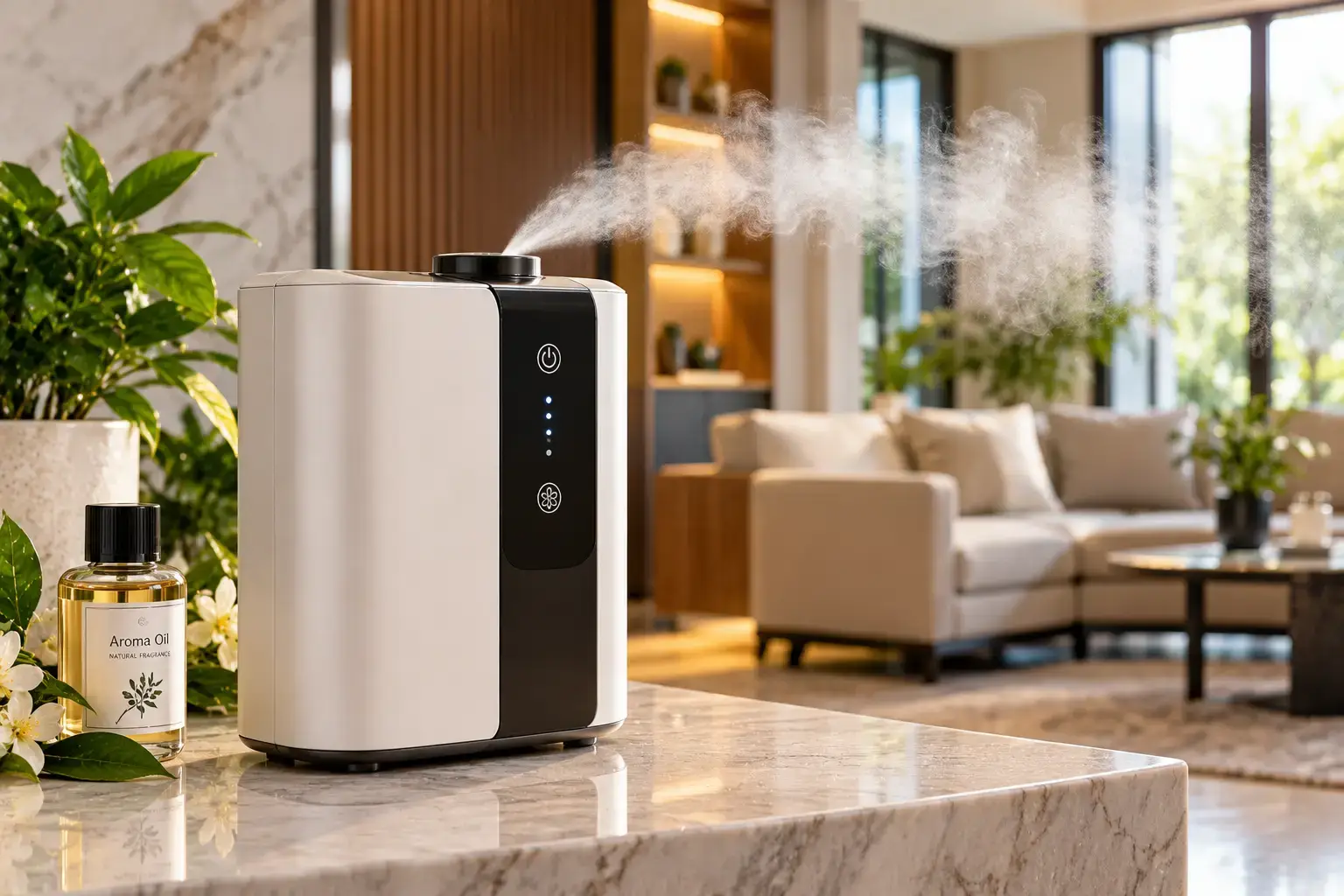
A cold air scent diffuser is a waterless, heat-free device that uses a small air pump to push fragrance or essential oil through an atomizer, breaking it into a dry nano-mist. Because nothing dilutes or heats the oil, the scent stays truer to the bottle and spreads across larger spaces than most ultrasonic diffusers.
How the technology actually works
Most models rely on a version of the Bernoulli principle: fast-moving air passes over a narrow tube, creating low pressure that draws oil upward and shatters it into tiny droplets. Bigger droplets fall back into the reservoir; the finest particles drift out into the room. That’s why you’ll see the terms “nebulizing diffuser,” “cold-air diffusion,” and “nano-mist” used almost interchangeably.
Why “dry mist” matters in practice
Ultrasonic diffusers vibrate water to create a damp mist, which means your oil is diluted and the scent fades quickly once the unit stops. A dry mist, by contrast, lingers. In practical terms, that means a waterless scent diffuser can often run on short intermittent cycles — 30 seconds on, a few minutes off — and still keep a room smelling consistent. It also means no stagnant water to clean, no humidity added to an already muggy summer room, and no mineral dust on your furniture.
The catch? Undiluted oil gets used up faster, and the device’s tiny atomizer can clog if you feed it thick oils. We’ll cover both issues in detail later.
Quick Comparison: 7 Cold Air Scent Diffusers at a Glance
| Model | Power | Rated Coverage | Oil Format | Price Range* | Best for |
|---|---|---|---|---|---|
| Airversa AN8 | Battery (USB-C) | Up to 600 sq ft | Screw-on 5/10/20 mL bottles | $30–$50 | Airversa AN8: budget, car + bedroom |
| Airversa Scenta DUO | Battery (2,500 mAh) | Up to 600 sq ft | Dual-nozzle bottles | $60–$100 | Airversa Scenta DUO: stronger portable throw |
| Hotel Collection Studio Pro | Cordless + remote | Up to 600 sq ft | Proprietary Pro-Pod | $60–$100 | Hotel Collection Studio Pro: hotel scents, small rooms |
| Aroma360 Mini Pro | Plug-in | Up to 600 sq ft | Proprietary Pro Pod | $100–$200 | Aroma360 Mini Pro: luxury ecosystem fans |
| Organic Aromas Raindrop 2.0 | Corded | 800+ sq ft | Open glass reservoir | $100–$150 | Organic Aromas Raindrop 2.0: pure essential oils |
| AromaTech AroMini BT Plus | Corded | 100–1,500 sq ft | 60 mL bottle | $250–$370 | AromaTech AroMini BT Plus: app scheduling, open plans |
| Aromadd 3500 Sq.Ft Smart Scent Diffuser | Corded | Up to 3,500 sq ft | 600 mL reservoir | Check current price | Aromadd 3500 Sq.Ft Smart Scent Diffuser: whole-home HVAC |
*Price ranges at the time of writing; prices vary — check the current price on Amazon.
Looking at the table above, the real dividing line isn’t price — it’s oil format. The Airversa AN8, Organic Aromas Raindrop 2.0, and AromaTech AroMini BT Plus let you choose your own oils, while the Hotel Collection Studio Pro and Aroma360 Mini Pro lock you into branded pods, which changes the long-term cost picture dramatically. If you have a big open-plan main floor, only the AromaTech AroMini BT Plus and Aromadd 3500 Sq.Ft Smart Scent Diffuser are realistically sized for it.
💬 One click helps other shoppers make an informed choice too! 😊
Top 7 Cold Air Scent Diffusers: Expert Analysis
1. Airversa AN8 — best budget entry into waterless scenting
The Airversa AN8 (marketed as the Scenta Prime) proves you don’t need to spend triple digits to try cold-air diffusion. It screws directly onto standard 5, 10, or 20 mL oil bottles, so there’s no pouring and no mess. A built-in lithium battery is rated for up to 48 hours of use and recharges via USB-C in roughly 3.5 hours — in practice, that “48 hours” figure reflects intermittent, low-setting use, so expect fewer hours if you run it hard.
Based on comparing the specs, this is the right pick for renters, students, and anyone who wants scent in a bedroom, a home office, and a car cup holder without buying three devices. Its 600 sq ft rating is optimistic for an open living room; think “one closed room” and you’ll be happy.
Retail listings show well over a thousand reviews, and customer feedback consistently praises the bundle value, easy operation, and rechargeable design. A recurring note is that the sample oils in the starter kit are hit-or-miss, so budget for a fragrance you actually love.
Pros:
- ✅ Screws onto standard oil bottles for zero-mess refills
- ✅ USB-C charging and cordless portability
- ✅ Fits most car cup holders
Cons:
- ❌ Real coverage is closer to one room
- ❌ Included sample oils get mixed reviews
Typically in the $30–$50 range, it’s the best value for testing whether cold-air scenting fits your life.
2. Airversa Scenta DUO — twice the nozzles for a stronger throw
The Airversa Scenta DUO takes Airversa’s portable formula and adds a second nozzle, which, on paper, means more atomized output per cycle. It packs a 2,500 mAh battery rated for 48 hours, five timer settings, four mist levels, and a dedicated vehicle mode, all in an aluminum body that feels more premium than the plastic AN8.
Here’s what to weigh: the dual-nozzle setup isn’t just about strength. It also lets you run two bottles, which opens the door to layering scents or switching between a morning citrus and an evening wood without swapping hardware. That makes the Airversa Scenta DUO a smart match for people who like variety, or for slightly larger bedrooms where a single-nozzle unit feels faint.
Verified review data for the DUO is thinner than for the AN8, so we can’t point to a large pool of aggregated feedback. What’s verifiable is the spec sheet and Airversa’s broader track record, where buyers generally report easy setup and dependable charging.
Pros:
- ✅ Dual nozzles allow stronger output or scent layering
- ✅ Aluminum housing looks at home on a nightstand
- ✅ Four mist levels give finer intensity control
Cons:
- ❌ Smaller pool of verified customer reviews
- ❌ Burns through oil faster on high settings
At around $60–$100, it’s a sensible step up if the AN8 feels too gentle.
3. Hotel Collection Studio Pro — the easiest route to “hotel lobby” scent
The Hotel Collection Studio Pro exists for one reason: making your bedroom or bathroom smell like a boutique hotel with almost no effort. It’s cordless, comes with a remote in some retail bundles, and covers up to 600 sq ft with a dry nano-mist. Hotel Collection’s fragrance library is built around scents inspired by well-known hotels, which is the real selling point.
What most buyers overlook with this model is the pod system. The Hotel Collection Studio Pro is designed around the brand’s Pro-Pod fragrance oils, so your ongoing cost depends heavily on their oil pricing and whether you opt into a subscription. The company has publicly priced the diffuser lower for subscribers, which tells you where the business model lives.
On the brand’s own site, the Studio Pro carries thousands of reviews with very high average ratings, and retailer reviews echo praise for strength, sleek design, and ease of use. Note that some retailer reviews are labeled as incentivized, so weigh them accordingly.
Pros:
- ✅ Very simple, near-zero learning curve
- ✅ Cordless design moves easily between rooms
- ✅ Large library of hotel-inspired fragrances
Cons:
- ❌ Locked into proprietary Pro-Pod oils
- ❌ Not built for large open spaces
Expect roughly $60–$100 depending on the bundle; long-term value depends on your oil plan.
4. Aroma360 Mini Pro — luxury design inside a closed ecosystem
The Aroma360 Mini Pro is the brand’s compact cold-air unit, rated for about 600 sq ft. Aroma360 built its name on commercial scenting, and the Mini Pro brings that “luxury perfume-grade” positioning into the home, with adjustable intensity, scheduling, and a sleek footprint that looks intentional on a console table.
Based on the product listings, the Aroma360 Mini Pro works with the brand’s Pro Pod bottles. That’s convenient — pods drop in cleanly — but it narrows your fragrance choices to Aroma360’s catalog. For shoppers who already love one of their signature blends, that’s a feature. For essential-oil purists, it’s a deal-breaker.
Independent review data is scattered across retailers rather than concentrated in one large pool, so aggregated sentiment is harder to pin down. Hands-on press coverage of Aroma360’s mini units generally praises the scent quality and easy setup, with a minor complaint that the pump makes a faint noise while running.
Pros:
- ✅ Polished design suits living spaces
- ✅ Premium fragrance catalog with signature blends
- ✅ Adjustable intensity and scheduling options
Cons:
- ❌ Proprietary pods limit oil choice
- ❌ Faint pump noise in quiet rooms
Usually in the $100–$200 range, it’s priced for buyers who value design and brand scents over flexibility.
5. Organic Aromas Raindrop 2.0 — the purist’s glass-and-wood nebulizer
The Organic Aromas Raindrop 2.0 (model OA-RD2.0-CL) is a classic nebulizing diffuser: hand-blown glass on a plantation hardwood base, using the Bernoulli principle to vaporize undiluted essential oil. It’s rated for 800+ sq ft, runs on 110–220V power, includes a touch-sensor LED, and carries a one-year parts-and-service warranty.
Here’s the analytical angle: if you’ve invested in high-quality essential oils, this design minimizes contact with plastic and lets you swap oils easily. That makes the Organic Aromas Raindrop 2.0 ideal for aromatherapy hobbyists who rotate lavender, eucalyptus, and citrus — not for someone who wants “set it and forget it” hotel fragrance.
Reviews are notably mixed. Marketplace ratings sit in the high-3 to low-4-star range across listings. Fans consistently describe it as far stronger than water-based diffusers and praise customer service; common complaints include heavy oil consumption, occasional clogging, and fragile glass that sometimes cracks.
Pros:
- ✅ Glass and wood construction, minimal plastic
- ✅ Works with any thin essential oil
- ✅ Responsive warranty support per reviews
Cons:
- ❌ Uses oil quickly on continuous settings
- ❌ Glass reservoir is fragile and can clog
At about $100–$150, it’s fair value for purists who’ll clean it properly.
6. AromaTech AroMini BT Plus — premium smart scenting for open floor plans
The AromaTech AroMini BT Plus is the upgraded version of AromaTech’s bestselling AroMini line, built in aluminum and rated for 100 to 1,500 sq ft. It holds 60 mL of oil and pairs with the AromaTech app over Bluetooth, so you can schedule scenting for mornings and evenings and adjust intensity from your phone.
Based on comparing the specs, the jump in coverage is what justifies the price. A typical $40 unit simply can’t push scent across a combined kitchen-living area; the AromaTech AroMini BT Plus can, and scheduling means you’re not wasting oil while you’re at work. AromaTech also publishes refill estimates — about one 60 mL bottle every two months on typical settings — which helps you budget honestly.
The Amazon listing has a relatively small pool of reviews with a solid average, and brand-site reviews praise the scheduling and scent consistency. The most common complaint is simply the price, sometimes paired with app connectivity hiccups.
Pros:
- ✅ Covers large, open-concept rooms
- ✅ App scheduling saves oil
- ✅ Accepts AromaTech oils and bottle refills
Cons:
- ❌ Premium price for a single-room device
- ❌ Bluetooth range limits remote control
In the $250–$370 range, it’s worth it only if you genuinely need 1,000+ sq ft coverage.
7. Aromadd 3500 Sq.Ft Smart Scent Diffuser — whole-home coverage via your HVAC
The Aromadd 3500 Sq.Ft Smart Scent Diffuser is a different animal. With a 600 mL reservoir, Bluetooth app control, and HVAC compatibility, it’s designed to connect to your ductwork and send scent throughout a house of up to 3,500 sq ft, rather than scenting one room from a shelf.
What the spec sheet doesn’t say, but reviews reveal: HVAC scenting is powerful but unforgiving. The Aromadd 3500 Sq.Ft Smart Scent Diffuser will spread whatever you load into every room, including bedrooms where someone may not want fragrance. It’s best for larger homes, Airbnb hosts, and small businesses that want one consistent signature scent everywhere.
A roundup citing roughly a thousand Amazon reviews reports a strong average rating, with buyers praising coverage and the large tank. The recurring complaints are an unpolished app with occasional connection drops, and potential oil residue in ductwork with year-round heavy use.
Pros:
- ✅ Scents an entire home from one unit
- ✅ Huge 600 mL tank means rare refills
- ✅ Works standalone or connected to HVAC
Cons:
- ❌ App connectivity can be unreliable
- ❌ Risk of oil buildup in ducts
Pricing sits well below boutique whole-home systems — check the current price for the exact figure.
✨ Don’t miss these smart scenting picks!
🔍 Take your home fragrance to the next level with this carefully curated lineup. Click a highlighted model to check current pricing and availability. These picks will help you create a space that greets you, your family, and your guests with a scent that feels like home!
Getting Started: Your First 30 Days With a Waterless Scent Diffuser
A cold-air unit behaves differently from the ultrasonic diffuser you might be used to, so the first month is about calibration, not maximum output.
Week 1: Start low, judge from the doorway
Begin on the lowest intensity with a cycle around 30 seconds on and a few minutes off, if your model allows it. Your nose adapts to a scent within minutes — a process called olfactory fatigue — so judge strength by stepping outside and walking back in. If the room smells pleasant on re-entry, you’re done.
Week 2: Find the right placement
Place the diffuser at waist to chest height, a few feet from walls, and away from direct airflow like a fan blowing straight at it. Avoid placing it right next to fabric, wood finishes, or electronics, since concentrated mist can leave residue at close range.
Week 3: Build a schedule
If you have an app-based unit like the AromaTech AroMini BT Plus or Aromadd 3500 Sq.Ft Smart Scent Diffuser, schedule two windows: before you wake up and an hour before you get home. Continuous all-day running mostly wastes oil.
Week 4: Establish a maintenance habit
Every time you change scents — or roughly every two to four weeks — wipe the nozzle and run a cleaning cycle with isopropyl alcohol if your manufacturer allows it. Thicker oils like vetiver and sandalwood can gum up atomizers, so blend them with thinner oils or save them for occasional use.
Common first-month mistakes
- ✅ Do: track how many days a bottle lasts so you can budget refills.
- ❌ Don’t: crank intensity to max on day one and assume the unit is “weak” because your nose has adapted.
- ❌ Don’t: mix brands of proprietary pods or oils unless the manufacturer allows it.
Real-World Scenarios: Matching a Cold Air Diffuser for Home to Your Life
Specs are easier to interpret when you attach them to an actual situation. Here are three common buyer profiles.
The apartment renter with a $60 budget
Say you live in a 700 sq ft one-bedroom, commute by car, and want something you can move around. The Airversa AN8 fits nicely: it runs in the bedroom overnight, moves to your desk during work-from-home days, and rides in the cup holder on weekends. Use it a couple of hours a day and the battery should comfortably last most of a week between charges, based on the manufacturer’s runtime ratings. If you find it too subtle, the Airversa Scenta DUO is the natural upgrade without changing your oil habits.
The suburban family in a 2,400 sq ft open-plan home
Here, a single small diffuser is fighting a losing battle against high ceilings and constant movement. The AromaTech AroMini BT Plus on the main floor, scheduled before school drop-off and before dinner, handles the shared space. If you want the whole house, including upstairs, the Aromadd 3500 Sq.Ft Smart Scent Diffuser connected to the HVAC makes more sense — but check that no one in the household is fragrance-sensitive before committing.
The essential-oil enthusiast
If you own a shelf full of single-origin oils and like rotating them by mood, avoid proprietary pod systems. The Organic Aromas Raindrop 2.0 lets you pour in any thin essential oil, and its glass reservoir rinses clean between scents. Budget for higher oil consumption, and use the unit in sessions rather than leaving it on all day.
Troubleshooting: 5 Common Problems and How to Fix Them
Even the best nebulizing diffuser runs into issues. Here’s how to solve the most frequent ones.
1. “I can’t smell anything anymore”
Usually this is olfactory fatigue, not a broken unit. Step outside for five minutes, then return. If guests can smell it but you can’t, lower the intensity — you’re likely overscenting.
2. The mist output has slowed or stopped
A clogged atomizer is the most common culprit, especially with thick oils. Run a cleaning cycle with isopropyl alcohol (if permitted), clear the nozzle, and switch to a thinner oil. Owners of the Organic Aromas Raindrop 2.0 frequently mention clogging when using viscous blends.
3. Oil disappears way too fast
Shorten the “on” portion of your cycle and add scheduled off-hours. Cold-air units diffuse undiluted oil, so continuous operation can drain a bottle in days. Apps on the AromaTech AroMini BT Plus make this easy to fine-tune.
4. Oily residue on nearby surfaces
Move the diffuser farther from furniture, raise it slightly, and reduce intensity. Residue is a sign the mist is settling before it fully disperses.
5. The app won’t connect
Restart the unit, toggle your phone’s Bluetooth, and stay within range during setup. Aggregated reviews for app-based models — including the Aromadd 3500 Sq.Ft Smart Scent Diffuser — mention occasional connection drops, so keep manual controls in mind as a backup.
How to Choose a Cold Air Scent Diffuser
Choosing the right cold air scent diffuser comes down to seven practical questions:
- Measure your actual space. Manufacturer coverage claims assume ideal conditions; for open plans or high ceilings, buy a unit rated for roughly double your square footage.
- Decide on open oils vs. proprietary pods. Open systems cost less over time; pods offer convenience and curated scents.
- Choose your power source. Battery models are portable but smaller; corded units handle long schedules without recharging.
- Check scheduling and intensity controls. Timers and intermittent cycles save oil and prevent overscenting.
- Look at reservoir capacity. Bigger tanks mean fewer refills — essential for whole-home or HVAC use.
- Factor in maintenance. Glass reservoirs and open nozzles need regular cleaning; sealed bottles need less.
- Read the safety guidance. Consider pets, kids, and anyone with asthma or fragrance sensitivity before buying.
The underlying rule is simple: buy for the room you actually have, not the one in the product photo. A diffuser that’s too small for a space doesn’t just underperform — it tempts you to run it at maximum, which burns oil and creates harsh, uneven scent.
Nebulizing Diffuser vs. Ultrasonic, Reed, and Candles
How does a nebulizing diffuser stack up against the home-fragrance options you already know? Here’s a side-by-side.
| Method | Water/Heat? | Scent Strength | Typical Coverage | Maintenance | Best for |
|---|---|---|---|---|---|
| Cold-air nebulizing | Neither | Strong, true to oil | One room to whole home | Clean nozzle periodically | AromaTech AroMini BT Plus-style open plans |
| Ultrasonic | Water | Mild, diluted | One small room | Frequent tank cleaning | Light scent + humidity |
| Reed diffuser | Neither | Subtle | Small spaces | Flip reeds | Bathrooms, entryways |
| Candles | Heat/flame | Moderate | One room | Wick trimming | Ambience in short bursts |
Reading the table, cold-air diffusion wins on strength and coverage, but it’s the most oil-hungry of the four. Ultrasonic units remain a reasonable choice if you actually want added humidity in a dry winter bedroom, while reed diffusers still make sense for small spaces where you want a faint background note. Candles are the only option with an open flame, which matters in homes with kids or pets.
The bigger takeaway is control. A cold-air unit lets you schedule, adjust, and stop scent instantly, whereas candles and reeds are mostly “on” or “off.” That control is exactly why commercial spaces moved to cold-air systems years ago.
Features That Actually Matter (and Ones That Don’t)
Marketing copy for cold-air diffusers tends to sound identical, so here’s how to cut through it.
Features that matter
- Intermittent cycle control. This is the single biggest factor for oil cost and scent quality. A unit that can run 30 seconds on, 3 minutes off will outperform a “stronger” unit that only runs continuously.
- Oil compatibility. Whether a model accepts standard bottles — like the Airversa AN8 — or requires branded pods affects every dollar you spend after checkout.
- Reservoir size relative to space. A 20 mL bottle is fine for a bedroom; a 600 mL tank is essential for HVAC.
- Warranty and replacement parts. Glass caps and nozzles break. Brands like Organic Aromas sell replacement glass, which extends the life of the Organic Aromas Raindrop 2.0.
Features that matter less than you’d think
- LED mood lighting. Pleasant, but irrelevant to scent performance.
- “Therapeutic-grade” claims. That phrase is a marketing term, not a regulated certification.
- Huge coverage numbers on small units. If a palm-sized battery device claims to scent a whole house, treat it as best-case marketing.
The pattern is clear: control and oil economics matter far more than aesthetics or headline coverage claims.
HVAC Scent Diffuser Systems: Is Whole-Home Scenting Worth It?
An HVAC scent diffuser connects to your heating and cooling system’s ductwork, typically near the return or supply line, so the blower distributes fragrance to every vent. The Aromadd 3500 Sq.Ft Smart Scent Diffuser is designed to work this way, though it can also run as a standalone unit.
When it makes sense
Whole-home scenting is compelling if you have a larger house, host guests frequently, or run a short-term rental where a consistent “signature” scent supports your brand. One device, one refill schedule, and every room smells the same.
When it doesn’t
If anyone in your home has asthma, migraines, or fragrance sensitivity, HVAC scenting removes their ability to escape it. It’s also harder to undo: oil can accumulate in ducts over time with heavy year-round use, according to aggregated user feedback. Run it on low, schedule it only during active hours, and consider pausing it during peak heating and cooling seasons.
Installation basics
Most consumer HVAC units connect with a flexible tube inserted into the duct; you don’t typically need to cut major components, but if you’re unsure, have an HVAC technician look at your setup. Always follow the manufacturer’s placement guide, and never block your system’s filter or airflow.
Long-Term Cost and Maintenance: The Real Price of a Hotel Scent Diffuser
The sticker price is only the beginning. With a hotel scent diffuser, oil is where most of your money goes over a year.
| Model | Upfront Range* | Oil System | Long-Term Cost Profile | Best for |
|---|---|---|---|---|
| Airversa AN8 | $30–$50 | Any standard bottle | Lowest — you shop freely | Airversa AN8: tight budgets |
| Hotel Collection Studio Pro | $60–$100 | Pro-Pod only | Moderate–high, subscription-driven | Hotel Collection Studio Pro: convenience seekers |
| Organic Aromas Raindrop 2.0 | $100–$150 | Any thin essential oil | Variable — high oil use | Organic Aromas Raindrop 2.0: oil collectors |
| AromaTech AroMini BT Plus | $250–$370 | Brand oils, refillable bottle | High upfront, predictable refills | AromaTech AroMini BT Plus: planners who schedule |
*Ranges at the time of writing; prices may vary.
The table shows why a low upfront cost can be misleading. The Hotel Collection Studio Pro is inexpensive to buy, but its pod-only design means you’re committing to a recurring fragrance budget. The AromaTech AroMini BT Plus costs more on day one, yet AromaTech’s estimate of one 60 mL bottle every two months makes yearly costs easy to predict.
Maintenance schedule
- Weekly: wipe the exterior and check for residue around the nozzle.
- Every scent change (or monthly): run a cleaning cycle and clear the atomizer.
- Every 6–12 months: inspect tubes, seals, and glass for wear; replace parts as needed.
Good maintenance does more than prevent clogs — it keeps output consistent, which means you’ll use less oil overall.
Safety, Indoor Air Quality, and Pets
Let’s be honest about the part most diffuser listings skip. Any fragrance — natural or synthetic — adds volatile organic compounds (VOCs) to indoor air. A widely cited survey summarized in Environmental Health Perspectives found that scented consumer products emitted more than 100 VOCs, and that “green” or “natural” labels didn’t reliably mean lower emissions.
What this means for diffuser owners
Research indexed by the EPA’s Health & Environmental Research Online database links air fresheners to symptoms like headaches and breathing difficulties in sensitive people. That doesn’t make a cold-air diffuser dangerous by default, but it does argue for moderation: use the lowest effective intensity, run it intermittently, ventilate regularly, and turn it off if anyone gets headaches or irritation.
Pets need extra caution
Cats, birds, and small mammals are especially vulnerable. The ASPCA’s guidance on essential oils and pets explains why concentrated oils can be risky and why birds’ respiratory systems are particularly sensitive. Practical rules:
- ✅ Keep the diffuser out of reach and in a room your pet can leave.
- ✅ Avoid oils commonly flagged for pets, such as tea tree and eucalyptus, around cats.
- ❌ Don’t use a diffuser at all near birds or pets with respiratory conditions.
If your pet ingests oil or shows symptoms, contact your veterinarian or the ASPCA Animal Poison Control Center right away.
Electrical basics
For corded units, look for safety certification marks such as UL or ETL on the power adapter, and never leave a damaged cable in use. Note that FCC compliance applies to Bluetooth-enabled devices like the AromaTech AroMini BT Plus.
Common Mistakes to Avoid When Buying a Cold Air Diffuser
Even careful shoppers fall into a few predictable traps.
Buying for coverage numbers alone
Coverage ratings are best-case estimates. A 600 sq ft rating in a room with 12-foot ceilings and an open staircase will feel much weaker. Size up when in doubt.
Ignoring the oil ecosystem
Pod-based models like the Aroma360 Mini Pro and Hotel Collection Studio Pro are convenient, but you’re effectively choosing a fragrance supplier for years. If you dislike their catalog six months from now, the device becomes a paperweight.
Using the wrong oil
Carrier oils, thick resins, and some perfume oils can clog atomizers. Stick to oils labeled for waterless or nebulizing diffusers, or to the manufacturer’s own formulas.
Skipping the household check
Before buying a whole-home system, ask everyone in the house — and consider the pets. A scent you love can be a headache trigger for someone else.
Expecting medical results
Diffusers improve atmosphere. Treat any health claims with skepticism, and talk to a healthcare provider about symptoms like insomnia or anxiety.
FAQ: Cold Air Scent Diffuser Questions Buyers Ask Most
❓ Is a cold air scent diffuser worth the money?
❓ Can I use regular essential oils in a cold air scent diffuser?
❓ How long does a bottle of oil last in a waterless diffuser?
❓ Are cold air diffusers safe to leave on overnight?
❓ Which is better for a large house: an HVAC unit or several small diffusers?
Conclusion: Finding the Right Cold Air Scent Diffuser for Your Space
The right cold air scent diffuser isn’t the most expensive one — it’s the one sized to your space and matched to how you actually use fragrance. If you’re curious and budget-conscious, the Airversa AN8 is a low-risk way to try cold-air scenting, and the Airversa Scenta DUO adds punch when you want it. If you love hotel-inspired scents and value convenience, the Hotel Collection Studio Pro and Aroma360 Mini Pro deliver, as long as you’re comfortable with branded oils.
Essential-oil purists will appreciate the Organic Aromas Raindrop 2.0, provided they clean it and accept higher oil use. For big open-plan rooms, the AromaTech AroMini BT Plus earns its premium through coverage and scheduling, while the Aromadd 3500 Sq.Ft Smart Scent Diffuser is the practical route to whole-home scenting through your HVAC.
Whatever you choose, start low, schedule smart, keep the nozzle clean, and keep pets and sensitive family members in mind. Do that, and your home can smell like that hotel lobby — without overwhelming anyone who lives there.
🌿 Ready to make your home smell unforgettable?
🛒 Pick the diffuser that fits your space, click a highlighted model to check current pricing and availability, and start enjoying a home that smells as good as it looks — every single day!
Recommended for You
- Aura House Diffuser Reviews 2026: 7 Honest Picks Worth It (or Not)
- air wick car freshener: 7 Best Picks, Honestly Ranked (2026)
- AirScent Hotel Fragrance Oil: 7 Best Luxe Scents to Try in 2026
Disclaimer: This post contains affiliate links. As an Amazon Associate, I earn from qualifying purchases made through these links, at no additional cost to you.
✨ Found this article helpful? Share it with someone who needs it! 💬🤗