
In This Article
What Is an Automatic Air Sanitizer?
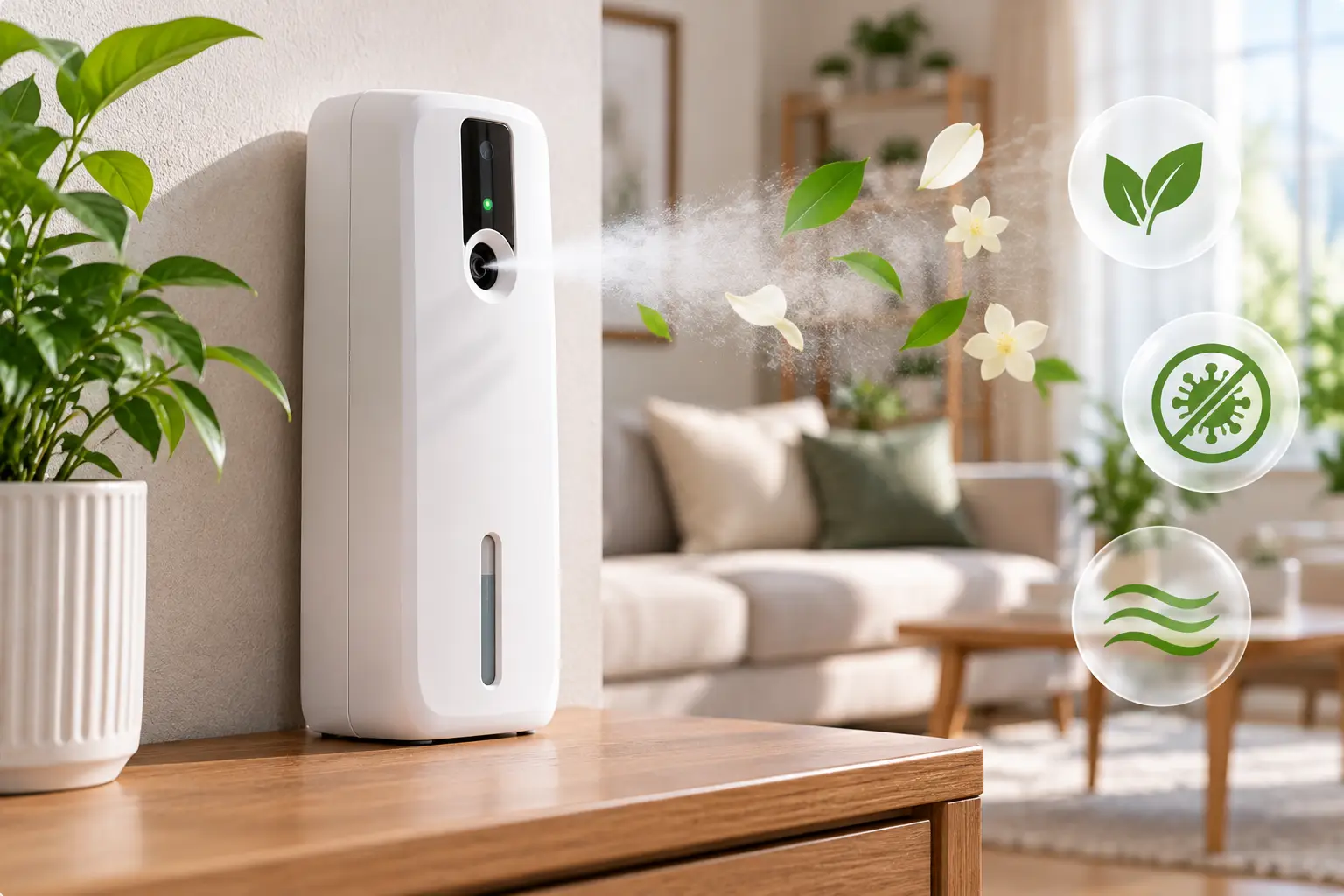
An automatic air sanitizer is a device that treats indoor air on its own schedule, without you pressing a button every hour. It uses UV-C light, filtration, ionization, or a combination to reduce airborne bacteria, mold spores, and odors, and it switches on, ramps up, or slows down based on sensors, timers, or motion.
That’s the textbook answer. The real-world answer is a little messier, and that’s exactly why this guide exists. 🧐
Walk down the “air quality” aisle on Amazon and you’ll see three very different machines wearing the same label: tiny plug-in UV-C units the size of a nightlight, tower purifiers with a UV-C bulb and a particle sensor, and premium smart purifiers that read the room with a laser and adjust themselves all day. All of them get sold as an automatic air sanitizer. Only some of them will actually change the air in your room.
Here’s the honest framing before we dive in. The U.S. Environmental Protection Agency’s guide to air cleaners and air filters in the home makes the point plainly: portable air cleaners can reduce indoor pollution, but they can’t remove every pollutant. So the smart question isn’t “Does it kill 99.9% of germs?” (that number usually comes from a lab chamber). It’s “How much air does it move, what does it do to that air, and does it run itself sensibly?”
In this 2026 guide, we compare seven real products available on amazon.com, from a budget plug-in UV-C air sanitizer to a sensor-driven flagship. You’ll get spec-by-spec analysis, what aggregated customer reviews actually report, the true yearly cost of bulbs and filters, and practical setup tips most product listings skip. ⚡
By the end, you’ll know which automatic air sanitizer for home fits your room size, your budget, and your tolerance for fan noise at 2 a.m.
Quick Comparison: 7 Automatic Air Sanitizers at a Glance
Short on time? This table gives you the essentials. Coverage figures come from manufacturer or AHAM-style ratings and assume different air-change rates, so read the analysis below before comparing them head to head.
| Product | Type | How It Runs Itself | Sanitizing Tech | Price Range | Best For |
|---|---|---|---|---|---|
| GermGuardian GG1100W | Plug-in | Always on (no sensor) | UV-C + titanium dioxide | Under $40 | GermGuardian GG1100W: litter-box rooms, small baths |
| Homedics TotalClean Personal UV-C | Plug-in | Motion + light sensors | UV-C + photocatalyst ionizer | Under $35 | Homedics TotalClean Personal UV-C: guest baths, hallways |
| Homedics TotalClean Deluxe 5-in-1 | Tower | Particle sensor auto mode | True HEPA + UV-C | $150–$250 | Homedics TotalClean Deluxe 5-in-1: bedrooms, offices |
| GermGuardian AC5109W | Tower | PM2.5 sensor auto mode | HEPA + UV-C + ionizer | $240–$320 | GermGuardian AC5109W: family living rooms |
| Winix 5520 | Box | Auto mode + light-sensing sleep | True HEPA + PlasmaWave (switchable) | $170–$260 | Winix 5520: best overall value |
| Air Oasis iAdaptAir 2.0 (Small) | Tower | Auto mode + Wi-Fi schedules | H13 HEPA + UV LED + bipolar ionization | $350–$550 | Air Oasis iAdaptAir 2.0: mold-prone homes |
| Rabbit Air A3 | Wall/floor panel | Laser sensor auto mode (adjustable) | BioGS HEPA + custom germ/odor filter + optional ions | $650–$800 | Rabbit Air A3: large, design-conscious spaces |
Looking at the table, the split is obvious: the two plug-ins are odor-and-germ helpers for tiny rooms, while the five purifiers actually move enough air to change a bedroom or living room several times an hour. Winix 5520 is the value sweet spot because its sensor-driven auto mode is paired with a genuinely strong fan, whereas Rabbit Air A3 charges a premium for quieter operation, adjustable sensor sensitivity, and wall-mount flexibility. If germ reduction is your top priority, GermGuardian AC5109W and Air Oasis iAdaptAir 2.0 are the only towers here that combine a sensor-based auto mode with a built-in UV stage.
💬 One click helps other shoppers make an informed choice too! 😊
Top 7 Automatic Air Sanitizers: Expert Analysis
Every pick below is a real model sold on amazon.com in 2026. They’re ordered from entry-level to premium, and each verdict is based on published specs, independent reviews, and aggregated owner feedback, not invented test results.
1. GermGuardian GG1100W — the cheapest odor fix for tiny rooms
This is the plug-in UV-C air sanitizer most people buy first, and for small, smelly spaces it earns its spot.
The 7-inch unit plugs straight into a wall outlet and pushes air past a UV-C bulb working with a titanium dioxide surface. In practice, that pairing targets odor-causing bacteria and some VOCs rather than dust. There’s no filter to buy; you only swap one LB1000 bulb, which GermGuardian now rates at every 10–12 months depending on use.
Based on comparing the specs, think of the GermGuardian GG1100W as a deodorizer with a germicidal bonus, not a room purifier. Its small fan can’t circulate a bedroom’s worth of air, so it shines in litter-box corners, small bathrooms, and laundry nooks. It also has no sensor, so “automatic” here means it simply runs around the clock.
Customer reviews are plentiful: deal trackers showed it holding roughly a 4.2-star average across 10,000+ Amazon ratings at the time of writing. Reviews consistently report fresher-smelling small rooms, while a recurring complaint is a faint hum and doubts about how much air the fan really moves.
Pros:
- ✅ No filters, just one inexpensive bulb
- ✅ Noticeably fewer odors in small rooms
- ✅ Tiny footprint that fits standard outlets
Cons:
- ❌ Too weak to treat a full bedroom
- ❌ Faint hum that some owners notice
💲 Usually between $20 and $50 (check the current price): excellent value if you treat it as a targeted odor tool.
2. Homedics TotalClean Personal UV-C — the motion-activated hallway helper
This plug-in turns itself on when you walk in, which makes it the most genuinely automatic small unit here.
Built-in motion and light sensors wake it when someone enters a dim room, and a night-light with three brightness levels doubles as a 2 a.m. guide to the bathroom. A photocatalyst ionizer handles odors, while Homedics cites third-party lab validation of 99.9% reductions of E. coli and a test virus. Keep in mind that lab-chamber figure describes air passing the lamp, not your whole room.
Here’s what to weigh: the Homedics TotalClean Personal UV-C is best where people come and go, such as a guest bath, a hallway outside kids’ rooms, or a laundry room. The sensor saves wear on the UV-C lamp, since the unit isn’t working hard in an empty room. Like any plug-in, though, its airflow is modest.
I couldn’t verify a large, consistent pool of Amazon reviews for this exact model, so treat sentiment cautiously. Owner comments I could confirm praise the motion night-light and the option to switch it off completely.
Pros:
- ✅ Motion sensor makes it truly hands-off
- ✅ Night-light adds real everyday usefulness
- ✅ No filters to clean or replace
Cons:
- ❌ Small airflow limits it to compact spaces
- ❌ Less review data than bigger-name rivals
💲 Typically under $35: great value for a high-traffic small room.
3. Homedics TotalClean Deluxe 5-in-1 — the entry point to sensor-driven HEPA
This is where an automatic air sanitizer starts to behave like a real purifier.
The tower wraps a 360-degree True HEPA filter around a pre-filter and activated carbon, then adds a UV-C stage aimed at bacteria and viruses in the air that has passed through. A particle sensor drives auto mode, raising fan speed when the air gets dusty and easing off afterward. Three essential-oil pads are included if you like a light scent, though fragrance and “clean” are not the same thing.
On paper, the Homedics TotalClean Deluxe 5-in-1 suits bedrooms, dorms, and home offices where you want filtration and germ control without fiddling. Live Science’s review called it an efficient, no-frills purifier for tight spaces, which matches its realistic sweet spot.
Owner reviews on the Homedics site repeatedly cite the automatic fan speed as the reason they chose the Deluxe over cheaper siblings. A recurring caution across the broader TotalClean tower family is noise on higher speeds, plus occasional reports of fan failures within the first year.
Pros:
- ✅ Particle-sensor auto mode at a mid-range price
- ✅ True HEPA plus carbon handles dust and smells
- ✅ Optional aroma pads for a light scent
Cons:
- ❌ Louder than premium units at high speed
- ❌ Some durability complaints across the TotalClean line
💲 Roughly $130 to $250 depending on size version: solid value for a first “real” sanitizer.
4. GermGuardian AC5109W — the UV-C tower with the smartest sensor
GermGuardian is known for putting UV-C in nearly every model, and this is the one that finally adds a proper auto mode.
The 23-inch tower combines a 360-degree HEPA filter, activated carbon, UV-C, and an ionizer. Its Intellisense system samples PM2.5 about 60 times per minute and shifts between four fan speeds automatically. Independent reviewers list its CADR at roughly 258 (dust), 254 (smoke), and 291 (pollen), with a top-speed noise level near 56 dB.
What most buyers overlook is that GermGuardian’s headline “1,905 sq ft” figure assumes just one air change per hour. For meaningful germ and allergen reduction, you’ll want four to five changes, which puts the GermGuardian AC5109W‘s realistic zone closer to a 300–400 sq ft living room. That’s still strong for a UV-C tower.
Review volume is thinner than for GermGuardian’s older AC4825, so treat early sentiment with care. Breathe Quality’s analysis ranked it as a solid mid-pack performer, and brand-wide feedback flags the UV-C bulb as an ongoing cost.
Pros:
- ✅ Fast-sampling PM2.5 sensor drives auto mode
- ✅ UV-C, carbon, and HEPA in one tower
- ✅ Child lock and timer for family homes
Cons:
- ❌ Marketing coverage figure overstates real reach
- ❌ Two consumables to budget: filter and bulb
💲 Generally between $240 and $320: fair value if UV-C is a must-have.
5. Winix 5520 — the best all-around value
If you want an air sanitizer with auto mode that simply works, this is the benchmark.
The Winix 5520 pairs a washable pre-filter, carbon, and True HEPA with PlasmaWave, Winix’s switchable ionization stage. Its AHAM-rated CADR is about 252 (dust) for a 392 sq ft room, and an air-quality sensor adjusts the fan in real time. A light sensor drops it into sleep mode when you turn off the lamp, then back to auto at sunrise.
The HouseFresh lab review of the Winix 5520 measured roughly 248 cfm on PM1 particles and just 3.5 watts in sleep mode. Translation: it moves serious air yet costs pennies to leave running all night. Note that PlasmaWave can be turned off, and the purifier filters normally without it, which is the cautious choice for sensitive users.
Reviews consistently report reliable long-term performance and an auto mode that responds quickly to cooking smoke. Common gripes involve the speed jump at the top setting and the app being optional rather than polished.
Pros:
- ✅ Strong CADR for the price class
- ✅ Light-sensing sleep mode is truly hands-off
- ✅ One main filter change per year
Cons:
- ❌ No UV-C stage for germ-focused buyers
- ❌ Noticeably loud on the highest speed
💲 Usually $170 to $260 (prices may vary): the best performance per dollar in this lineup.
6. Air Oasis iAdaptAir 2.0 — the germ-focused smart tower
This one throws the whole toolbox at airborne microbes and still runs itself.
The Small model moves about 177 CFM through a five-stage system: H13 HEPA, carbon, a silver-ion screen, bipolar ionization, and UV LEDs. Auto mode reads a particle sensor, shows a live particle count, and lights a green, orange, or red ring. Wi-Fi adds schedules and filter-life tracking, and Air Oasis says the filter set lasts up to two years.
Based on comparing the specs, the Air Oasis iAdaptAir 2.0 suits mold-prone basements, allergy households, and anyone who wants UV and ions they can toggle off. Its “1,325 sq ft” claim relies on a low air-change rate, so size it for a bedroom or modest living area if you want frequent turnover.
Owner reviews on the brand’s store praise how well it behaves in auto mode, and a ZDNET reviewer reported it kept an open-plan living area fresh after a month of use. The most common hesitation is price, which is steep for its airflow.
Pros:
- ✅ UV and ionization can be switched off
- ✅ Long two-year filter interval lowers upkeep
- ✅ Live particle count builds real confidence
Cons:
- ❌ Expensive relative to its CFM rating
- ❌ Coverage claim needs careful reading
💲 Typically in the $350–$550 range for the Small: worth it mainly for mold or germ-sensitive homes.
7. Rabbit Air A3 — the quiet, customizable flagship
The premium pick trades UV-C for a smarter sensor, whisper-quiet operation, and filters you choose for your problem.
The Rabbit Air A3 uses a six-stage stack built around a BioGS HEPA filter, plus a customizable layer such as Germ Defense or Odor Remover. A laser particle sensor powers auto mode with adjustable sensitivity, and Rabbit Air lists noise from about 20 to 51 dBA and power from 5 to 60 watts. Rated coverage is 1,070 sq ft at two air changes per hour.
Here’s what to weigh: there’s no UV lamp, so “sanitizing” comes from filtration and the optional germ-focused filter. For big open rooms or bedrooms where silence matters, that’s a smart trade. It can also hang on a wall like art, which no other model here offers.
In Live Science’s smoke test, the A3 cleared match and incense smoke within about 15 minutes on its top speed. Reviews consistently report praise for the design and quietness, while the main complaint is cost, including roughly $116 a year in filters according to the brand.
Pros:
- ✅ Adjustable-sensitivity laser sensor auto mode
- ✅ Exceptionally quiet at low speeds
- ✅ Wall-mountable with swappable custom filters
Cons:
- ❌ No UV-C lamp for germ-focused buyers
- ❌ Premium purchase price and filter costs
💲 Around $650 to $800 at the time of writing: a luxury, but justified for large quiet spaces.
✨ Don’t miss these smart picks!
🔍 Take your indoor air to the next level with this carefully curated lineup. Click a highlighted product name to check current pricing and availability. These picks will help you breathe fresher, cleaner air the whole family will enjoy!
How to Set Up Your Automatic Air Sanitizer: The First 30 Days
A great machine placed badly performs like a mediocre one. These steps take ten minutes and make a bigger difference than most spec upgrades. 🛠️
Day 1: Placement and first run
- Unwrap every filter. HEPA and carbon filters often ship sealed in plastic bags inside the housing. Running a purifier with a bagged filter is the single most common first-week mistake, and the unit’s sensor won’t tell you.
- Give it breathing room. Keep towers and box units at least 12–18 inches from walls and furniture so the intake isn’t starved. Plug-ins work best on an open outlet, not behind a dresser.
- Place it where the problem lives. Put a plug-in near the litter box or the toilet, not across the room. Put a tower where people actually spend time, such as near the bed rather than in a corner.
- Run it on high for an hour. This clears the backlog of dust and odors so the sensor starts from a realistic baseline.
Week 1: Let auto mode learn your home
Switch to auto mode and leave it alone for a few days. Watch when it ramps up: cooking, vacuuming, and opening a door during pollen season are classic triggers. If a unit like the Rabbit Air A3 reacts too eagerly, lower its sensitivity in the app instead of switching to manual.
Weeks 2–4: Fine-tune and set reminders
- ✅ Rinse washable pre-filters, like the one on the Winix 5520, every two to four weeks in dusty or pet homes.
- ✅ Note the install date on the UV-C bulb with a marker; plug-in bulbs lose output long before they burn out.
- ✅ Decide on ionization. If anyone in the home has asthma, start with PlasmaWave or bipolar ionization off and add it later only if you want to.
- ✅ Add calendar reminders for filter and bulb swaps, because the indicator light is easy to ignore.
Real-World Scenarios: Which Automatic Air Sanitizer Fits Your Life?
Specs only matter once they meet a real home. Here are three common buyer profiles, each matched with a reasoned recommendation. 🏠
Scenario 1: The apartment cat owner on a tight budget
Maya rents a 650 sq ft one-bedroom and keeps the litter box in a 40 sq ft bathroom. Her budget is under $60, and the problem is odor, not allergies.
Best match: the GermGuardian GG1100W in the bathroom outlet. A plug-in UV-C air sanitizer works on a small, enclosed source, and its one-bulb upkeep keeps yearly costs low. If she later wants whole-apartment filtration, the Winix 5520 is the logical upgrade rather than a second plug-in.
Scenario 2: The family with a toddler and seasonal allergies
The Garcias have a 350 sq ft living room, a toddler who touches every button, and spring pollen that flattens Dad. Budget: around $300.
Best match: the GermGuardian AC5109W. Its PM2.5-driven auto mode reacts when pollen drifts in through the patio door, the UV-C stage adds a germ-reduction layer during cold season, and the child lock matters more than most reviews admit. Its realistic coverage lines up with their room.
Scenario 3: The remote worker in a big open-plan home
Daniel works from a 900 sq ft open kitchen-living area, takes video calls all day, and hates fan noise. He’ll pay for quiet.
Best match: the Rabbit Air A3. At low speeds it’s quieter than most refrigerators, its laser sensor ramps up while he cooks lunch, and the wall-mount option frees floor space. If germ reduction was his priority instead of silence, the Air Oasis iAdaptAir 2.0 in a larger size would be the alternative worth pricing out.
Common Problems and Quick Fixes
Most frustrations with an automatic air sanitizer come down to five issues. Here’s how to solve each one without calling support. 🔧
Problem 1: “The room still smells after a week.”
✅ Odor usually means the source is outpacing the machine. Move the unit closer to the source, run it on a higher fixed speed for a day, and check whether your model has real carbon. A thin carbon sheet saturates fast; the Rabbit Air A3‘s Odor Remover filter or the Winix 5520‘s carbon layer handle persistent smells better than a plug-in.
Problem 2: “Auto mode never seems to turn on.”
✅ Sensors need airflow and a clean lens. Wipe the dust-sensor window gently (your manual shows where), and make sure the unit isn’t wedged against a wall. If the air is genuinely clean, a quiet unit in auto mode is a good sign, not a fault.
Problem 3: “It’s too loud at night.”
✅ Use light-activated or manual sleep modes. The Winix 5520 drops into sleep automatically when the room darkens, and the Air Oasis iAdaptAir 2.0 has a night mode that also dims the display.
Problem 4: “The blue UV light keeps me awake.”
✅ On towers such as the GermGuardian AC5109W, the UV-C stage can be switched off overnight without stopping filtration. Run UV during the day when the room is empty.
Problem 5: “Allergies didn’t improve.”
✅ Check the math. Divide the unit’s CADR by your room’s square footage; if you’re far below a 2:3 ratio (for example, about 200 CFM for a 300 sq ft room), the machine is undersized. Also remember that heavy allergens like dust mite debris settle fast, so vacuuming and washing bedding still do a lot of the work.
How to Choose an Automatic Air Sanitizer (7 Steps)
Choosing well comes down to matching airflow, technology, and automation to your room. Follow these seven steps in order. 📋
- Measure the room first. Multiply length by width. Everything else, including CADR and price, depends on this one number.
- Match CADR to the room. Aim for a smoke CADR of at least two-thirds of the square footage (a 300 sq ft room needs about 200 CFM). Plug-ins don’t publish CADR because their airflow is tiny.
- Decide what “automatic” should mean. Motion sensors suit pass-through rooms, particle sensors suit living spaces, and light-sensing sleep modes suit bedrooms.
- Pick the sanitizing stage deliberately. UV-C adds germ reduction on air passing the lamp; HEPA does the heavy lifting on particles. Ionization is optional, and you should be able to turn it off.
- Check ozone compliance. Look for the CARB certification label, which California requires for every portable air cleaner sold there.
- Price the consumables before checkout. A cheap unit with expensive filters and bulbs can cost more over three years than a pricier one.
- Listen before you commit. Compare low-speed decibel ratings if the unit will run in a bedroom; anything under about 30 dB is near-silent.
In short, the right pick isn’t the one with the biggest germ-kill percentage on the box. It’s the one whose airflow, sensor, and upkeep fit the space you actually live in.
Common Mistakes to Avoid When Buying an Automatic Air Sanitizer
Even careful shoppers trip over these. Each one is avoidable once you know the pattern. ⚠️
- ❌ Trusting “covers up to 1,900 sq ft” claims. Many brands calculate coverage at one air change per hour. For allergies or germs, you want four or more, which shrinks the realistic room size dramatically.
- ❌ Expecting a plug-in to clean a bedroom. A plug-in UV-C air sanitizer treats the air right around it. It’s a spot treatment, like a bathroom fan, not whole-room purification.
- ❌ Confusing fragrance with clean air. Scented pads and aerosol “sanitizers” make a room smell fresh, but scent itself adds VOCs rather than removing them.
- ❌ Buying an ozone generator by accident. Some marketplace listings sell “ozone purifiers” as sanitizers. Ozone is a lung irritant, and California bans the sale of uncertified high-ozone air cleaners.
- ❌ Ignoring the bulb. UV-C lamps fade gradually and keep glowing blue long after their germicidal output drops, so the light being on proves little.
- ❌ Skipping the sleep test. A unit that’s great at noon can be maddening at midnight. Check the lowest-speed noise level and whether the display dims.
Plug-In UV-C Air Sanitizer vs Air Purifier With UV-C Light vs Aerosol Dispensers
These three options all promise “sanitized air,” but they work in completely different ways. Understanding the trade-offs saves you from buying the wrong category entirely.
A plug-in UV-C air sanitizer like the GermGuardian GG1100W pulls a small stream of air past a lamp. It’s cheap, nearly silent, and filter-free, but it only treats air that drifts close to it. An air purifier with UV-C light, such as the GermGuardian AC5109W or the Air Oasis iAdaptAir 2.0, captures particles on a HEPA filter and then exposes air to UV, so it reduces dust, dander, and some microbes at room scale. Automatic metered aerosol dispensers, common in offices and restrooms, spray a sanitizing or fragrance chemical on a timer.
| Option | What It Actually Does | Ongoing Cost | Main Drawback | Best For |
|---|---|---|---|---|
| Plug-in UV-C sanitizer | Treats air near the outlet; reduces odors | Low (one bulb a year) | Very limited airflow | Litter boxes, small baths |
| Purifier with UV-C + HEPA | Filters particles room-wide, adds UV germ stage | Moderate (filter + bulb) | Larger, needs space | Bedrooms, living rooms |
| Sensor-driven HEPA (no UV) | Filters particles room-wide, adjusts itself | Moderate (filter only) | No UV stage | Allergy and smoke control |
| Metered aerosol dispenser | Sprays chemical mist on a timer | Ongoing refills | Adds chemicals to the air | Commercial restrooms |
The table makes the pattern clear: room-scale results come from airflow plus filtration, and UV-C is a useful add-on rather than a replacement. Aerosol dispensers are the outlier, since their EPA-registered labels typically warn against use in nurseries or rooms where infants, ill, or elderly people are confined. For most homes, a sensor-driven purifier, with or without UV-C, is the better long-term bet.
Features That Actually Matter (and Ones That Don’t)
Marketing sheets list a dozen features. Only a handful change your daily experience. 🎯
Features that matter:
- ✅ CADR and honest coverage. This is the engine. A unit with 250 CFM, like the Winix 5520, will outperform a fancier-looking one with half the airflow.
- ✅ A real particle sensor. Auto mode is only as good as its sensor. Laser and PM2.5 sensors, as on the Rabbit Air A3 and GermGuardian AC5109W, react faster and more precisely than basic dust sensors.
- ✅ Switchable extras. Being able to turn off UV-C and ionization gives you control at night and around sensitive family members.
- ✅ Low-speed noise. You’ll spend most hours at the lowest speed, so that number matters more than the max.
Features that rarely matter:
- ❌ “Kills 99.9% of germs.” These figures usually come from a sealed lab chamber, not a living room with open doors.
- ❌ App bells and whistles. Remote control is convenient, but a good auto mode makes you forget the app exists.
- ❌ Aromatherapy pads. Pleasant, yes; purifying, no.
The takeaway: spend your money on airflow, sensing, and upkeep, not on percentages printed in big type.
Automatic Air Sanitizer for Pet Owners, Allergy Sufferers, and Seniors
Different households need different strengths, so here’s tailored advice for three groups that buy these machines most. 🐾
Pet owners fight two things: dander and odor. Prioritize real carbon and strong airflow, then add a plug-in near the litter box. Pairing the Winix 5520 in the living room with a GermGuardian GG1100W by the litter box covers both for a reasonable combined price.
Allergy sufferers benefit most from True HEPA and high air turnover in the bedroom, where you spend a third of your life. A sensor-driven unit such as the Homedics TotalClean Deluxe 5-in-1 or Winix 5520, sized for four to five air changes per hour, beats any UV gadget for pollen and dust.
Seniors and caregivers should value simplicity and quiet. Auto mode removes the need to fiddle with buttons, and a motion-sensing night-light like the one on the Homedics TotalClean Personal UV-C can make nighttime bathroom trips safer. Skip aerosol dispensers in rooms where an older or ill person spends long periods, since many sanitizer sprays carry label warnings against exactly that.
Long-Term Cost and Maintenance of an Automatic Air Sanitizer
The sticker price is only the beginning. Over three years, filters, bulbs, and electricity can rival what you paid for the unit. 💰
| Product | Airflow / Coverage | Main Consumables | Estimated Yearly Upkeep | Best For |
|---|---|---|---|---|
| GermGuardian GG1100W | Not published (very low) | LB1000 UV-C bulb | About $15–$25 | GermGuardian GG1100W: lowest running cost |
| Homedics TotalClean Personal UV-C | Not published (very low) | None listed | Minimal | Homedics TotalClean Personal UV-C: set-and-forget |
| Homedics TotalClean Deluxe 5-in-1 | Varies by size version | HEPA/carbon filter | About $30–$60 | Homedics TotalClean Deluxe 5-in-1: budget HEPA |
| GermGuardian AC5109W | ~254 CFM smoke CADR | Filter + UV-C bulb | About $70–$130 | GermGuardian AC5109W: UV + HEPA families |
| Winix 5520 | ~253 CFM smoke CADR | One filter set | About $40–$80 | Winix 5520: best value over time |
| Air Oasis iAdaptAir 2.0 | 177 CFM (Small) | Filter set every ~2 years | About $50–$100 | Air Oasis iAdaptAir 2.0: low swap frequency |
| Rabbit Air A3 | 1,070 sq ft at 2 ACH | Filter stack | About $116 (brand figure) | Rabbit Air A3: premium quiet spaces |
Upkeep figures are estimates based on typical replacement-part prices at the time of writing; check current prices before you buy.
Reading across the table, the Winix 5520 delivers the strongest airflow per upkeep dollar, while the GermGuardian AC5109W costs more each year because it needs both a filter and a bulb. The Air Oasis iAdaptAir 2.0 offsets its high purchase price with a longer filter interval, and the Rabbit Air A3 is the most expensive to own overall, which is the price of its quiet performance. Electricity is a minor factor: efficient units sip just a few watts in sleep mode.
Maintenance schedule at a glance:
- ✅ Every 2–4 weeks: vacuum or rinse pre-filters.
- ✅ Every 6–12 months: replace HEPA/carbon filters (per indicator and manual).
- ✅ Every 10–12 months: replace UV-C bulbs, even if they still glow.
- ✅ Every month: dust the sensor window and intake grille.
Safety, Regulations, and Standards for Automatic Air Sanitizers
An automatic air sanitizer runs unattended for thousands of hours, so safety credentials matter more than they do for most gadgets. Here’s what to check in the U.S. market. 🛡️
Ozone limits. California’s air cleaner regulation (AB 2276) requires every portable air cleaner sold in or shipped to the state to be certified by the California Air Resources Board for low ozone emissions and electrical safety. Even if you live elsewhere, the “CARB certified” label is a useful national shorthand for low ozone. Keep in mind that CARB certification covers ozone and electrical safety, not how well a device cleans the air.
UV-C exposure. Enclosed UV-C lamps inside a housing are designed so you never see the light directly. The FDA’s guidance on UV lights and lamps for disinfection explains that direct UVC exposure can injure eyes and skin, and that some UV lamps generate ozone. Never run a unit with a cracked housing, and never stare into an exposed lamp.
Electrical certification. Look for UL or ETL listing marks on the unit or its packaging. These confirm the product passed recognized electrical safety testing, which matters for a device plugged in 24/7.
EPA registration. Chemical air sanitizer sprays and many sanitizing devices carry an EPA registration or establishment number. That number shows the product or facility is registered with the agency, but it isn’t an EPA endorsement of effectiveness.
The bottom line: choose ozone-compliant, UL- or ETL-listed equipment, use UV stages as designed, and treat sanitizing claims as helpful extras rather than medical guarantees.
Frequently Asked Questions
❓ Is an automatic air sanitizer worth buying for flu season?
❓ Can I leave an automatic air sanitizer on 24/7?
❓ What is the best automatic air sanitizer for a bedroom?
❓ Do plug-in air sanitizers produce ozone?
❓ Are automatic air sanitizers safe around babies and pets?
Conclusion: Choosing the Right Automatic Air Sanitizer in 2026
The best automatic air sanitizer isn’t the one with the boldest germ-kill claim. It’s the one that moves enough air for your room, senses when to work harder, and costs a reasonable amount to keep running.
If you just need to tame odors in a tiny space, the GermGuardian GG1100W or the motion-sensing Homedics TotalClean Personal UV-C will do the job for very little money. For a bedroom or office, the Homedics TotalClean Deluxe 5-in-1 is a friendly entry point into sensor-driven HEPA. Families who want UV-C built into a capable tower should look at the GermGuardian AC5109W.
For most people, though, the Winix 5520 remains the smartest all-around buy: strong airflow, a genuinely hands-off auto mode, and low running costs. Germ- and mold-focused households can justify the Air Oasis iAdaptAir 2.0, while the Rabbit Air A3 is the splurge for large, quiet spaces.
Whatever you choose, size it honestly, unwrap the filters, and keep up with maintenance. Do that, and your air sanitizer with auto mode will quietly earn its place in your home every single day. 🌿
🚀 Ready to breathe easier?
🔍 Click any highlighted product name above to check the current price and availability on Amazon. Pick the one that fits your room, set it to auto, and let it do the work while you get on with your day!
Recommended for You
- AirScent Hotel Fragrance Oil: 7 Best Luxe Scents to Try in 2026
- Home Fragrance Gifts: 7 Best Picks They’ll Actually Love (2026)
- Best Whole House Scent System: 7 Proven Picks for 2026
Disclaimer: This post contains affiliate links. As an Amazon Associate, I earn from qualifying purchases made through these links, at no additional cost to you.
✨ Found this article helpful? Share it with someone who needs it! 💬🤗