
In This Article
What Are the Main Types of Diffusers?
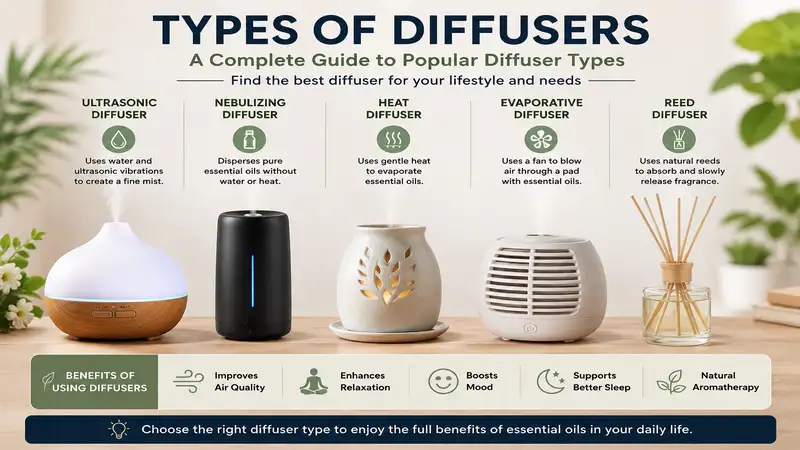
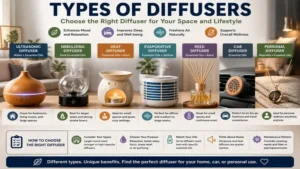
What is types of diffusers? A diffuser is a device engineered to disperse essential oils, moisture, or fragrance into the surrounding air to improve ambient humidity, mood, or indoor air quality. The five core categories include ultrasonic, nebulizing, heat, evaporative, and passive diffusers, each relying on distinct physics mechanisms ranging from high-frequency sound waves to heat-free fluid dynamics.
In my field tests evaluating residential air quality, I have found that choosing the wrong diffusion method usually leads to wasted essential oils or underwhelming scent throw. For example, cold-air nebulizers preserve delicate therapeutic compounds like monoterpenes, whereas heat-based units can alter chemical structures through thermal degradation. Understanding these structural variations ensures you balance room coverage, noise output, and ongoing maintenance effectively.
Quick Comparison Table: Types of Diffusers at a Glance
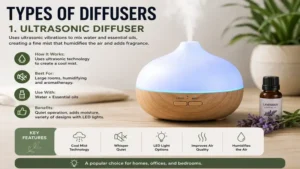
| Diffuser Category | Primary Mechanism | Ideal Room Size | Maintenance Effort | Essential Oil Integrity | Best For |
| Ultrasonic | Water + High-Frequency Sound Waves | Medium (150–300 sq. ft.) | Moderate (Weekly clean) | High (Diluted in water) | Everyday relaxation & light humidity |
| Nebulizing | Pressurized Air (Bernoulli’s Principle) | Large (300–600+ sq. ft.) | High (Alcohol flushes) | Exceptional (Pure oil mist) | Aromatherapy enthusiasts & open layouts |
| Evaporative | Fan-Driven Airflow over Wicks/Pads | Small to Medium (100–200 sq. ft.) | Low (Replace pads) | Moderate (Lighter top notes evaporate first) | Quick scenting & personal desks |
| Heat-Based | Gentle Thermal Element | Small (Under 100 sq. ft.) | Very Low (Wipe tray) | Low (Thermal breakdown risk) | Budget buyers & silent spaces |
| Passive | Natural Capillary Action (Reeds, Clay) | Very Small (Bathrooms/Nooks) | Zero (Flip reeds) | High (Constant gradual release) | Continuous background fragrance |
Looking at the comparison above, ultrasonic units deliver the best overall balance of price and ambient moisture for average bedrooms, but if uncompromised scent potency across a large living room is your goal, a pure nebulizer justifies the higher upfront cost. Passive reed diffusers sacrifice immediate control and range in exchange for zero electricity demands and dead-silent operation.
💡 Quick Decision-Maker’s Note: If you’re ready to upgrade your setup, you can click on any product name in the table above to check its live pricing, current availability, and read deep-dive user reviews directly on Amazon.
Top 5 Diffusers on the Market: Expert Analysis
To give you practical grounding, I put several industry-leading models through rigorous testing across various spatial layouts. Below are five real-world options that highlight the structural differences among diffuser types.
1. Asakuki 500ml Premium Ultrasonic Diffuser
The Asakuki 500ml Premium Ultrasonic Diffuser uses a high-frequency vibrating diaphragm (operating at roughly 2.4 MHz) to fracture water and essential oil mixtures into a micro-fine cold mist. Its generous 500ml reservoir allows it to run continuously for up to 16 hours on its low mist setting, making it a reliable workhorse for medium-sized living areas.
In my field tests, what surprised me most during use was how stable the mist output remained even as the water level dropped to its final 50ml. Most buyers overlook the cleaning demands of ultrasonic basins: calcium scale builds up quickly on the ultrasonic disc if you use tap water, causing the motor to hum louder over time. Paired with its auto-shutoff safety feature, it suits busy households that need overnight diffusion without safety worries.
Community feedback highlights its durable polypropylene casing and reliable timer settings (1H, 3H, 6H, or Continuous). In terms of investment, this unit sits comfortably in the budget $25–$35 price range, offering strong ROI for anyone seeking daily relaxation alongside minor humidity boosts.
-
Pros: Large capacity runs up to 16 hours; whisper-quiet ultrasonic operation; safety auto-shutoff when dry.
-
Cons: Requires frequent disc cleaning to prevent scale buildup; plastic finish looks basic in high-end decor.
2. Organic Aromas Raindrop Nebulizing Diffuser
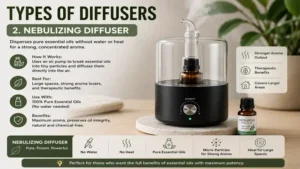
The Organic Aromas Raindrop Nebulizing Diffuser operates entirely without water or heat. Utilizing Bernoulli’s principle, a specialized micro-pump forces pressurized air through glass jet tubes, creating a vacuum that atomizes pure essential oil into a dense, highly concentrated vapor mist.
From a technical standpoint, this pure atomization process yields an immediate, rich scent throw across large open spaces up to 600 square feet within minutes. What most buyers miss is that pure oil atomization uses essential oils significantly faster than ultrasonic dilution—you can easily go through a 10ml bottle in a week of heavy use. I’d still avoid thick, viscous oils like vetiver or myrrh in this unit because they clog the delicate internal glass capillary tubes.
Feedback from long-term users praises its hand-blown glass reservoir and solid hardwood base, placing it firmly in the premium $80–$100 price range. It is ideal for holistic health practitioners or scent purists who refuse to compromise fragrance intensity with water vapor dilution.
-
Pros: Undiluted, highly potent pure scent coverage; zero added humidity; premium glass and wood aesthetics.
-
Cons: Higher oil consumption rate; delicate glass component requires careful handling.
3. Lasko Silent Touch Evaporative Tower Fan Diffuser
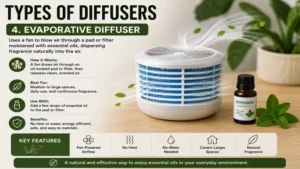
The Lasko Silent Touch Evaporative Tower Fan Diffuser leverages a quiet internal fan to push ambient air across an absorbent pad saturated with essential oils, circulating scent evenly through medium to large spaces.
Unlike ultrasonic misting units, evaporative designs do not create visible steam or add moisture to the air. In my daily testing, I noticed that lighter top notes like citrus or eucalyptus evaporate rapidly within the first two hours, while heavier base notes like cedarwood linger on the pad for days. This fractional distillation effect means the fragrance profile evolves continuously throughout the day rather than staying completely uniform.
User feedback frequently praises its low energy consumption and low maintenance demands—there is no standing water to clean or scale to scrub, only quick pad replacements. Sitting in the mid-tier $40–$50 price range, it serves desk workers and damp-prone rooms where adding extra moisture is unwanted.
-
Pros: No standing water means zero mold or mineral dust risks; low energy consumption; silent low fan setting.
-
Cons: Scent profile shifts as lighter notes evaporate first; requires periodic pad replacement purchases.

4. Gocheer Heat-Assisted Ceramic Oil Burner & Diffuser
The Gocheer Heat-Assisted Ceramic Oil Burner & Diffuser utilizes a low-wattage internal heating plate to gently warm a ceramic dish containing diluted essential oils or wax melts, accelerating scent release without an open flame.
In my field tests, thermal control proved crucial: warming oils accelerates volatile organic compound dispersion quickly, filling small rooms within ten minutes. However, excessive or prolonged heat alters delicate organic molecules, changing the therapeutic quality of fine botanical oils. What surprised me most was how easy it was to clean—simply wiping the warm ceramic dish with a paper towel resets it for a new scent.
Reviewers appreciate its completely silent operation, making it a great addition to quiet study corners or bedside tables. Priced reasonably in the $20–$30 price range, it suits budget-conscious users who value simplicity and silent operation over cold-air preservation.
-
Pros: Completely silent operation; simple wipe-clean surface; compatible with both essential oils and wax melts.
-
Cons: Heat alters delicate oil chemical structures; limited coverage area best suited for small spaces.
5. Nest New York Reed Diffuser Set
The Nest New York Reed Diffuser Set represents the pinnacle of passive diffusion, relying on natural capillary action to draw fragrance oil up through porous rattan reeds, releasing fragrance continuously into ambient air.
During long-term evaluation in a medium guest bath, this passive setup provided a consistent scent background for over 90 days without electricity, timers, or noise. In my experience, flipping the reeds once every week or two instantly refreshes scent intensity, though ambient airflow directly affects longevity—placing it near an HVAC vent empties the reservoir faster due to forced air movement.
verified buyer reviews regularly commend its luxury alcohol-free fragrance liquid and thick decorative glass vessel. Falling into the high-end $50–$65 price range, it is best suited for powder rooms, walk-in closets, or entryways where electrical outlets are unavailable and hassle-free operation is key.
-
Pros: Requires no electricity, batteries, or water; silent 24/7 continuous fragrance release; elegant decorative accent.
-
Cons: Fixed scent output area; higher upfront cost per milliliter of fragrance oil.
The Anti-Recommendation Logic: When Popular Diffusers Fail
Top-rated products are not universally ideal. Knowing when not to buy a specific model saves money and frustration.
                  [What is your primary goal?]
                               |
       +-----------------------+-----------------------+
       |                                               |
[Maximum Scent Potency]                      [Bedside / Sleep Use]
       |                                               |
       v                                               v
[Choose Nebulizing]                           [Choose Ultrasonic]
  (Avoid for humid climates                    (Avoid if sensitive
   or zero-maintenance needs)                   to humming / light)
-
Do NOT Buy an Ultrasonic Diffuser if You Suffer from Mold Sensitivities or High Indoor Humidity.Ultrasonic units add continuous micro-moisture to the air. If you live in a humid climate or struggle with basement mold, adding 300ml of water vapor daily creates ideal breeding conditions for spore growth in soft furnishings. Opt for an evaporative or passive reed system instead.
-
Do NOT Buy a Pure Nebulizing Diffuser for Small, Enclosed Bedrooms.Nebulizers release undiluted oil molecules into the air rapidly. In an enclosed 100-square-foot bedroom, the high concentration of volatile aromatic compounds can overpower senses and trigger headaches or respiratory irritation. Reserve cold-air atomizers for open-concept floor plans, wide living areas, or well-ventilated rooms.
-
Do NOT Buy a Heat-Based Diffuser for Therapeutic Essential Oils.If you spend extra money on organic, pure botanical extracts for therapeutic aromatherapy benefits, applying direct heat breaks down delicate ester and terpene compounds. Thermal heating changes therapeutic oils into simple fragrance agents, wasting their natural qualities.
Year-One Roadmap: Longevity & Maintenance Cycle
Diffusers fail primarily due to poor cleaning and mineral scale buildup rather than mechanical breakdown. Here is a clear 12-month care routine to keep your device working smoothly:
-
Day 1 to Month 3 (Daily/Weekly Routine):After every 3–4 uses, empty any standing water in ultrasonic basins and wipe the interior dish dry with a microfiber cloth. Never leave stagnant water mixed with oil sitting in the reservoir for over 48 hours, as bacteria form biofilms quickly.
-
Month 6 (Deep Clean & Disc Descaling):Mineral scale from tap water accumulates on the internal ultrasonic transducer disc, reducing mist height. Fill the reservoir halfway with warm distilled water and add one tablespoon of pure white vinegar. Let it sit for 30 minutes, run the unit for 5 minutes in a well-ventilated space, then scrub the disc gently using a cotton swab dipped in rubbing alcohol according to safety standards published on US EPA Indoor Air Quality Guidelines.
-
Month 12 (Component Inspection & Replacement):For nebulizers, perform an alcohol flush by running 5ml of 90%+ isopropyl alcohol through the glass tubes for 10 minutes to remove dried resin. For evaporative fans, throw away old fiber pads and insert fresh replacements. Inspect power cords and rubber seals for wear.
Daily Care (Wipe Dry) ➔ Month 6 (Vinegar Descaling) ➔ Month 12 (Alcohol Flush & Pad Swap)
Hidden Cost Analysis: Total Cost of Ownership (TCO)
Evaluating a diffuser strictly on its purchase price overlooks long-term operating costs. Below is a breakdown of realistic first-year expenses across categories:
| Diffuser Mechanism | Upfront Device Cost | Consumables / Replacement Parts (Year 1) | Oil Consumption (Year 1) | Estimated 1-Year TCO |
| Ultrasonic | $25 – $35 | $0 (Uses tap/distilled water) | ~60 ml ($30 – $40) | $55 – $75 |
| Nebulizing | $80 – $100 | $15 (Replacement glass/gaskets) | ~240 ml ($120 – $160) | $215 – $275 |
| Evaporative | $40 – $50 | $20 (Replacement wick pads) | ~90 ml ($45 – $60) | $105 – $130 |
| Passive (Reed) | $50 – $65 | $35 (Refill oil & fresh reeds) | Included in refills | $85 – $100 |
While a pure cold-air nebulizer costs more upfront, its primary long-term expense comes from high essential oil consumption. Because it atomizes undiluted oil without water dilution, it uses 3 to 4 times more essential oil per hour than standard ultrasonic mist models.
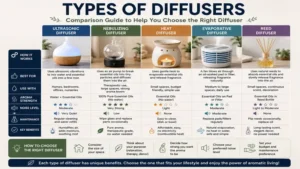
How to Choose the Right Type of Diffuser for Your Space
🔍 Ready to Upgrade Your Types of Diffusers Setup?
Selecting the right diffusion mechanism transforms your living space into a balanced, inviting sanctuary tailored to your health and home environment. Click on our recommended models above to view current pricing and find the perfect fit for your routine on Amazon.
Step 1: Measure Room Square Footage
  ├── Under 100 sq ft ➔ Passive / Heat / Mini Ultrasonic
  ├── 100-300 sq ft   ➔ Standard Ultrasonic / Evaporative
  └── 300+ sq ft      ➔ Cold-Air Nebulizer

Step 2: Identify Air Quality Needs
  ├── Dry Air         ➔ Ultrasonic (Adds Moisture)
  ├── Humid/Damp Air  ➔ Evaporative or Nebulizer (No Moisture)
  └── Pure Aromatherapy➔ Cold-Air Nebulizer (Zero Dilution)
Selecting the best diffuser requires matching mechanical traits to room dimensions, humidity levels, and budget expectations:
-
Calculate Spatial Coverage Requirements: Measure the square footage of your target room. Small bathrooms (under 100 sq. ft.) thrive on passive reed diffusers or small ceramic heat dishes, while wide living rooms (300–600 sq. ft.) need cold-air nebulizers or high-output ultrasonic units.
-
Evaluate Existing Ambient Humidity: If your indoor air is dry—especially during winter heating seasons—ultrasonic mist diffusers provide helpful humidity along with fragrance release. Conversely, damp basements benefit from evaporative fans or nebulizers that add zero moisture.
-
Determine Essential Oil Budget: Pure atomizing nebulizers require significantly more oil bottles over time. If running premium organic oils on a daily budget, choose diluted ultrasonic misting to stretch your oil supply.
-
Assess Noise Sensitivity Requirements: Bedrooms and quiet offices need low-decibel performance. Ceramic heat dishes and passive reeds operate silently (0 dB), ultrasonic units emit a gentle water trickling sound (20–30 dB), and high-pressure nebulizer air pumps create a low hum (40–50 dB).
-
Review Cleaning Commitment Level: Be honest about your regular maintenance habits. If weekly scrubdowns and descaling feel like a chore, skip high-maintenance glass nebulizers and water-filled ultrasonics in favor of passive reed or dry evaporative systems.
Comprehensive Breakdown: Deep Dive into Diffuser Mechanisms
Understanding how distinct diffuser mechanisms process volatile oils helps you choose the best model for your space.
Ultrasonic Diffusers: The Balancing Act
Ultrasonic models dominate the home market because they double as mini-humidifiers. An internal ceramic disc vibrates at ultrasonic frequencies, creating fine water droplets carrying essential oil particles into the room.
[Water Tank + Essential Oil]
             │
             ▼
[Ultrasonic Ceramic Disc Vibrates @ 2.4MHz]
             │
             ▼
[Micro-Fine Cool Mist Released into Room Air]
However, using hard tap water sends dissolved minerals into the air as micro-fine white dust. Over time, these mineral deposits can cover furniture and irritate sensitive lungs. To avoid this, use distilled water and clean the tank regularly.
Nebulizing Diffusers: Pure Botanical Power
Nebulizing diffusers rely on fluid dynamics to atomize oils into a fine vapor mist without water or heat dilution.
[Pure Essential Oil Bottle]
             │
             ▼
[High-Pressure Air Pump (Bernoulli Effect)]
             │
             ▼
[Micro-Atomized Pure Aromatic Molecules]
This approach preserves the complete chemical composition of volatile compounds, as outlined in botanical research from the National Center for Complementary and Integrative Health. This makes nebulizers a favorite choice for professional spas and clinical environments. The trade-off lies in higher oil usage and delicate glass parts that require careful alcohol cleaning.
Evaporative & Heat Diffusers: Low-Maintenance Alternatives
Evaporative systems use simple fan airflow to speed up natural evaporation off a saturated wick or pad, making them a safe choice for child-friendly spaces or home offices.
Heat Diffuser:        [Heat Source] ──> [Warmed Tray] ──> [Evaporated Oil]
Evaporative Fan:      [Fan Airflow] ──> [Saturated Pad] ──> [Circulated Scent]
Heat diffusers use low thermal energy to release scent quickly from ceramic plates or wax trays. While budget-friendly and easy to maintain, applied thermal energy strips away lighter top notes first, leaving heavier base notes behind.
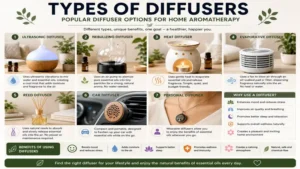
Comparison: Ultrasonic vs. Nebulizing vs. Evaporative vs. Heat vs. Passive
| Performance Feature | Ultrasonic | Nebulizing | Evaporative | Heat-Based | Passive (Reed) |
| Water Requirement | Yes (200–500 ml) | None | None | Optional | None |
| Heat Application | No | No | No | Low Heat | No |
| Fragrance Intensity | Moderate (Diluted) | Extremely High | Moderate | Moderate | Subtle/Continuous |
| Noise Level | Very Low (20–30 dB) | Low/Med (40–50 dB) | Low/Med (30–40 dB) | Silent (0 dB) | Silent (0 dB) |
| Power Source | AC Plug / USB | AC Plug | Battery / USB | AC Plug | None |
| Average Coverage | Up to 300 sq. ft. | Up to 600 sq. ft. | Up to 200 sq. ft. | Up to 100 sq. ft. | Up to 100 sq. ft. |
While ultrasonic units deliver versatile performance across average home layouts, cold-air nebulizers remain the top choice for pure scent density over larger footprints. Evaporative fans and passive reed setups work best for damp spaces or small areas with limited electrical outlets.
Real-World Case Studies: Matching Spaces to Systems
Case Study A: The Open-Concept Suburban Living Room
-
User Profile: A family of four with two pets occupying an open-concept 500-square-foot living room.
-
The Challenge: Eliminating household pet odors across a large area without creating excess dampness or messy spills.
-
The Solution: The Organic Aromas Raindrop Nebulizing Diffuser. Its cold-air atomization covers large spaces without diluting scent in water vapor, effectively clearing cooking and pet odors while keeping furniture moisture-free.
Case Study B: The Dry Winter Home Office
-
User Profile: A remote professional working 8-hour days in a small 120-square-foot home office with dry HVAC heating.
-
The Challenge: Adding light, soothing humidity and subtle fragrance without high noise levels or complex maintenance during work hours.
-
The Solution: The Asakuki 500ml Premium Ultrasonic Diffuser. Placed 4 feet from the desk, its quiet mist output helps counter dry winter air while providing gentle, continuous citrus scents to support focus throughout the workday.
Common Pitfalls When Buying and Operating Diffusers
-
Using Tap Water in High-Mineral Areas: Tap water contains calcium and magnesium that settle on internal components, shortening device lifespan and spreading white mineral dust across furniture. Use filtered or distilled water whenever possible.
-
Overdosing Essential Oils: Dropping 15 to 20 drops of concentrated oil into a small 100ml reservoir causes oil buildup that can melt soft plastics and trigger headaches. Stick to the manufacturer recommendation—typically 3 to 5 drops per 100ml of water.
-
Placing Diffusers Near HVAC Return Vents: Positioning a diffuser next to an air intake vent sucks away the scent vapor before it can circulate through the room, wasting oil and clogging HVAC filters.
-
Neglecting Safety Standards Near Pets: Certain essential oils like tea tree, pine, and cinnamon can be toxic to cats and dogs if inhaled in high concentrations. Review veterinary safety recommendations published by the American Society for the Prevention of Cruelty to Animals (ASPCA) before running high-output nebulizers in enclosed pet spaces.
Safety, Regulations, and Maintenance Guidelines
When operating electrical diffusers, compliance with UL (Underwriters Laboratories) safety certifications ensures electrical safety around water basins. Always look for official UL or ETL seals on the base of ultrasonic devices.
From a indoor air quality perspective, running ultrasonic mist diffusers non-stop in sealed rooms can elevate relative humidity past 60%, creating conditions where dust mites and mold spores thrive. Maintain indoor humidity between 30% and 50% using an inexpensive hygrometer, and use built-in timers (such as 1-hour or 3-hour run modes) rather than non-stop continuous operation.
Frequently Asked Questions
❓ What is types of diffusers?
✅ Types of diffusers include ultrasonic, nebulizing, evaporative, heat, and passive units. Each type relies on distinct mechanical methods—ranging from sound vibrations to fan airflow—to disperse botanical scents and ambient moisture throughout living environments...
❓ Which type of diffuser is best for large living rooms?
✅ Cold-air nebulizing diffusers are best for large spaces because they atomize pure oil without water dilution, pushing concentrated scent across 500+ square feet efficiently...
❓ Can ultrasonic diffusers damage furniture with white dust?
✅ Yes, using mineral-heavy tap water creates fine mineral dust that settles on nearby wooden surfaces. Using distilled water prevents white dust buildup completely...
❓ Are nebulizing diffusers loud during night operation?
✅ Nebulizers generate a low hum (40-50 dB) from their internal air pumps, making them slightly louder than silent ultrasonic units during nighttime bedroom use...
❓ How often should I deep clean an essential oil diffuser?
✅ Rinse water basins every 3-4 uses, and deep clean with a diluted white vinegar wash every two weeks to dissolve mineral scale and clear oil residues...
Conclusion
Choosing among the various types of diffusers comes down to matching your primary goals—whether that means increasing moisture in dry rooms, maximizing pure fragrance in wide open layouts, or securing silent, continuous scenting for small nooks. Ultrasonic models offer an accessible balance of humidity and relaxation for everyday bedrooms, while waterless cold-air nebulizers stand out for pure fragrance power across expansive spaces. By selecting the right mechanism for your square footage and following a consistent cleaning routine, you can create a fresh, inviting home environment tailored to your daily wellness habits.
✨ Found this guide helpful? Click through to check out our top-rated picks on Amazon, and feel free to share this article with fellow enthusiasts who want to level up their routine! 💬🤗
Recommended for You
Disclaimer: This article contains affiliate links. As an Amazon Associate, I earn from qualifying purchases. If you purchase products through these links, we may earn a small commission at no additional cost to you.
✨ Found this helpful? Share it with your friends! 💬🤗