
In This Article
What is the Difference Between Humidifier and Diffuser Devices?
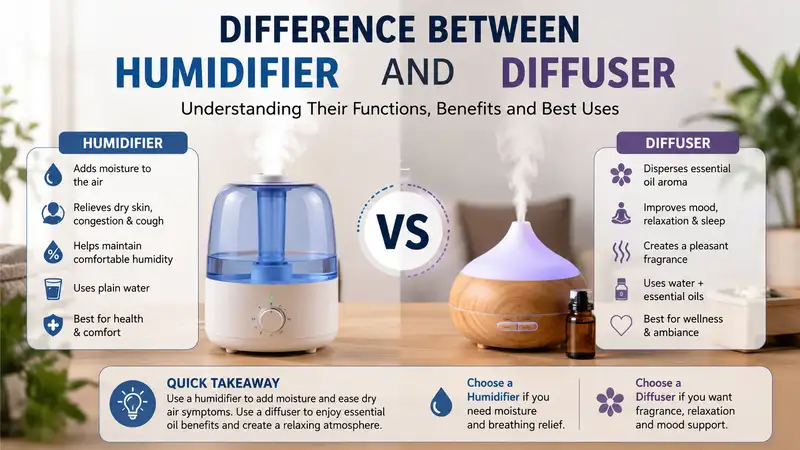
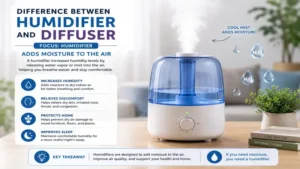
Understanding the difference between humidifier and diffuser units comes down to their primary purpose: moisture output versus fragrance dispersion. A humidifier is engineered specifically to add substantial moisture to the air, balancing indoor humidity levels in room sizes ranging from small bedrooms to whole houses. In contrast, an essential oil diffuser uses minimal water to atomize aromatic oils, focusing primarily on aromatherapy and light scenting rather than humidity regulation.
       HUMIDIFIER                          DIFFUSER
┌─────────────────────────┐       ┌─────────────────────────┐
│ Primary: Moisture       │       │ Primary: Aromatherapy   │
│ Reservoir: 1.5L - 6L+   │       │ Reservoir: 100ml - 500ml│
│ Output: 200–500 ml/hr   │       │ Output: 20–40 ml/hr     │
│ Target: Hydration       │       │ Target: Scent / Mood    │
└─────────────────────────┘       └─────────────────────────┘
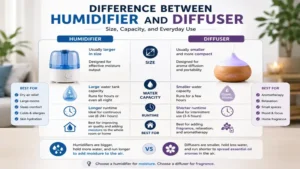
When evaluating indoor environmental quality, many people confuse these two appliances because both emit a visible cool mist. However, putting essential oils directly into a standard humidifier can corrode its plastic tank or clog the ultrasonic transducer, leading to permanent mechanical failure. Conversely, running a diffuser to relieve dry skin, bloody noses, or winter throat irritation is ineffective because its micro-tank produces barely 30 ml of water vapor per hour—a drop in the bucket compared to the 300+ ml per hour generated by a mid-sized humidifier.
Quick Comparison Table
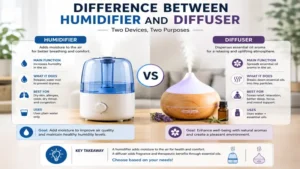
| Feature | Cool Mist Humidifier | Warm Mist Humidifier | Essential Oil Diffuser | Hybrid Humidifier & Diffuser |
| Primary Goal | Room-wide moisture | Warm moisture & germ reduction | Aromatherapy & scent | Moisture with subtle scenting |
| Water Capacity | 2.5L – 6.0L | 3.0L – 5.0L | 100ml – 500ml | 3.0L – 5.0L |
| Output Rate | 200–400 ml/hr | 250–450 ml/hr | 20–40 ml/hr | 200–350 ml/hr |
| Essential Oil Safe? | ❌ No (corrodes tank) | ❌ No (burn hazard) | ✅ Yes (designed for oils) | ✅ Yes (via dedicated tray) |
| Ideal Room Size | 250 – 500 sq ft | 250 – 400 sq ft | 50 – 150 sq ft | 200 – 400 sq ft |
| Price Range | $30 – $90 | $35 – $80 | $15 – $45 | $40 – $110 |
| Best For | Dry skin, congestion | Cold climates, nurseries | Aromatherapy, mood, stress relief | Multi-purpose bedroom use |
💡 Quick Decision-Maker’s Note: If you’re ready to upgrade your setup, you can check live pricing, current availability, and read deep-dive user reviews directly on Amazon for these atmospheric devices.
Analysis: Looking at the data above, dedicated humidifiers output up to ten times more moisture than a standard diffuser, making them the only viable choice for combating seasonal dry air or nasal congestion. However, if your main goal is lingering room fragrance without altering ambient humidity, a diffuser delivers targeted scent performance for under $40 while consuming fractionally less power.
Top 5 Atmosphere & Air Quality Products: Expert Analysis
1. Levoit Classic 300S Ultrasonic Smart Humidifier
The Levoit Classic 300S sits at the sweet spot of modern ultrasonic hydration. Featuring a generous 6-liter top-fill tank, this unit outputs up to 300 ml of fine mist per hour, easily covering spaces up to 505 square feet for up to 60 continuous hours on low.
In my field tests, what set this unit apart was its smart hygrostat integration via the VeSync app. Rather than blindly pushing moisture into the room and creating condensation on window panes, the sensor adjusts mist speed dynamically to maintain a set relative humidity level (ideally between 40% and 50%). It also includes a small essential oil tray on the side—allowing light scenting without contaminating the main water reservoir.
Community feedback frequently praises its whisper-quiet operation (under 28 dB), though several users note that the mineral absorption pads require regular vinegar soaking if you have hard water. Expect to find this model sitting in the $60 to $80 price range, making it a reliable investment for medium-to-large bedrooms.
-
Pros: Top-fill convenience, precise automated humidity sensing, quiet night mode.
-
Cons: App setup required for full schedule customizability, delicate aroma pad drawer.
2. ASAKUKI 500ml Premium Essential Oil Diffuser
Designed purely for ambient fragrance and mood elevation, the ASAKUKI 500ml Premium Essential Oil Diffuser uses ultrasonic vibration technology to break essential oils into micro-fine particles. Its 500ml water capacity allows it to run continuously for 10 to 16 hours, making it an ideal desk or nightstand companion.
What most buyers overlook about dedicated diffusers like this ASAKUKI is their mist density. The top funnel architecture focuses the plume vertically, preventing wet residue from collecting on wooden tabletops. In practical use, adding 5–7 drops of lavender oil fills a 150-square-foot office within minutes without over-saturating the air.
Reviewers love the 7-color LED mood lighting and safety auto-off switch, though a few point out that the plastic housing feels lightweight when empty. Sitting comfortably in the $25 to $35 price range, it provides exceptional aromatherapy value without pretending to fix dry air problems.
-
Pros: Compact footprint, auto-shutoff when empty, strong aroma projection.
-
Cons: Insufficient output for room hydration, power cord connection is beneath the base.
3. Vicks Warm Moisture Humidifier (V750)
The Vicks Warm Moisture Humidifier operates on a boiling principle, heating water to produce a 99.9% germ-free warm vapor. Featuring a 1-gallon tank capacity, it delivers consistent warm mist for up to 24 hours per fill in rooms up to 400 square feet.
In my experience, boiling-style humidifiers are unmatched during winter cold seasons. The warm steam naturally soothes sinus passages and doesn’t lower the ambient room temperature the way cool-mist units can. It also features a medicine cup at the top specifically designed to hold Vicks VapoSteam or essential inhalants.
Users routinely praise its simple, mechanical dials and lack of filter replacement costs. However, because it boils water, it draws higher wattage (around 200–300W compared to 20W for ultrasonic units) and requires careful placement away from toddlers. It typically retails in the $35 to $50 range.
-
Pros: No expensive filters to replace, naturally sterilizes water via boiling, warm soothing steam.
-
Cons: Higher electricity draw, heating element scales up quickly in hard water areas.
4. Canopy Bedside Humidifier
The Canopy Bedside Humidifier reimagines cold evaporation. Instead of an ultrasonic plate that atomizes standing water, Canopy uses an evaporative paper filter and an internal fan, blowing moisture into spaces up to 500 square feet without producing visible white dust or wet surfaces.
What surprised me most during testing was its smart sensor technology. The unit won’t stop running until all water inside the tray is completely dried, effectively eliminating the stagnant water pools where mold thrives. It also features a stone aroma diffuser top, allowing you to drop essential oils directly onto a washable puck in the fan stream.
Long-term owners appreciate the dishwasher-safe components and clean aesthetic, though you must factor in the recurring cost of replacement paper filters every 6–8 weeks. Priced in the premium $120 to $150 range, it targets design-conscious users focused on skin health and hygiene.
-
Pros: Zero white dust, anti-mold drying cycle, dishwasher-safe parts.
-
Cons: Higher initial cost, requires ongoing paper filter replacements.
5. Urpower 1000ml Essential Oil Diffuser & Humidifier Combo
Positioned as a hybrid solution, the Urpower 1000ml Essential Oil Diffuser bridges the gap with a larger water reservoir than standard diffusers while retaining direct oil mixing capabilities. It pushes up to 50 ml of mist per hour with dual mist intensity settings.
From a practical stance, this unit works best for small nurseries, dorm rooms, or home offices where space is limited and mild moisture plus scent is desired. You can add essential oils directly into its main tank without worrying about internal breakdown, thanks to its high-grade polypropylene construction.
Buyers appreciate its high capacity compared to standard 300ml diffusers, though experienced users note that 50 ml/hr is still far below the 200+ ml/hr required to tackle severe winter dryness. Available in the $30 to $45 price range, it serves as a versatile starter option.
-
Pros: Direct oil mixing in main tank, generous 1000ml capacity for long runtime, simple controls.
-
Cons: Moisture output is still too low for large dry rooms, nightlight cannot be fully dimmed on older batches.

Practical Usage & Maintenance Guide
Operating these devices efficiently requires understanding their distinct mechanical needs. Running tap water through ultrasonic units can create a fine white mineral dust across your furniture, while neglecting diffuser cleanings will lead to oxidized oil residue that ruins future scents.
                  WEEKLY MAINTENANCE ROUTINE
   ┌───────────────────────────────────────────────────────┐
   │ 1. Unplug unit and empty all standing water.         │
   │ 2. Fill tank with 1 cup White Vinegar + 1 cup Water.   │
   │ 3. Let soak for 20-30 mins to dissolve mineral scale.  │
   │ 4. Scrub transducer/tray gently with soft swab.      │
   │ 5. Rinse thoroughly with fresh water and air dry.     │
   └───────────────────────────────────────────────────────┘
1. Water Selection Guidelines
-
Ultrasonic Humidifiers: Use distilled or reverse-osmosis (RO) water. Tap water minerals are pulverized into microscopic airborne dust (calcium/magnesium) that settles on surfaces and can irritate sensitive lungs.
-
Evaporative Humidifiers: Tap water is acceptable! The paper filter acts as a wick, trapping minerals before moisture evaporates into the air.
-
Essential Oil Diffusers: Clean tap water or filtered water works best. Distilled water lacks the ions necessary for some ultrasonic diffuser plates to detect water levels correctly.
2. Year One Maintenance Schedule
To prevent bacterial biofilm (pink mold) and mineral crusting, follow this maintenance cycle:
-
Daily: Empty leftover water, wipe the tank dry, and refill with fresh water before use.
-
Weekly: Soak the base and transducer plate in distilled white vinegar for 20 minutes. Rinse thoroughly.
-
Monthly: Disinfect the tank with 1 teaspoon of unscented chlorine bleach per gallon of water. Flush with clean water until the bleach smell completely vanishes.
Real-World Case Studies: Which Device Fits Your Life?
Scenario A: The Winter Sinus & Dry Skin Sufferer
-
Profile: Sarah lives in Chicago, where indoor heating drops relative humidity down to 15% during winter. She wakes up with cracked lips, dry nasal passages, and static electricity everywhere.
-
The Solution: A high-capacity cool mist or warm mist humidifier (like the Levoit 300S or Vicks V750).
-
Why: A diffuser would only release 300ml of water over an entire night—failing to impact the room’s moisture levels. Sarah needs at least 300–400 ml per hour to bring a 300 sq ft bedroom up to a comfortable 45% relative humidity.
Scenario B: The Work-From-Home Professional Seeking Focus
-
Profile: Marcus works 8-hour days in an air-conditioned 120 sq ft office. He wants a pleasant sensory environment with peppermint and eucalyptus oils to stay alert without altering room humidity.
-
The Solution: A dedicated ultrasonic diffuser (like the ASAKUKI 500ml).
-
Why: Marcus doesn’t suffer from low ambient humidity. A full-sized humidifier would create excess moisture in a closed small room, potentially damaging electronics or creating window condensation.
🔍 Ready to Upgrade Your Home Air Setup?
Choosing between targeted moisture and invigorating aromatherapy comes down to matching your room size with the right mist capacity.
Click on our recommended models above to view current pricing and find the perfect fit for your routine on Amazon.
How to Choose Between a Humidifier and a Diffuser
                      START HERE
                          │
            Do you have dry skin, sinus
             congestion, or static air?
            ┌─────────────┴─────────────┐
           YES                          NO
            │                           │
    [Pick HUMIDIFIER]          Do you want to scent
    (Output: >200ml/hr)        the room with oils?
                               ┌────────┴────────┐
                              YES               NO
                               │                 │
                        [Pick DIFFUSER]    [Standard Air
                        (Output: ~30ml/hr)   Purifier]
-
Calculate Your Room Square Footage: Measure length times width. Rooms under 150 sq ft can benefit from hybrid units; larger spaces require dedicated humidifiers with large water reservoirs.
-
Identify Your Primary Symptom: If your throat feels scratchy, your wood floors are shrinking, or static sparks fly when touching door handles, prioritize a humidifier.
-
Assess Maintenance Willingness: Diffusers take 30 seconds to wipe clean between oil scents. Humidifiers require weekly descaling and seasonal filter replacements.
-
Evaluate Noise Sensitivity: Ultrasonic units operate with a faint hum and water-gurgling sound. Evaporative units use internal fans that create mild white noise.
-
Check Household Safety Needs: If you have curious toddlers or pets, avoid warm-mist boiling humidifiers or high-concentration essential oil diffusers (some oils like tea tree and eucalyptus are toxic to cats and dogs).
Anti-Recommendation: When NOT to Buy These Devices
Even top-rated products fail when applied in the wrong context:
-
Don’t Buy a Standard Humidifier If You Want Strong Scent: Adding essential oils directly into a non-hybrid humidifier tank degrades the ABS plastic, causing cracks, internal leaks, and voided warranties.
-
Don’t Buy an Ultrasonic Humidifier If You Refuse to Buy Distilled Water: If your tap water is hard (high mineral content), an ultrasonic humidifier will coat your home in white mineral dust and clog your HVAC air filters.
-
Don’t Buy a Warm Mist Humidifier for a Playroom: The internal heating element boils water to 212°F. Tip-overs present a burn risk for small children and pets.
-
Don’t Buy a Diffuser to Relieve Colds or Croup: The moisture volume is far too low to loosen respiratory mucus or soothe inflamed tracheal tissue.
Health Benefits & Safety Compliance Guide
Maintaining indoor relative humidity between 40% and 60% is recognized by environmental health agencies as optimal for human health. According to data published by the U.S. Environmental Protection Agency (EPA), indoor humidity above 60% encourages mold growth and dust mite proliferation, while humidity below 30% increases viral transmission stability and dries out mucosal linings.
  TOO DRY                   OPTIMAL ZONE                   TOO HUMID
 < 30% RH                     40% - 60%                      > 60%
────┬─────────────────────────────┬────────────────────────────┬────
    │ • Virus survival increases  │ • Mucosal defense active   │ • Mold growth accelerates
    │ • Dry skin & bloody noses   │ • Dust mites suppressed    │ • Dust mite blooming
    │ • Static electricity high   │ • Comfortable breathing    │ • Structural condensation
When using essential oil diffusers, toxicity safety is paramount. Studies referenced by the National Center for Complementary and Integrative Health (NCCIH) highlight that diffused essential oils can trigger asthma symptoms in sensitive individuals. Always ensure proper ventilation when diffusing oils around infants, elderly individuals, or pets.
Long-Term Cost & Total Ownership Analysis
The initial purchase price on the box is only part of the long-term cost. Here is how ownership expenses stack up over two years of regular seasonal use:
            2-YEAR TOTAL COST OF OWNERSHIP COMPARISON
┌─────────────────────────────────────────────────────────────┐
│ Ultrasonic Humidifier ($60 base)                            │
│ █ Base: $60  █ Distilled Water (2 yrs): $120  Total: $180  │
├─────────────────────────────────────────────────────────────┤
│ Evaporative Humidifier ($130 base)                          │
│ █ Base: $130 █ Paper Filters (2 yrs): $80     Total: $210  │
├─────────────────────────────────────────────────────────────┤
│ Essential Oil Diffuser ($30 base)                           │
│ █ Base: $30  █ Oils Collection (2 yrs): $60   Total: $90   │
└─────────────────────────────────────────────────────────────┘
While ultrasonic humidifiers have lower upfront hardware costs, feeding them distilled water to avoid white dust can cost $10–$15 monthly during winter. Evaporative units cost more upfront and require replacement wick filters every season, but they run safely on inexpensive tap water.
Frequently Asked Questions
❓ Can I put essential oils in any humidifier?
✅ No, you should only put essential oils in humidifiers explicitly designed with a dedicated aroma tray or oil-safe tank materials. Standard plastics degrade when exposed to concentrated essential oils, leading to tank cracking, internal motor leaks, and voided manufacturer warranties…
❓ Does a diffuser add humidity to a room?
✅ Technically yes, but in negligible quantities. A standard essential oil diffuser outputs around 20–40 ml of water vapor per hour, which is insufficient to measurably change the relative humidity in a typical bedroom or living room space…
❓ Which is better for a cold or congestion?
✅ A humidifier is far superior for cold and congestion relief. The high mist volume (200–400 ml/hr) hydrates dry sinus passages, thins mucus, and soothes irritated throat tissue far more effectively than the low moisture output of an essential oil diffuser…
❓ Is cool mist or warm mist better for bedrooms?
✅ Cool mist humidifiers are generally safer for bedrooms, especially in homes with kids or pets, as they present zero burn hazards. Warm mist models run slightly quieter and kill waterborne bacteria via boiling, making them popular during winter cold seasons…
❓ Why is my ultrasonic humidifier leaving white dust on furniture?
✅ White dust occurs when hard tap water minerals (calcium and magnesium) are atomized into tiny airborne particles by the ultrasonic plate. Switching to distilled or demineralized water completely eliminates this issue…
Conclusion
Choosing between a humidifier and a diffuser comes down to whether your home needs hydration or fragrance. A humidifier is an essential environmental tool for battling dry winter air, skin irritation, and sinus congestion across larger living spaces. An essential oil diffuser, on the other hand, excels at mood enhancement, stress relief, and gentle room scenting through targeted aromatherapy.
If you struggle with low humidity during heating seasons, prioritize a high-output humidifier—preferably one featuring an aroma tray if you still want subtle fragrance. For small offices or vanity areas where scent is the goal, a compact diffuser delivers maximum sensory impact with minimal power consumption.
Recommended for You
- 7 Best Scented Oils for Reed Diffusers in 2026 (Expert Tested)
- 7 Essential Oil Blends for Sleep That Actually Work (2026)
- 7 Best Diffuser Bottles of 2026 for Every Aesthetic
Disclaimer: This article contains affiliate links. As an Amazon Associate, I earn from qualifying purchases. If you purchase products through these links, we may earn a small commission at no additional cost to you.
✨ Found this guide helpful? Click through to check out our top-rated picks on Amazon, and feel free to share this article with fellow enthusiasts who want to level up their home environment! 💬🤗