
In This Article
What Is a Wooden Oil Diffuser?
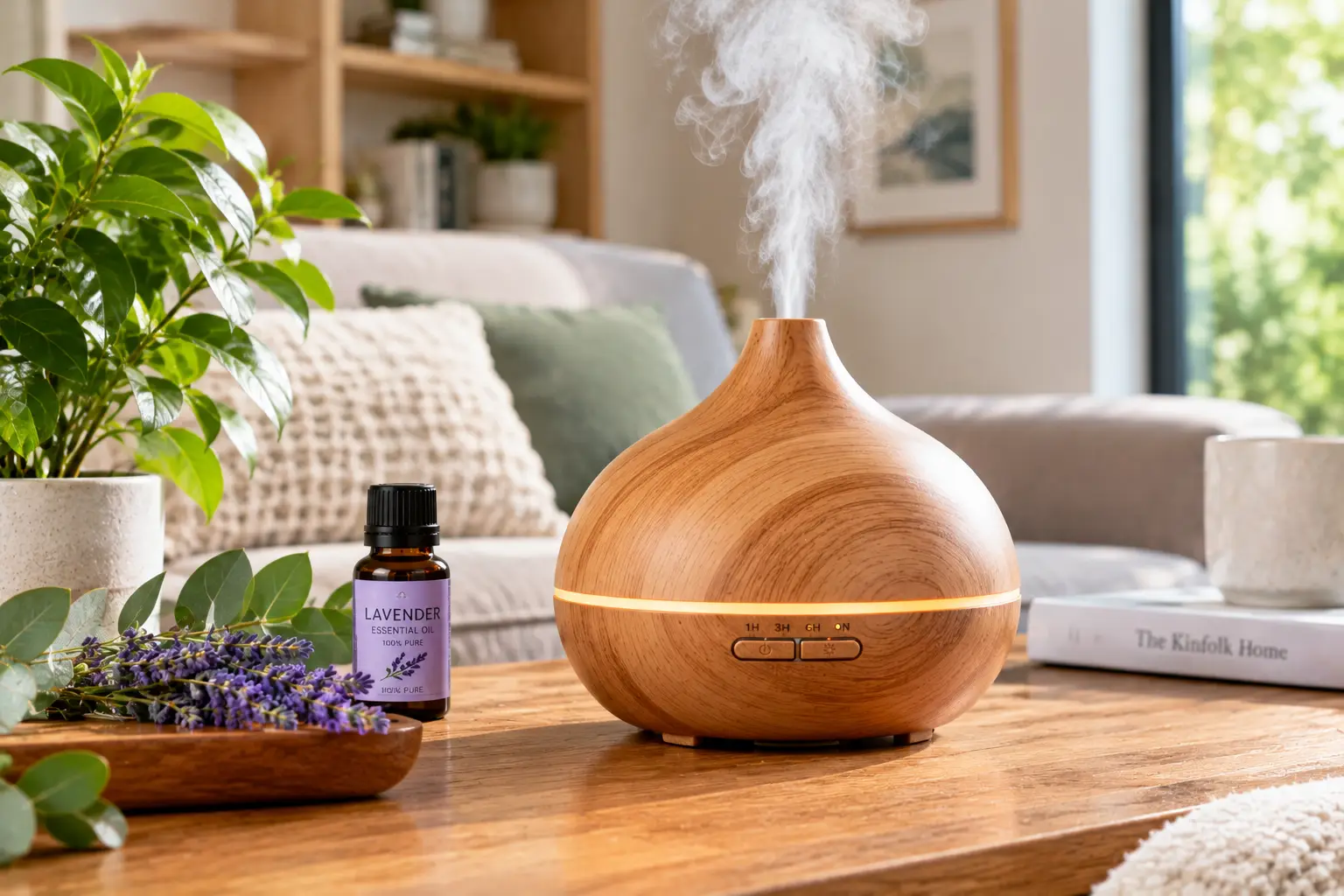
A wooden oil diffuser is an aromatherapy device that uses natural wood—solid hardwood, bamboo, or pine—as its housing, base, or scent-absorbing surface. It releases essential oil aroma through ultrasonic mist, waterless nebulization, or slow passive evaporation, giving you a warmer, more natural look than the all-plastic diffusers that dominate store shelves.
Here’s the thing most shopping guides skip: “wooden” means wildly different things depending on the listing. Some diffusers wear a genuine bamboo shell over a plastic water tank. Some are high-end nebulizers that sit a hand-blown glass reservoir on a hardwood base. Others are simply a block of beech that soaks up a few drops of oil and lets them evaporate. And a big chunk of the “wood” diffusers you’ll scroll past are plastic printed with a wood-grain pattern—fine products, but not what this guide is about.
That distinction matters because each type behaves differently in your home. A bamboo ultrasonic unit adds a little humidity and runs quietly all night. A wooden nebulizing diffuser throws concentrated scent across an open-plan living room in minutes. A passive wood diffuser is silent, cordless, and subtle enough for a desk drawer or a car.
Whichever style you lean toward, you’re working with essential oils—concentrated, volatile plant extracts—so the device you choose shapes how strong, how long, and how safely that scent fills your space. Below, you’ll find seven real, purchasable picks spanning budget, mid-range, and premium, plus practical setup advice, troubleshooting, and a clear-eyed look at what’s marketing fluff and what actually matters.
Quick Comparison: Which Type of Wooden Diffuser Fits You?
| Diffuser Type | How It Works | Scent Strength | Needs Power? | Best for |
|---|---|---|---|---|
| Passive wood diffuser | Wood absorbs oil drops; scent evaporates slowly | Subtle, close-range | No | Desks, closets, cars — e.g., Wealrit Beech Wooden Diffusers |
| Bamboo ultrasonic diffuser | Vibrating plate turns water + oil into cool mist | Moderate | Yes | Bedrooms, overnight use — e.g., NOW Solutions Ultrasonic Real Bamboo Diffuser |
| Wooden nebulizing diffuser | Air pump atomizes pure, undiluted oil | Strong, room-filling | Yes | Living rooms, large spaces — e.g., Organic Aromas Raindrop 2.0 |
Looking at the table, the core trade-off is intensity versus convenience. A passive wood diffuser costs almost nothing to run and never needs an outlet, but it only scents the air within a few feet. Ultrasonic bamboo units hit the sweet spot for bedrooms, while nebulizers deliver the most power—at the cost of a higher price and faster oil consumption.
💬 One click helps other shoppers make an informed choice too! 😊
Top 7 Wooden Oil Diffusers: Expert Analysis
1. NOW Solutions Ultrasonic Real Bamboo Diffuser — best all-around bamboo pick
The NOW Solutions Ultrasonic Real Bamboo Diffuser (model 7521) earns its spot by pairing a genuine bamboo cover and base with a well-documented spec sheet—something many no-name wood diffusers lack.
It holds 150 ml (about 5 oz) of water and runs up to 7 hours continuously or 14 hours on intermittent mode, with 1-hour and 2-hour timers and automatic shut-off. In practice, that 14-hour intermittent setting covers a full night with room to spare. NOW rates it for roughly 400 square feet at 12W, which translates to a standard bedroom or home office rather than an open-concept great room.
Based on the specs, this is the pick for someone who wants real wood and predictable behavior without paying nebulizer prices. The 1-year warranty and a stated 5,000+ hour run life also suggest NOW expects it to last. If you need to scent a big living area, though, the coverage figure tells you to look elsewhere.
Review sentiment is mostly positive about the clean, natural look and the quiet operation, though some buyers note the mist output feels lighter than other diffusers they own, and at least a few have voiced frustration with customer-service responsiveness.
Pros:
- ✅ Genuine bamboo cover and base, not printed wood grain
- ✅ Up to 14 hours on intermittent mode
- ✅ BPA-free build with a 1-year warranty
Cons:
- ❌ Mist output is modest compared with larger units
- ❌ Coverage tops out around a mid-size room
Expect it in the $35–$50 range at the time of writing—fair value for real bamboo and a reputable brand.
2. URPOWER Real Bamboo Essential Oil Diffuser — budget-friendly real bamboo shell
The URPOWER Real Bamboo Essential Oil Diffuser is one of the most affordable ways to get an actual bamboo exterior rather than a wood-grain print.
The listing describes a bamboo-and-plastic build—bamboo on the outside, a plastic water reservoir inside—with ultrasonic misting, continuous and intermittent modes, and color-changing accent lights you can switch off. That light switch matters more than it sounds: if you’re running a bamboo oil diffuser in the bedroom, the ability to go fully dark is the difference between sleeping well and staring at a glowing orb. It comes in a natural bamboo tone and a darker stained finish.
Honestly, this is a smart first diffuser for small rooms. It’s not built for big spaces, and its spec details are less consistent than the NOW model’s.
Reviews consistently praise how quiet it is and how easy it is to set up, and several buyers mention the intermittent mode lasting through the night. On the flip side, some report it runs dry in about four hours in larger rooms, one noted a first-use leak, and another flagged confusion between the advertised tank capacity and the manual’s max-fill line.
Pros:
- ✅ Real bamboo exterior at an entry-level price
- ✅ Lights can be turned off for sleep
- ✅ Very quiet, according to most reviews
Cons:
- ❌ Best suited to small rooms only
- ❌ Some quality-control complaints about leaks and color mismatch
Usually found in the $20–$35 range—strong value if your space is small.
3. Organic Aromas Raindrop 2.0 — the most popular wooden nebulizer
The Organic Aromas Raindrop 2.0 is a waterless nebulizing diffuser built from a plantation hardwood base and a hand-blown glass reservoir—no water, no heat, and no plastic touching the oil.
Instead of ultrasonic vibration, it uses an air pump working on Bernoulli’s principle: fast-moving air creates low pressure that pulls oil up and breaks it into microscopic droplets. The practical result is concentrated scent—Organic Aromas rates it for up to about 800 square feet. It cycles 2 minutes on, 1 minute off, and shuts down after 2 hours, which keeps you from going “nose blind” and slows oil consumption. A rainbow LED can be switched on or off.
Here’s what to weigh: nebulizers use pure oil, so your running cost rises noticeably compared with a few drops in water. If you want powerful, short sessions in a living room or studio, though, this wooden nebulizing diffuser is the benchmark the category is measured against.
Reviews frequently describe scent strength that water-based diffusers can’t match and praise the warm, smooth wood base; several owners say they’ve had no clogs with regular cleaning. A minority report electrical or return hassles.
Pros:
- ✅ Strong, room-filling scent without water dilution
- ✅ Real hardwood and hand-blown glass construction
- ✅ Auto cycle and 2-hour shut-off reduce oil waste
Cons:
- ❌ Uses noticeably more oil than ultrasonic models
- ❌ Glass reservoir needs gentle handling
Generally priced around $100–$130—worth it if scent strength is your top priority.
4. ArOmis Premium Glass Nebulizer (Wood Base) — quietest look, no lights at all
The ArOmis Premium Glass Nebulizer pairs a natural pine wood base with a hand-blown glass bottle, and it skips LED lights entirely—a genuine plus for light-sensitive sleepers.
It’s waterless and heat-free, with an adjustable intensity knob and a built-in “10 on / 10 off” cycle that shuts off after 4 hours. ArOmis says it can scent areas up to roughly 30 by 30 feet. In plain terms, the longer 4-hour window makes it friendlier than the 2-hour Raindrop for an evening routine, and the intensity control lets you dial it down for a small bedroom.
Based on comparing the specs, this is the minimalist’s nebulizer: no light show, no plastic in the oil path, and a longer cycle. It’s an especially good fit if you find rainbow LEDs tacky.
Customer feedback highlights the elegant look and a rubber-backed base that keeps the unit steady even though it vibrates during use. Common caveats: the glass is delicate around pets and kids, very thick oils (amyris is one example mentioned) won’t diffuse well, and cleaning the narrow tubes takes patience—a few buyers felt its scent was no stronger than their previous diffuser.
Pros:
- ✅ No lights—ideal for dark bedrooms
- ✅ Longer 4-hour cycle with adjustable intensity
- ✅ Pine wood and glass only in the oil path
Cons:
- ❌ Thick oils struggle to nebulize
- ❌ Fragile glass and fiddly tube cleaning
Typically in the $90–$110 range—solid value for a lights-free nebulizer.
5. Organic Aromas Radiance — premium hardwood statement piece
The Organic Aromas Radiance is the brand’s showpiece: a 100% whole plantation hardwood body finished with water-based lacquer, topped by an individually hand-blown glass reservoir.
Functionally, it shares the nebulizing approach of the Organic Aromas Raindrop 2.0: the 2-minutes-on, 1-minute-off cycle, a 2-hour auto shut-off, rainbow LED lighting, and a rated coverage around 800 square feet. The meaningful difference is design and finish. The water-based lacquer is a detail worth noting—Organic Aromas states it won’t off-gas, which matters when the whole point is cleaner indoor air.
So who’s it for? Someone who wants their wooden oil diffuser to double as décor on a mantel or bookshelf. If you only care about performance, the Raindrop 2.0 gets you most of the way for less.
Owners often describe it as looking like a piece of art and are surprised by how little oil it uses for the scent it produces. A few reviewers say it’s not quite as silent as advertised, and some have mixed feelings about the color-changing lights.
Pros:
- ✅ Solid plantation hardwood with non-off-gassing finish
- ✅ Gallery-worthy design for living spaces
- ✅ Powerful nebulizing scent with efficient oil use
Cons:
- ❌ Premium price for similar performance to Raindrop
- ❌ Faint pump noise in very quiet rooms
Typically priced above $130—check the current price; you’re paying mainly for craftsmanship.
6. Plant Therapy Lava Rock Passive Diffuser — zero electricity, zero noise
The Plant Therapy Lava Rock Passive Diffuser proves a wooden diffuser doesn’t need a plug: a porous lava stone disc sits in a fitted beech wood base.
You add a few drops of oil to the unglazed lava rock, which absorbs it and releases scent slowly—no heat, no water, no electricity. The beech base is mostly about presentation and protecting your furniture, while the stone does the diffusing. In practice, expect a gentle, close-range aroma ideal for a nightstand, a desk, or a bathroom counter, not a whole room.
This is the honest pick for anyone who’s sensitive to strong scents, lives with roommates, or simply wants a cordless passive wooden diffuser that works anywhere. It’s also a thoughtful low-cost gift.
Broad, verifiable review data for this specific item is limited, so we won’t summarize sentiment we can’t confirm. What’s well established about passive diffusers in general: scent fades within hours and needs re-dosing, and porous stone or wood can discolor with darker oils over time.
Pros:
- ✅ No cords, power, or water needed
- ✅ Silent and safe from tip-over spills
- ✅ Low cost with reusable materials
Cons:
- ❌ Scent only reaches a small area
- ❌ Requires re-applying oil frequently
Usually in the $10–$20 range—great value for subtle, personal-space aroma.
7. Wealrit Beech Wooden Diffusers (6-Pack) — cheapest way to scent many spaces
The Wealrit Beech Wooden Diffusers are small 1.2-inch beech wood pieces sold as a six-pack, built to absorb essential oil and release it slowly.
Unlike every electric option above, these are pure passive wood—the wood itself is the diffuser. Beech has a fairly fine, even grain, which means it absorbs oil steadily rather than in blotchy patches. Six pieces lets you tuck one in a closet, a gym bag, a car cup holder, a dresser drawer, and a desk all at once.
Based on the format, this is a utility buy rather than a centerpiece: perfect for keeping linens fresh or giving you a whiff of peppermint at your desk. It’s also a low-risk way to test whether you even enjoy diffusing before investing in an electric wood essential oil diffuser.
Verified review volume for this listing appears limited, so we can’t responsibly summarize customer sentiment. The general limits of small passive pieces apply: very localized scent and frequent re-dosing.
Pros:
- ✅ Six pieces cover multiple small spaces
- ✅ Fine-grained beech absorbs oil evenly
- ✅ Pocket-sized for cars, bags, and drawers
Cons:
- ❌ Scent radius is just a few inches to feet
- ❌ Limited verified customer reviews so far
Generally under $15 for the set—an inexpensive experiment in passive aromatherapy.
Side-by-Side: All 7 Wooden Diffusers Compared
| Product | Type | Wood Material | Run Time / Cycle | Rated Coverage | Price Range | Best for |
|---|---|---|---|---|---|---|
| NOW Solutions Ultrasonic Real Bamboo Diffuser | Ultrasonic | Bamboo cover & base | 7 hr cont. / 14 hr int. | ~400 sq ft | $35–$50 | Overnight bedroom use |
| URPOWER Real Bamboo Essential Oil Diffuser | Ultrasonic | Bamboo shell | Cont. + int. modes | Small rooms | $20–$35 | First-time buyers |
| Organic Aromas Raindrop 2.0 | Nebulizer | Plantation hardwood | 2 on / 1 off, 2-hr shut-off | ~800 sq ft | $100–$130 | Strong scent, large rooms |
| ArOmis Premium Glass Nebulizer | Nebulizer | Pine base | 10 on / 10 off, 4-hr shut-off | ~30 × 30 ft | $90–$110 | Lights-free bedrooms |
| Organic Aromas Radiance | Nebulizer | Plantation hardwood | 2 on / 1 off, 2-hr shut-off | ~800 sq ft | $130+ | Décor-focused buyers |
| Plant Therapy Lava Rock Passive Diffuser | Passive | Beech base | Hours per dose | Personal space | $10–$20 | Scent-sensitive users |
| Wealrit Beech Wooden Diffusers | Passive | Beech | Hours per dose | Inches to feet | Under $15 | Cars, closets, drawers |
Reading across the rows, the NOW Solutions Ultrasonic Real Bamboo Diffuser offers the best balance of real wood, run time, and price for most bedrooms. If raw scent power is non-negotiable, the Organic Aromas Raindrop 2.0 justifies its higher price, while the ArOmis Premium Glass Nebulizer wins for anyone who wants nebulizer strength without any lights. Budget shoppers testing the waters should start with the Wealrit Beech Wooden Diffusers.
Getting Started: How to Set Up and Maintain Your Wooden Diffuser 🌿
A wooden diffuser rewards a little care more than a plastic one does, because wood reacts to water, oil, and sunlight. Here’s how to get it right from day one.
For bamboo ultrasonic models
- ✅ Fill below the max line. Use room-temperature tap water (or distilled water if you have hard water) and stop at the marked line. Overfilling is the number-one cause of leaks onto your furniture.
- ✅ Start with 3–5 drops of oil. The NOW Solutions Ultrasonic Real Bamboo Diffuser suggests about five drops for its 150 ml tank. You can always add more; you can’t take it back out.
- ✅ Wipe the bamboo dry. Condensation that sits on bamboo can lead to warping or water spots. A soft, dry cloth after each session is enough.
For wooden nebulizers
- ✅ Never add water. Nebulizers run on pure oil only.
- ✅ Clean every few bottles. Run a small amount of isopropyl alcohol through the glass, per the maker’s instructions, to keep resin from building up—especially with citrus or thick oils.
- ✅ Keep the glass upright and secured. Hand-blown glass is the most fragile part of any wooden nebulizing diffuser.
For passive wood diffusers
- ✅ Dose lightly, refresh often. Three or four drops every few hours beats soaking the wood.
- ✅ Dedicate one piece per scent family if you rotate oils, since wood holds onto previous aromas.
Maintenance tip: if raw wood surfaces begin to look dry or chalky, a very light coat of food-grade mineral oil or beeswax can restore the finish—apply it only to exterior surfaces, never inside a tank or reservoir. Finally, keep any wooden diffuser out of direct sun and away from heating vents, which dry and crack wood over time.
Real-World Scenarios: Matching the Right Diffuser to Your Life
Specs are abstract until you picture them in a real home. Here are three common profiles and the reasoning behind each match.
🛏️ The light sleeper in a small apartment
Picture someone in a 600-square-foot one-bedroom who wants lavender at night but wakes up at the slightest glow. Budget: under $60. Use: nightly, 7–8 hours. The NOW Solutions Ultrasonic Real Bamboo Diffuser is the natural fit—its 14-hour intermittent mode covers the whole night, and its 400-square-foot rating matches a bedroom well. If a completely dark room is the top priority and the budget stretches, the ArOmis Premium Glass Nebulizer has no lights at all, though its 4-hour shut-off means it’s better for winding down than for all-night scent.
🛋️ The open-plan host
Now imagine a family with a combined kitchen and living area of about 700 square feet who wants the space to smell inviting before guests arrive. Budget: around $100–$150. Use: a few times a week, in short bursts. A nebulizer is the only category that genuinely fills that volume, and the Organic Aromas Raindrop 2.0 is built for exactly this: run it 20–30 minutes before people show up, and the 2-hour shut-off handles the rest. If the diffuser will sit front-and-center on a console table, the Organic Aromas Radiance adds a design upgrade.
🚗 The commuter and remote worker
Finally, think of someone splitting time between a car, a home desk, and a gym bag. Budget: under $25. Use: daily, personal space. The Wealrit Beech Wooden Diffusers six-pack spreads across every location, while a Plant Therapy Lava Rock Passive Diffuser on the desk adds a more decorative touch. Neither requires an outlet—which, in a car, is a safety feature, not just a convenience.
✨ Ready to bring natural warmth and calming scent home?
🔍 Take your aromatherapy to the next level with this carefully curated lineup. Click a highlighted item to check current pricing and availability. These picks will help you create a calmer, better-smelling home the whole family will enjoy!
Troubleshooting: Common Wooden Diffuser Problems and Fixes 🔧
Even the best wooden diffuser hits a snag now and then. Here are the most frequent issues buyers report, with practical fixes.
Problem 1: Weak or no mist from a bamboo ultrasonic unit. Mineral buildup on the ultrasonic plate is the usual culprit. Unplug the unit, add a little white vinegar to the tank, let it sit a few minutes, then gently wipe the plate with a cotton swab. Switching to distilled water reduces how often this happens. If output is still weak, remember that compact units like the URPOWER Real Bamboo Essential Oil Diffuser are designed for small rooms—so the issue may be room size, not a defect.
Problem 2: Nebulizer sputters or stops diffusing. Thick oils (vetiver, sandalwood, some resins) and old citrus oils can gum up the narrow glass channels. Clean with isopropyl alcohol per the manufacturer’s directions, and blend thick oils with a thinner one. Reviewers of the ArOmis Premium Glass Nebulizer specifically note that very viscous oils won’t diffuse well no matter what.
Problem 3: Water spots or warping on the bamboo. This happens when condensation or spills sit on the wood. Dry the exterior after each use, place the diffuser on a coaster, and never fill above the max line.
Problem 4: Passive diffuser smells like the wrong oil. Wood absorbs and holds scent. Give each piece a “home” scent, or let it air out for several days before switching to a very different oil.
Problem 5: You stopped smelling anything. That’s often olfactory fatigue—your nose adapting—not the diffuser failing. This is exactly why the Organic Aromas Raindrop 2.0 runs on an on/off cycle. Use intermittent modes, and step outside the room for a few minutes to “reset” your nose.
How to Choose a Wooden Oil Diffuser: 7 Steps
- Confirm it’s real wood. Check the materials list for “bamboo,” “hardwood,” “beech,” or “pine.” “Wood grain” usually means printed plastic.
- Pick your diffusion method. Passive for subtle personal space, ultrasonic for overnight bedroom use, nebulizer for strong scent in large rooms.
- Match coverage to your room. Measure the space; a 400-square-foot unit won’t fill an 800-square-foot open plan.
- Check run time and cycle. Overnight users need long intermittent modes; nebulizer owners benefit from automatic cycling to save oil.
- Look for automatic shut-off. Every electric pick in this guide has it—treat it as a must, not a perk.
- Consider lights and noise. If you sleep with the diffuser on, choose a model whose LEDs switch off, or one with no lights at all.
- Factor in ongoing oil costs. Nebulizers can go through a bottle much faster than ultrasonic or passive diffusers.
Want the deeper “why” behind those steps? Keep reading—the next sections break down the comparison between types and the features that genuinely change your experience.
Bamboo Oil Diffuser vs Wooden Nebulizing Diffuser vs Plastic Diffuser
The biggest decision isn’t brand—it’s technology. A bamboo oil diffuser is, at heart, an ultrasonic diffuser with a natural shell. It dilutes a few drops of oil in water and releases a cool mist, so it’s gentle, economical, and slightly humidifying. A wooden nebulizing diffuser takes the opposite approach: no water, pure oil, and much stronger output. A standard plastic ultrasonic diffuser works just like the bamboo version but trades natural materials for lower cost and often bigger tanks.
| Factor | Wood/Bamboo Diffuser | Standard Plastic Diffuser | Best for |
|---|---|---|---|
| Look and feel | Warm, natural, blends with décor | Functional, often clinical | Design-minded rooms — Organic Aromas Radiance |
| Oil contact surfaces | Glass (nebulizers) or plastic tank (bamboo ultrasonic) | Plastic throughout | Plastic-avoiders — ArOmis Premium Glass Nebulizer |
| Price | Moderate to premium | Usually lowest | Budget wood fans — URPOWER Real Bamboo Essential Oil Diffuser |
| Care needed | Keep wood dry; occasional conditioning | Wipe and descale only | Low-fuss users — plastic models |
The table makes one honest point clear: if avoiding plastic contact with your oils is the goal, only nebulizers like the ArOmis Premium Glass Nebulizer and the Organic Aromas Raindrop 2.0 truly deliver, because bamboo ultrasonic models still use a plastic water tank inside. For most people, though, the bamboo shell is about aesthetics—and that’s a perfectly good reason to choose one. Plastic models remain the cheapest, easiest-care option if looks don’t matter to you.
Features That Actually Matter (and Ones That Don’t)
Listings for any wood essential oil diffuser are packed with buzzwords. Here’s how to separate what changes your daily experience from what just fills bullet points.
Features that matter:
- ⚡ Intermittent or cycling modes. They stretch a tank through the night on ultrasonic units and dramatically slow oil use on nebulizers, while reducing nose fatigue.
- 🌙 A light-off option. Seemingly minor, but for bedroom use it’s a dealbreaker. The ArOmis Premium Glass Nebulizer skips lights entirely; the URPOWER Real Bamboo Essential Oil Diffuser lets you switch them off.
- 🔋 Auto shut-off. Protects the device and your home if you forget it’s running.
- 🌳 Finish quality. A sealed or lacquered finish resists water spots and oil stains. Organic Aromas’ note that its lacquer won’t off-gas is the kind of detail worth looking for.
Features that matter less than you’d think:
- 🎨 Seven-color LED shows. Fun for some, but they don’t affect scent at all.
- 📏 Huge tank capacity on its own. Capacity means little without knowing the mist rate; a bigger tank on a high-output setting can run out just as fast.
- 💊 “Therapeutic” marketing claims. The National Center for Complementary and Integrative Health notes that rigorous research on aromatherapy for issues like insomnia is limited. Enjoy diffusing for the atmosphere and pleasure it adds—but don’t buy a diffuser expecting medical outcomes.
Long-Term Cost and Maintenance
The sticker price is only the first chapter. The real cost of a wooden oil diffuser depends on how much oil it consumes and how long it lasts.
| Product | Upfront Price Range | Ongoing Oil Use | Maintenance Effort | Best for |
|---|---|---|---|---|
| Wealrit Beech Wooden Diffusers | Under $15 | Very low (few drops) | Minimal | Lowest total cost |
| NOW Solutions Ultrasonic Real Bamboo Diffuser | $35–$50 | Low (drops in water) | Weekly descaling | Long-term value |
| Organic Aromas Raindrop 2.0 | $100–$130 | High (pure oil) | Periodic alcohol cleaning | Scent power per dollar |
| Organic Aromas Radiance | $130+ | High (pure oil) | Periodic alcohol cleaning | Décor + performance |
The pattern is clear: passive and ultrasonic models are cheap to run because they use only a handful of drops per session, while nebulizers consume pure oil and can cost far more over a year if you run them daily. That said, a nebulizer used in short 20–30 minute bursts can be surprisingly efficient—several Organic Aromas Radiance owners specifically comment on how little oil it uses relative to the scent it produces.
To maximize lifespan, prioritize models with stated warranties (the NOW Solutions Ultrasonic Real Bamboo Diffuser and Organic Aromas nebulizers both advertise one-year coverage), clean on schedule, and protect the wood from moisture. A well-maintained wooden diffuser can easily outlast several cheap plastic replacements.
Safety, Regulations, and Standards 🛡️
Natural wood doesn’t make a diffuser automatically “safe”—how and where you use it does. Keep these points in mind.
Electrical safety. For any plug-in diffuser, look for a UL or ETL listing on the adapter or product label; these marks indicate testing to recognized US safety standards by a Nationally Recognized Testing Laboratory. Avoid placing electric units where water could reach an outlet, and use the included adapter only.
Indoor air quality. Essential oils release volatile organic compounds (VOCs), the same broad class of chemicals found in many air fresheners. The EPA’s guidance on VOCs and indoor air recommends good ventilation, following label directions, and keeping products away from children and pets. In practice, that means diffusing in shorter sessions, cracking a window when possible, and favoring intermittent modes—especially with powerful nebulizers.
Pets and kids. Some essential oils can be harmful to pets, particularly cats and birds, and glass reservoirs are an obvious breakage hazard. Place diffusers out of reach, make sure animals can leave the room, and check with your veterinarian before diffusing around pets. NOW’s own label carries a “keep away from children and pets” caution.
Sensitive individuals. People with asthma, allergies, or respiratory conditions should talk to a healthcare provider before using any diffuser regularly. Start with a passive wooden diffuser, which produces the gentlest exposure.
Fire safety. None of the picks here use heat or flame—one of the quiet advantages over candles and heated oil warmers.
Common Mistakes to Avoid When Buying a Wooden Oil Diffuser
Even savvy shoppers trip over the same few pitfalls. Steer clear of these and you’ll be happier with your purchase.
- Assuming “wood grain” means wood. It almost always means printed plastic. If real wood is the goal, read the materials line, not the photo.
- Buying a nebulizer for a small bedroom. A unit rated for 800 square feet can overwhelm a 120-square-foot room. Choose the ArOmis Premium Glass Nebulizer with its intensity knob, or step down to an ultrasonic bamboo model.
- Ignoring the cost of oil. Nebulizers are only “expensive” once you factor in the pure oil they consume. Budget for it.
- Expecting a passive diffuser to fill a room. Pieces like the Wealrit Beech Wooden Diffusers are designed for personal space. That’s a feature, not a flaw—just set your expectations accordingly.
- Placing wood next to heat or sun. Windowsills and radiators dry out wood and can crack finishes over time.
- Using fragrance oils in a nebulizer. Most nebulizer makers, including Organic Aromas, recommend pure essential oils only; synthetic fragrance oils and thick carrier blends can clog the glass.
- Skipping the return-window check. Several reviewers mention return hassles with electronics bought online. Test your diffuser promptly and keep the packaging until you’re sure.
FAQ: Wooden Oil Diffuser Questions Answered
❓ Is a wooden oil diffuser better than a plastic one?
❓ Can you put essential oil directly on a wooden diffuser?
❓ How long does the scent last on a passive wood diffuser?
❓ Which wooden oil diffuser is best for a large living room?
❓ Are wooden diffusers safe to leave on overnight?
Conclusion: Find the Wooden Oil Diffuser That Fits Your Space
Choosing a wooden oil diffuser comes down to three honest questions: how big is your room, how strong do you want the scent, and how much do you care about keeping plastic out of the picture?
For most bedrooms and home offices, the NOW Solutions Ultrasonic Real Bamboo Diffuser delivers the best mix of real bamboo, long run time, and fair pricing, while the URPOWER Real Bamboo Essential Oil Diffuser is the friendliest entry point for small spaces. If you want scent that genuinely fills a large, open room, the Organic Aromas Raindrop 2.0 remains the benchmark wooden nebulizing diffuser, with the Organic Aromas Radiance as its design-forward upgrade and the ArOmis Premium Glass Nebulizer as the lights-free alternative. And if you’d rather skip cords entirely, the Plant Therapy Lava Rock Passive Diffuser and Wealrit Beech Wooden Diffusers prove that a little wood and a few drops of oil can go a long way.
Whatever you choose, keep the wood dry, clean on schedule, ventilate your space, and enjoy diffusing for the calm, welcoming atmosphere it creates—rather than for promised health cures. Treat your diffuser like a small piece of furniture, and it will reward you with years of natural warmth and great scent.
🌿 Your calmer, better-smelling home starts here!
🔍 Take your aromatherapy to the next level with this carefully curated lineup. Click a highlighted item to check current pricing and availability. These picks will help you create a cozy, inviting atmosphere the whole family will enjoy!
Recommended for You
- Spa Scented Candles: 7 Best Picks for Pure Calm in 2026
- sparoom essential oil diffuser: 7 Smart Picks & Honest Guide 2026
- Large Reed Diffuser: 7 Best Picks That Actually Fill a Room (2026)
Disclaimer: This post contains affiliate links. As an Amazon Associate, I earn from qualifying purchases made through these links, at no additional cost to you.
✨ Found this article helpful? Share it with someone who needs it! 💬🤗