
In This Article
As an Amazon Associate I earn from qualifying purchases. Links in this article may be affiliate links. How we choose products
Verdict first: a listing that promises “essential oils skin safe” is really promising a dilution, not a bottle, and the percentage on the label matters more than the word natural. FDA’s aromatherapy page says a plant origin guarantees nothing, since some plant oils irritate, trigger allergies or blister skin, and the Tisserand Institute’s dilution guide runs from 0.2 percent for impaired skin up to 10 percent for a small rollerball. That spread is why this 2027 guide starts with strength and ends with the bottle.
Dilution charts from the Tisserand Institute and Plant Therapy, FDA and ASPCA guidance, a Tisserand survey of reactions to cinnamon oils, the Airversa manual and a handful of HVAC-maker FAQs supply the facts below, and each one is named where it changes a decision.
The route runs from label to arm to room: how to read a bottle, which strength suits which job, five picks from neat lavender to a cordless diffuser, then a plain look at furnaces, ducts and pets.
How to know if essential oils are skin safe before one touches your arm
“Safe” is not a legal category. FDA’s aromatherapy page notes that essential oils have no regulatory definition, that natural and organic have none for cosmetics either, and that every cosmetic ingredient faces the same safety requirement whatever its source. Cumin oil is the agency’s own example: fine in food, capable of blistering skin. Certain citrus oils can also harm skin, mostly where it meets sun.
A bottle can answer four questions before a single drop is used:
- A printed strength. A pre-diluted product should state its percentage and its carrier, the way Plant Therapy’s roll-on page does.
- The extraction method on citrus oils. Plant Therapy’s dilution guide explains that cold-pressed citrus oils contain furanocoumarins, which can cause photosensitization under UV light, and it points to steam-distilled or bergapten-free citrus for products worn outdoors.
- Freshness. The Herbal Academy’s guidance ties oxidation to irritation and calls for tight caps and cool, dark storage. Plant Therapy adds that a pre-diluted blend in dark glass lasts up to its carrier’s shelf life, typically one to two years.
- Who handed out the tag. KidSafe, Pregnancy Safe and Pup & Pony Safe are brand labels, not regulatory ones, and the picks below show where they sit awkwardly beside the same brand’s own numbers.
Reaction data shows why strength heads that list. A Tisserand Institute survey found 27 percent of respondents reporting adverse skin reactions to cinnamon bark or cassia oil, with undiluted application and frequent use raising the risk and people with seasonal allergies six times likelier than average to react. The same report reviewed 30 US retailers’ guidelines for cinnamon bark oil and found recommended dilutions from 0.07 percent to 20 percent, a gap of close to 300 times. It is one survey of aromatherapy users, so it shows a pattern, not a rate, but the spread in retailer advice for a single oil is the part worth remembering.
Body safe essential oils: dilution numbers for each job
The Tisserand Institute’s dilution guide offers six ranges as guidelines, not rules:
| Use | Dilution range | What the guide says |
|---|---|---|
| Sensitive or impaired skin | 0.2 to 1 percent | Start very low and watch closely |
| Facial cosmetics, deodorants, underarms | 0.5 to 1.2 percent | Covers other sensitive areas |
| Body oils and lotions | 1 to 3 percent | Range used for body massage for over 50 years |
| Bath and wash-off products | 2 to 4 percent | Products do not linger, so slightly higher |
| Acne spot treatment, wound healing | 2 to 10 percent | Short-term and targeted |
| Pain and feel-good rollerballs | 3 to 10 percent | Assumes a small area |
Three of the six rows stop at 3 percent or below, which means a general body blend rarely needs more than a few drops per ounce. The top of the scale exists for spot use on small areas, and the guide treats it that way.
Plant Therapy translates the same logic into drops. Its guide lists 1 percent (6 drops per ounce of carrier) for facial use, long-wear scalp blends, children ages 2 to 10 as a maximum, and the usual ceiling in pregnancy; 2 percent (12 drops per ounce) for healthy adults using body oils and massage blends; 0.25 percent for children under two; and no topical use under three months. It also notes that many oils are contraindicated in the first trimester and recommends asking a healthcare provider before starting a routine.
Skipping the carrier entirely is the one move every source above rules out. The Tisserand article quotes dermatologist Divya Shokeen: “You should never apply undiluted essential oils to your skin.” It adds that allergic reactions are the most common type and can persist, so diluting after a reaction does not undo it.
Dilution scale: where each pick sits
| Pick | What it is | Strength or form | The facts rest on |
|---|---|---|---|
| Plant Therapy Lavender Essential Oil | Single oil, 10 mL | Undiluted | Plant Therapy dilution guide, retailer listings |
| Plant Therapy Organic Lavender Essential Oil Pre-Diluted Roll-On | Premixed roll-on, 10 mL | 10 percent in organic fractionated coconut oil | Maker page, Tisserand rollerball range |
| Plant Therapy Organic Jojoba Carrier Oil | Carrier oil | One ingredient | Maker page, Eden Botanicals, Plant Therapy guide |
| Plant Therapy Fractionated Coconut Oil | Carrier oil with pump | One ingredient | Plant Therapy guide, listing |
| Airversa AN6 Waterless Diffuser | Cordless nebulizer | Undiluted oil, released as mist | Airversa manual, listings |
Four of the five picks come from one brand because the skin side of this question depends on printed percentages, and that brand prints them. The fifth pick handles the other half of the household: oil that goes into the air, not onto skin.
The five picks, from neat oil to cordless mist
1. Plant Therapy Lavender Essential Oil — the undiluted base for blending
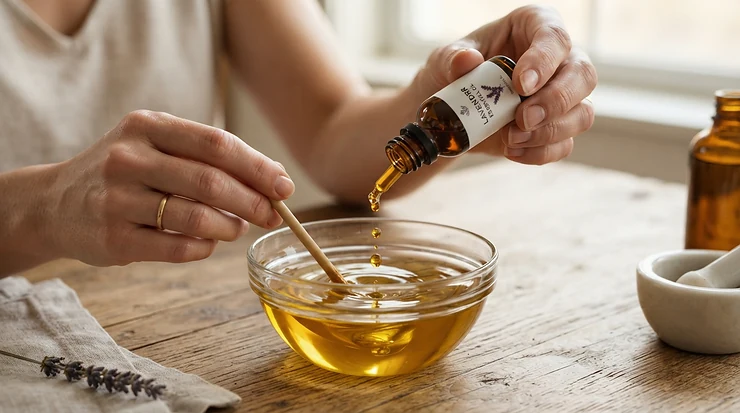
Neat lavender is a concentrate, so this bottle’s first job is to be mixed. Plant Therapy’s listings describe it as 100 percent pure and undiluted, and a retailer page for the 10 mL size advises combining one to two drops with a carrier such as coconut or jojoba before skin use. Plant Therapy’s own guide turns that advice into counts: 6 drops per ounce of carrier for 1 percent, 12 for 2 percent. Retailer listings put a 10 mL bottle between roughly $7 and $9.
One caution travels with the oil itself. Hill’s Pet lists lavender among the oils the Canadian Veterinary Medicine Association names as toxic to cats, so a household with a cat should keep the bottle, and any blend made from it, off furniture and fur.
2. Plant Therapy Organic Lavender Essential Oil Pre-Diluted Roll-On — premixed, with a strength to read
Convenience here comes with a number attached. Plant Therapy’s page lists a 10 mL roll-on pre-diluted to 10 percent in organic fractionated coconut oil, tagged KidSafe, Pregnancy Safe, Nursing Safe and Pup & Pony Safe, and a retailer lists the contents as caprylic/capric triglyceride plus lavender oil. Tisserand’s range for pain and feel-good rollerballs is 3 to 10 percent for small areas, which puts this bottle at the top edge.
Two statements from the same maker sit side by side. The roll-on page carries the child and pregnancy tags, while the maker’s dilution guide caps ages 2 to 10 at 1 percent and treats 1 percent or less as the usual ceiling in pregnancy. A household with a child or a pregnancy should ask the maker how the tags apply to a 10 percent bottle, and a healthcare provider is the second person to ask. Check the current price on Amazon.com.
Pros:
- The percentage and carrier are printed on the maker’s page
- Nothing to measure or mix
Cons:
- 10 percent sits well above the 1 to 3 percent range for body oils
- Tisserand’s range assumes use on a small area
3. Plant Therapy Organic Jojoba Carrier Oil — one-ingredient base for sensitive skin
Carrier choice counts most for reactive skin, and Plant Therapy’s guide points to sunflower or jojoba for that case while calling jojoba a lightweight option for normal to oily skin. The maker’s page describes it as lightweight, quick-absorbing and compatible with all skin types, and a retailer FAQ stresses that it is a single ingredient with no added fragrance. Eden Botanicals, a specialist supplier, lists no known safety concerns for golden jojoba but still advises a patch test for sensitive skin.
Sample calculation, with stated assumptions: at Plant Therapy’s rate of 6 drops per ounce for a 1 percent blend, a 4-ounce bottle of carrier takes 24 drops of oil, and 48 drops reaches 2 percent. The 1 percent figure also matches the Tisserand ceiling for sensitive skin. Check the current price on Amazon.com.
4. Plant Therapy Fractionated Coconut Oil — stays liquid in roll-on bottles
Texture decides this one. Plant Therapy’s guide says fractionated coconut oil stays liquid, absorbs quickly and suits roll-ons and daily use, while virgin coconut oil solidifies below room temperature and suits thicker balms. The brand’s own roll-ons are pre-diluted in it, and a retailer mirror of the Amazon listing shows a 16-ounce bottle with a pump included.
Size is the trade-off. The same guide says oxidized or unstable carriers limit a blend’s shelf life and that pre-diluted blends last up to the carrier’s shelf life, typically one to two years in cool storage, so a large bottle only pays off when it is used up inside that window.
5. Airversa AN6 Waterless Diffuser — cordless mist without water or heat
Leaks make this a skin topic too. The manual warns that tilting past 45 degrees with an oil bottle installed can leak, which means undiluted oil on hands and surfaces, and it tells owners to keep the unit away from children and pets. The manual describes cold diffusion with no heat or water, nano vapor of about 1 to 3 microns, a 2000 mAh battery with a charge time near 4.5 hours, a 20 mL maximum oil capacity, and a weight of 266 grams.
Coverage claims differ. The manual’s suggested room size is 300 to 500 square feet, while retailer listings advertise up to 600. Oil advice differs too: the manual’s FAQ says carrier oils can be mixed with essential oils, but the same FAQ says resin and thick oils are not recommended, and Nēbu, a different maker, says oils cut with carrier, water or alcohol can clog an atomizer. A third-party review-analysis tool, NullFake, scored the black AN6 listing at 4.89 original and 4.60 adjusted on April 27, 2026, and flagged roughly 10 percent of reviews as likely fake. Airversa sells several waterless models, so compare the exact model number before buying.
Pros:
- No heat and no water, per the manual
- Battery power, so no cord across a floor
- Cleaning step is a 3 to 5 mL syringe of 90 percent ethanol
Cons:
- Leaks if tilted past 45 degrees
- Needs pure, thin oil for steady mist
How to safely use essential oils on skin: a routine that fits any of the picks
- Choose the job first. Take the range from the table above and start at the low end for the face, underarms or reactive skin, where Tisserand’s ranges run 0.2 to 1.2 percent.
- Mix by drops. Six drops per ounce of carrier gives 1 percent and twelve gives 2 percent, per Plant Therapy, and a label with the dilution and date on the bottle saves guessing later.
- Patch test, with limits. AromaWeb describes one or two drops of diluted oil on the inner forearm or back, covered with a bandage and kept dry for 48 hours, and warns that no test rules out a later allergy. It also notes that Robert Tisserand does not recommend initial patch testing because it is hard to do accurately and hard to read. A clean patch means no immediate reaction, not clearance.
- Keep citrus off sunlit skin. FDA and Plant Therapy both flag citrus oils and sun, and cold-pressed lemon, lime and bergamot are the usual suspects, so check whether a citrus bottle is cold-pressed or steam-distilled.
- Stop at the first sign of irritation and wash the area with mild soap and water. FDA’s aromatherapy page lists skin irritation, allergic reactions and blistering as risks and points to its Report a Product Problem form at contact.fda.gov/report-problem or 1-888-INFO-FDA.
Is the Airversa waterless essential oil diffuser safe for furnaces? What the temperature range means
The AN6 is a free-standing, battery-powered unit, and its manual describes room use only: upright on a stable surface, at least 6 feet from the user for quieter operation. It lists an operating range of 4 to 104 degrees Fahrenheit.
Furnace air is hotter than that. HouseMaster’s forced-air primer puts register temperatures at 120 to 140 degrees, and Ace Hardware Home Services says air leaving the burner area runs 140 to 170 degrees before ducts cool it to the 120 to 140 range at vents. The sources therefore support a narrow answer: the diffuser is fine in a room that the furnace heats, a poor fit in a register’s airflow or beside the furnace itself, and it is not a duct-mounted system at all. Heat pumps run cooler, typically 85 to 100 degrees at the vent according to Filterbuy, so the range matters less there, though the manual still governs.
Fragrance oils safe for HVAC systems: three makers, three rules
Whole-home scenting units are a separate product category from a portable nebulizer, and their makers disagree about which oils are acceptable.
- Aroma360’s instructions for its VanGogh360 say only its own oils should be used and that others may damage the unit and void the warranty. The company describes IFRA-compliant oils released into ductwork as a dry mist.
- Nēbu says its HVAC unit injects fragrance downstream of the air filter, that its oils are blended to the viscosity its atomizer needs, and that true essential oils are too thick for its compressors. Using a non-Nēbu oil does not void its 180-day warranty, but clog damage from an unsuitable oil is not covered.
- HVAC contractors writing about oils on furnace filters warn that saturating a filter can reduce airflow and shorten its life. One contractor blog says direct damage is unlikely from very small amounts but residue can build on coils or blower parts, and advises stopping if energy bills rise.
Other sources contradict the filter advice: an engineering-tips site calls a few drops on a clean filter an approved method, while Hunker, in a January 2025 piece citing air duct experts, advises a dedicated diffuser and notes that dust and debris in ducts can feed a fire. The furnace manual, the warranty and an HVAC technician settle it, since no oil blend carries a universal approval. Skin-safe is also a separate claim from HVAC-safe: FDA says fragrance products not applied to the body fall under the Consumer Product Safety Commission, not its cosmetics rules.
Pet safe fragrance oils: what a label cannot promise
Makers and veterinary sources disagree, and both positions are on the record. Aroma360 and Nēbu describe waterless diffusion as safe for pets and children because there is no heat, propellant or residue, though Nēbu still advises asking a veterinarian when an animal has a known respiratory sensitivity. VCA Animal Hospitals takes the opposite line: it advises against diffusing scented oils at all, says even oils marketed as pet safe can cause adverse reactions, and says most fragrance oils are unsafe for cats.
The ASPCA’s guidance for veterinary professionals is more specific. Risk depends on the oil, its concentration, the species and how the animal is exposed. Skin or fur exposure produced the most signs in the cases ASPCA Poison Control sees, including unsteady movement, weakness and lethargy, and cats, rabbits, guinea pigs and hamsters can swallow oil while grooming. Pennyroyal and tea tree oils have been linked to seizures. Diffusers worry the ASPCA less than skin or oral exposure, except for birds, which face higher respiratory risk.
Its advice is practical: keep diffusers out of reach, let pets leave a room if the scent gets strong, and avoid running one around animals that groom themselves. VCA adds that spills should be washed with dish soap and that suspected exposure calls for a veterinarian or the ASPCA Animal Poison Control Center at 1-888-426-4435.
Skin, furnaces, pets and ducts: the short answers
How do you know if essential oils are skin safe?
Can you put essential oils on skin without diluting them?
Is a waterless diffuser safe to run near a furnace?
Are there pet safe fragrance oils?
Are fragrance oils safe for HVAC systems?
Choosing a bottle: strength first, scent second
Anyone chasing essential oils skin safe by label alone ends up guessing, because the sources agree on one rule: pick the dilution for the job, then pick the oil. Plant Therapy Lavender Essential Oil paired with Plant Therapy Organic Jojoba Carrier Oil gives full control over a 1 to 2 percent blend, with Plant Therapy Fractionated Coconut Oil as the lighter carrier for roll-on bottles. The Plant Therapy Organic Lavender Essential Oil Pre-Diluted Roll-On suits small-area use once its 10 percent strength is weighed against the household. The Airversa AN6 Waterless Diffuser belongs in a room away from the furnace register, and homes with cats or birds should treat every oil, diffused or not, as a risk to manage before it is a scent to enjoy. Read the manual’s temperature range before placing any diffuser, and the label’s percentage before opening any bottle.
Recommended for You
- Clean smelling essential oils: Which Fits Which Room?
- Bath and Body Fragrance Oils: 7 Best Skin-Safe Picks for 2026
- Essential oils for house smell — Which Oil for Which Room
Match the percentage on the label to the job in the dilution table before the first drop touches skin.