
In This Article
Why an Automobile Oil Diffuser Beats the Cardboard Tree
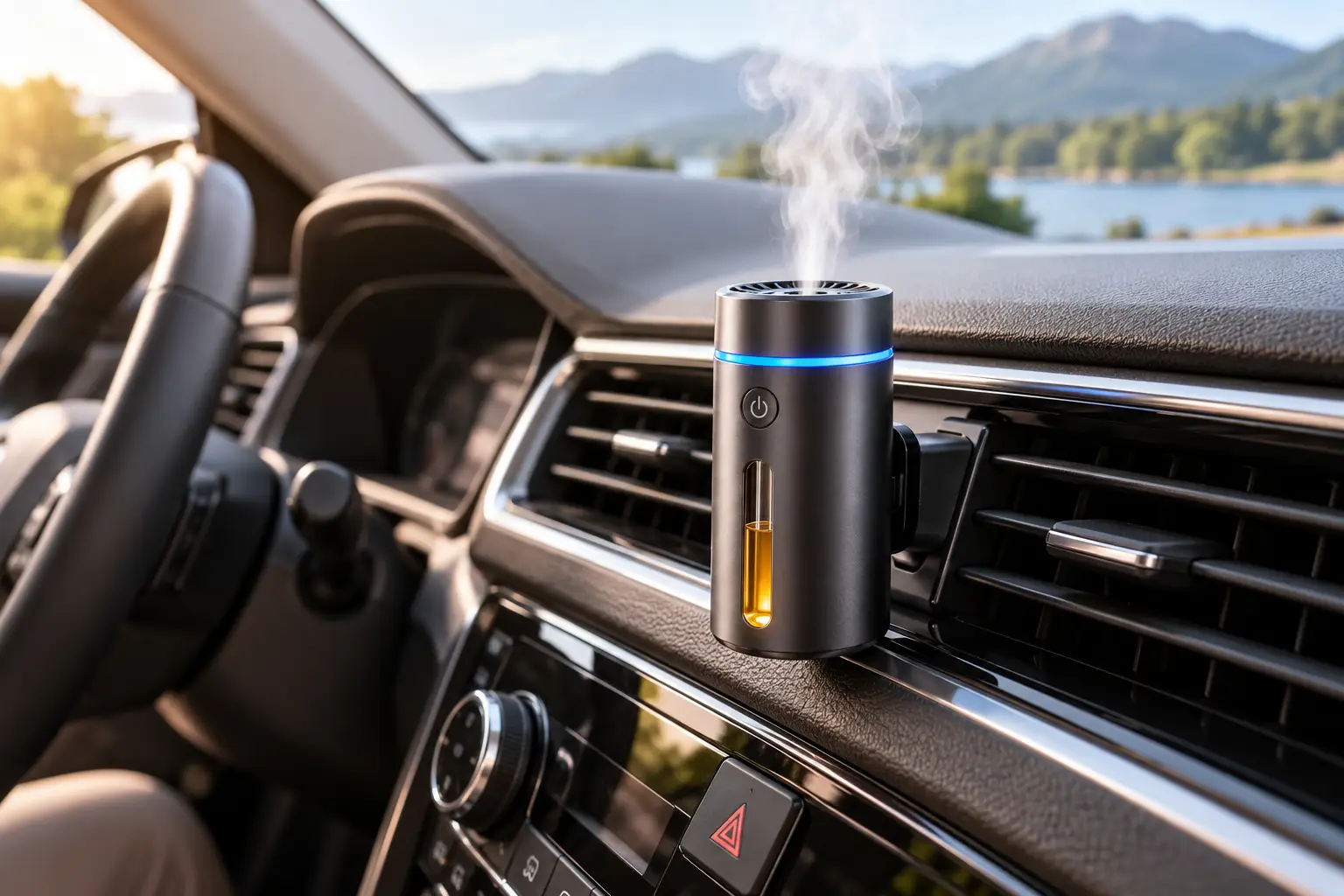
Let’s be honest: most cars smell like one of three things — yesterday’s drive-thru, a damp gym bag, or a synthetic “Ocean Breeze” that has never been anywhere near an ocean. An automobile oil diffuser offers a smarter fix. Instead of masking odors with a cardboard cutout that fades in ten days, a good automobile oil diffuser lets you choose exactly what your cabin smells like, how strong it is, and when it switches on.
The category has quietly grown up. Five years ago, your options were a felt pad in a vent clip or a wobbly USB humidifier that sloshed water every time you took a corner. In 2026, you’ll find waterless nebulizers with 48-hour batteries, motion-sensing units that start diffusing when you drive off, and refillable vent lockets that cost less than a fancy latte.
That variety is great — and confusing. A diffuser that’s perfect for a 15-minute school run can be overkill (or underpowered) for a three-hour highway commute. Some models run on your own essential oils; others lock you into proprietary refill cartridges. Some leave a faint mist on your dashboard; others are bone-dry.
This guide cuts through it. We compared spec sheets, dug into recurring themes across customer reviews, and translated the numbers into what they mean in an actual car. You’ll get 7 real picks across budget, mid-range, and premium tiers, plus practical setup tips, troubleshooting fixes, and safety guidance that product listings rarely mention. If you’ve ever wondered whether aromatherapy can make your commute more pleasant, this is where to start.
What Is an Automobile Oil Diffuser?
An automobile oil diffuser is a compact device that disperses essential or fragrance oil into a vehicle’s cabin. It works passively (a pad or reed that evaporates oil, often clipped to an air vent) or actively (an ultrasonic mister or waterless nebulizer powered by USB or a rechargeable battery).
The three main types at a glance
- ✅ Passive vent clips — oil soaks into a felt pad; your car’s airflow carries the scent. No power, no noise, low output.
- ✅ Ultrasonic USB diffusers — a vibrating plate turns a water-and-oil mix into cool mist. Gentle scent, mild humidity, needs regular cleaning.
- ✅ Waterless nebulizers — compressed air atomizes undiluted oil into a fine, dry mist. Strongest scent, zero water, highest oil consumption.
Think of it like coffee: a vent clip is drip, an ultrasonic is a café au lait, and a nebulizer is a straight espresso shot. All three work — the right one depends on how much “kick” you want and how much maintenance you’ll tolerate.
Quick Comparison: Automobile Oil Diffuser Picks at a Glance
| Product | Type | Power | Oil Capacity | Approx. Price Range | Best For |
|---|---|---|---|---|---|
| RoyAroma Vent Aromatherapy Diffuser | Passive vent clip | None | Felt pads (a few drops) | Under $15 | RoyAroma Vent Aromatherapy Diffuser: budget minimalists |
| InnoGear USB Car Diffuser | Ultrasonic | USB | 50 mL (water + oil) | $15–$25 | InnoGear USB Car Diffuser: dry-climate commuters |
| Pure Enrichment PureSpa Go | Ultrasonic | USB | 50 mL (water + oil) | $20–$30 | Pure Enrichment PureSpa Go: car-and-desk double duty |
| Airversa AN6 Waterless Diffuser | Waterless nebulizer | Rechargeable (USB-C) | 20 mL bottle | $25–$40 | Airversa AN6 Waterless Diffuser: strong, dry scent |
| AMAZING FLOWER A4 Smart Car Diffuser | Waterless, motion-sensing | Rechargeable | Small bottle | Under $30 | AMAZING FLOWER A4 Smart Car Diffuser: forgetful drivers |
| Airversa RD1 Waterless Diffuser | Waterless nebulizer | Rechargeable | 100 mL glass bottle | $40–$60 | Airversa RD1 Waterless Diffuser: fewest refills |
| Pura Car Pro | Smart heat diffusion | Rechargeable (USB-C) | Proprietary cartridge | $50–$65 | Pura Car Pro: app lovers and brand-name scents |
Looking at the table, the split is clear: the RoyAroma Vent Aromatherapy Diffuser and InnoGear USB Car Diffuser win on price, while the Airversa AN6 Waterless Diffuser delivers the biggest jump in scent strength for a modest step up. The Pura Car Pro sits in its own lane — it’s the most convenient, but it trades oil freedom for proprietary refills. Prices fluctuate, so treat these ranges as a snapshot at the time of writing.
💬 One click helps other shoppers make an informed choice too! 😊
Top 7 Automobile Oil Diffuser Picks: Expert Analysis
1. RoyAroma Vent Aromatherapy Diffuser — cheapest way to start
If you want to test whether you even like scenting your car, this is the low-risk entry point. The RoyAroma Vent Aromatherapy Diffuser (model DC-312) is a stainless steel locket that clips to your air vent and holds a replaceable felt pad; you add a few drops of oil, and your car’s airflow does the rest.
In practice, that passive design means zero noise, zero cords, and zero electronics to fail. The catch is that output depends entirely on your HVAC: blast the AC and the scent is noticeable; turn the fan off and it fades to a whisper. The stainless body won’t absorb oil the way plastic can, so switching scents is as simple as swapping the pad.
Based on the specs, this is best for short-trip drivers, minimalists, and anyone who dislikes the “mist cloud” look of active diffusers. It’s not the right tool for neutralizing stubborn odors like smoke or pet smell.
Customer reviews are generally positive about build quality and looks, but a recurring complaint is that pads dry out quickly, so many owners find themselves re-oiling every day or two.
Pros:
- ✅ No power needed, so it never drains your battery
- ✅ Stainless steel locket feels sturdier than plastic clips
- ✅ Swapping scents takes about five seconds
Cons:
- ❌ Scent strength depends heavily on fan speed
- ❌ Pads need frequent re-oiling, per many reviews
Typically under $15, it’s excellent value as a starter — just don’t expect it to overpower a funky cabin.
2. InnoGear USB Car Diffuser — best budget cup-holder mister
The InnoGear USB Car Diffuser (often listed as model UD50) is the classic plug-and-play ultrasonic option that has appeared on “best car diffuser” lists for years — and the design explains why.
It holds about 50 mL of water with a few drops of oil, sits in a standard cup holder, and weighs just under five ounces. Ultrasonic vibration creates a cool mist, so the scent is softer than a nebulizer’s but adds a touch of humidity — genuinely pleasant during winter, when car heaters dry out the air. Continuous and intermittent modes let you stretch a fill, and the automatic shut-off cuts power when water runs low, which protects the ultrasonic plate from burning out.
This one fits commuters in dry climates and anyone who prefers a gentle, background scent. Because it needs a powered USB port, it’s tethered to your dash and only runs while your car supplies power.
Aggregated reviews praise its simplicity and quiet operation; however, a recurring theme is that the cap can pop off, and some owners report the unit stopped working after extended use.
Pros:
- ✅ Very affordable entry into active diffusion
- ✅ Auto shut-off protects the unit when water runs low
- ✅ Adds light humidity during dry winter drives
Cons:
- ❌ Water can slosh on aggressive turns or bumps
- ❌ Some reviewers report durability issues over time
Usually in the $15–$25 range, it’s a solid value if you treat it gently and clean it weekly.
3. Pure Enrichment PureSpa Go — best for car-and-desk double duty
The Pure Enrichment PureSpa Go is built for people who want one diffuser that moves between car and office without feeling like a compromise in either place.
According to the manufacturer, it holds 50 mL of water, runs up to about 4 hours, outputs 5–15 mL of mist per hour, and covers up to roughly 107 square feet. That coverage figure matters: a typical sedan cabin is far smaller, so even the low setting should scent your car comfortably. It ships with a UL-approved USB cable and a cleaning brush — a small but telling detail, since mineral buildup is the number-one killer of ultrasonic diffusers.
On paper, this is the pick for hybrid workers who commute in, then want the same scent at their desk. The adjustable output is more useful than it sounds: you can run it lighter in the car (where space is tight) and stronger in a larger room.
Verified review volume is smaller than for mass-market rivals, so we can’t point to a broad consensus; the feedback that is available tends to highlight the auto shut-off as a peace-of-mind feature.
Pros:
- ✅ Adjustable mist output suits both car and desk
- ✅ UL-approved cable and cleaning brush included
- ✅ Auto shut-off when the tank is nearly empty
Cons:
- ❌ Four-hour runtime means frequent refills on road trips
- ❌ Smaller pool of verified reviews to judge durability
Generally in the $20–$30 range, it’s fair value for a brand-name unit with useful accessories.
4. Airversa AN6 Waterless Diffuser — strongest scent per dollar
If you’ve tried an ultrasonic diffuser and thought “I can barely smell it,” the Airversa AN6 Waterless Diffuser is the upgrade that changes your mind.
It’s a waterless nebulizer: compressed air turns undiluted oil into a dry mist, so the scent is far more concentrated than a water-based mister. The unit measures roughly 2.7 × 2.7 × 5 inches, drops into most cup holders, holds a 20 mL oil bottle, and Airversa rates its battery at up to 48 hours per USB-C charge. Three mist levels and several timer options let you dial it down, and a 45-degree spill-protection design is meant to keep oil inside if the unit tips.
Based on comparing the specs, this is the sweet spot for most drivers: cordless, strong, and compatible with standard oil bottles rather than locked-in pods. It’s ideal for long commutes and for masking persistent odors.
Reviews consistently report strong scent throw and good battery life. A common caveat: even the lowest setting can feel intense in a small car, so some owners move it to a rear cup holder.
Pros:
- ✅ Dry mist means no water spills or dashboard residue
- ✅ Long battery life frees up your USB port
- ✅ Uses your own oils — no proprietary refills
Cons:
- ❌ Occupies an entire cup holder slot
- ❌ Lowest setting may overwhelm compact cars
Typically in the $25–$40 range (starter kits with oils cost more), it’s arguably the best value in this guide.
5. AMAZING FLOWER A4 Smart Car Diffuser — best hands-free automation
The AMAZING FLOWER A4 Smart Car Diffuser solves a surprisingly common problem: forgetting to turn your diffuser off, then returning to a car that reeks of peppermint and a dead battery.
The headline feature is a G-sensor that detects vehicle movement, so the unit switches on when you drive and pauses when you park. It’s paired with a 2,000 mAh rechargeable battery and three mist levels. In real-world terms, motion sensing isn’t a gimmick — it can significantly cut wasted oil, because diffusing into a parked, closed car accomplishes nothing except emptying the bottle.
Based on the specs, this suits busy parents, rideshare drivers, and anyone who wants scent to “just happen.” The automation also reduces in-car fiddling, which is a genuine safety bonus.
Honestly, verifiable independent review data for this model is thinner than for Airversa or InnoGear, so we can’t confirm long-term reliability with confidence. What’s verifiable is the feature set, which is unusually generous for its price tier.
Pros:
- ✅ Motion sensor starts and stops diffusion automatically
- ✅ Saves oil by not running while parked
- ✅ Three mist levels for small or large cabins
Cons:
- ❌ Limited independent reviews on long-term durability
- ❌ Sensor may trigger from vibrations like door slams
Usually under $30, it’s strong value if automation is your top priority.
6. Airversa RD1 Waterless Diffuser — fewest refills in its class
The Airversa RD1 Waterless Diffuser (sold as the Scenta Ice line) targets the biggest complaint about nebulizers: they drink oil fast, so you’re refilling constantly.
Its answer is a 100 mL glass bottle — about five times the capacity of a typical 20 mL unit — inside an aluminum body roughly 2.8 inches wide, so it still fits a standard cup holder. Glass resists the slow absorption and odor “ghosting” that some plastics show after months of strong oils, and aluminum handles cabin heat better than lightweight plastic. Battery life is rated around 48 hours per charge.
Here’s what to weigh: a bigger bottle doesn’t mean a bigger scent — it means fewer refills. That makes the RD1 ideal for road-trippers, high-mileage drivers, and people who use the same diffuser at home and in the car. On the other hand, a full glass bottle adds weight, which matters if your cup holder is shallow.
Review volume is moderate; feedback tends to praise the premium feel and the long intervals between refills, while some note it won’t accept small 5 mL sample bottles.
Pros:
- ✅ 100 mL glass reservoir drastically cuts refill frequency
- ✅ Aluminum body tolerates cabin heat well
- ✅ Doubles as a capable home diffuser
Cons:
- ❌ Heavier and pricier than the AN6
- ❌ Not compatible with small sample bottles
Typically $40–$60 at the time of writing, it justifies its premium for heavy users only.
7. Pura Car Pro — best smart, app-controlled option
The Pura Car Pro is the most polished “set it and forget it” option here — with one big caveat you need to know before buying.
Unlike everything else on this list, it doesn’t diffuse your own essential oils. It uses low-heat vaporization of Pura’s proprietary fragrance cartridges, including scents from well-known home-fragrance brands. It’s fully cordless, retailers list roughly 15 hours of runtime per charge, it recharges via USB-C, and an accelerometer starts and stops diffusion with your car’s movement. The app lets you adjust intensity and check remaining fragrance, and each cartridge is rated to last up to four weeks.
So who’s it for? Drivers who care more about a luxurious, consistent fragrance than about essential-oil aromatherapy, and who like app control. If you already own a cabinet full of oils, it’s the wrong pick.
Customer ratings at major US retailers sit around 4 out of 5 from a modest number of reviews, with praise centered on scent quality and ease of use. Ongoing refill costs are the most common reservation.
Pros:
- ✅ Motion-activated, cordless, and app-controlled
- ✅ Brand-name fragrances with consistent intensity
- ✅ Scent-remaining tracking removes guesswork
Cons:
- ❌ Locked into proprietary cartridges — no essential oils
- ❌ Highest long-term running cost in this guide
Usually $50–$65, it’s worth it for convenience seekers; check current Amazon availability, as stock varies.
Head-to-Head: Specs, Value, and Who Wins Where
| Product | Diffusion Strength | Maintenance Effort | Runs While Parked? | Uses Your Own Oils? | Best For |
|---|---|---|---|---|---|
| RoyAroma Vent Aromatherapy Diffuser | Low (fan-dependent) | Very low | Passively, yes | Yes | RoyAroma Vent Aromatherapy Diffuser: subtle scent on a budget |
| InnoGear USB Car Diffuser | Low–medium | Medium (weekly cleaning) | Only with USB power | Yes | InnoGear USB Car Diffuser: winter humidity + scent |
| Pure Enrichment PureSpa Go | Low–medium | Medium | Only with USB power | Yes | Pure Enrichment PureSpa Go: car-to-office users |
| Airversa AN6 Waterless Diffuser | High | Low | Yes, unless timer set | Yes | Airversa AN6 Waterless Diffuser: best all-rounder |
| AMAZING FLOWER A4 Smart Car Diffuser | Medium–high | Low | No (motion sensor) | Yes | AMAZING FLOWER A4 Smart Car Diffuser: automation on a budget |
| Airversa RD1 Waterless Diffuser | High | Very low | Yes, unless timer set | Yes | Airversa RD1 Waterless Diffuser: high-mileage drivers |
| Pura Car Pro | Medium–high | Very low | No (motion sensor) | No | Pura Car Pro: app-driven luxury |
Reading across the rows, the real dividing line isn’t price — it’s water. The two ultrasonic units (InnoGear USB Car Diffuser and Pure Enrichment PureSpa Go) demand the most cleaning and deliver the gentlest scent, while the waterless group (Airversa AN6 Waterless Diffuser, Airversa RD1 Waterless Diffuser, AMAZING FLOWER A4 Smart Car Diffuser) wins on strength and convenience. If you hate maintenance, skip water entirely.
✨ Don’t miss these top-rated picks!
🔍 Take your daily drive to the next level with this carefully curated lineup. Click a highlighted product to check current pricing and availability — these picks will help you turn your commute into the calmest part of your day! 🚗🌿
Automobile Oil Diffuser vs Traditional Car Air Fresheners
Why bother with a diffuser when a three-pack of vent clips costs a few dollars? Because the two products solve different problems.
Traditional air fresheners — hanging cardboard, gel cans, pre-filled vent clips — are disposable, single-scent, and front-loaded: they’re strongest on day one and fade steadily. You also have little insight into what’s in them; “fragrance” on a label can cover dozens of undisclosed compounds.
| Factor | Automobile Oil Diffuser | Traditional Air Freshener | Best For |
|---|---|---|---|
| Scent control | Adjustable strength and timing | Fixed, fades over time | Diffuser: people sensitive to strong scents |
| Ingredient transparency | You choose the oil | Often undisclosed “fragrance” | Diffuser: ingredient-conscious buyers |
| Upfront cost | $10–$65 | A few dollars | Freshener: occasional drivers |
| Long-term waste | Reusable device | Constant disposable refills | Diffuser: eco-minded drivers |
| Variety | Switch scents anytime | One scent per product | Diffuser: mood-based scenting |
The table makes the trade-off plain: traditional fresheners win only on upfront cost. Over a year, a reusable car essential oil diffuser typically produces less waste and gives you far more control, especially if you already own oils.
Where a vent clip oil diffuser fits in
A refillable vent clip oil diffuser like the RoyAroma Vent Aromatherapy Diffuser is the bridge between both worlds — the simplicity of a traditional clip with the ingredient freedom of a diffuser. It’s the logical first step if you’re switching away from disposables.
How to Choose an Automobile Oil Diffuser
Choosing the right automobile oil diffuser comes down to seven decisions. Work through them in order:
- Decide how strong you want the scent. Subtle background aroma points to a vent clip or ultrasonic; a strong, room-filling scent points to a waterless nebulizer.
- Check your power situation. Older cars with few USB ports benefit from rechargeable models; newer cars with switched USB ports handle plug-in units easily.
- Measure your cup holder. Most diffusers here are around 2.7–2.8 inches wide. Deep or oddly shaped holders can leave tall units wobbling.
- Consider your climate. In hot states, waterless designs avoid stagnant water that can grow mold; in cold, dry regions, an ultrasonic’s humidity is a bonus.
- Look for auto-off or motion sensing. Timers, low-water shut-off, and G-sensors save oil and battery — and stop you from fiddling while driving.
- Calculate the running cost. Nebulizers consume oil faster; proprietary refills cost more over time. Pads and ultrasonics are the thriftiest.
- Confirm oil freedom. If you want aromatherapy with your own essential oils, rule out cartridge-only systems like the Pura Car Pro.
One overlooked factor: who rides with you. A strong nebulizer that’s perfect for a solo commuter can be overwhelming for a carpool, a toddler in the back, or a dog with a sensitive nose.
Getting Started: Your First 30 Days With a Car Diffuser for Essential Oils
Buying the diffuser is the easy part. Here’s how to set up a car diffuser for essential oils so it works well from day one.
Week 1: Start low and slow
Use the lowest setting (or two drops on a pad) for the first several drives. Car cabins are tiny — often well under 150 cubic feet of air — so a setting that’s subtle in a living room can be overpowering in a sedan. Increase only if you genuinely can’t smell anything after five minutes.
Week 2: Find the right placement
⚡ Rear cup holders soften intensity; front holders sharpen it. For vent clips, choose a vent on the passenger side so airflow isn’t blowing scent directly into the driver’s face.
Week 3: Build a cleaning habit
For ultrasonic units, empty leftover water after every use and wipe the tank weekly; a cotton swab with a little isopropyl alcohol clears oil film from the ultrasonic plate. For nebulizers, run the unit briefly with a small amount of alcohol when switching between very different scents.
Week 4: Lock in your routine
🔋 Set a recurring reminder to recharge battery models — for example, every Sunday night. Track how long a fill actually lasts in your car; real-world consumption often differs from manufacturer estimates depending on your settings and drive time.
Common first-month mistakes
- ❌ Overfilling ultrasonic tanks past the max line, which causes leaks
- ❌ Leaving water sitting in a hot car for days
- ❌ Using thick oils like vetiver or sandalwood in a nebulizer, which can clog the nozzle
Which Car Aromatherapy Diffuser Fits Your Drive? Real-World Scenarios
Specs are abstract until you map them to an actual life. Here are four realistic driver profiles and the car aromatherapy diffuser that fits each.
🚗 The 20-minute suburban commuter (budget: under $20)
You drive to work and back, mostly in daylight, with the AC or heat usually on. A passive clip like the RoyAroma Vent Aromatherapy Diffuser is plenty — your HVAC runs constantly, so the vent does the diffusing for free. Upgrade to the InnoGear USB Car Diffuser if you want slightly more presence in winter.
🛣️ The 90-minute highway warrior (budget: $30–$60)
Long drives demand runtime and consistency. The Airversa AN6 Waterless Diffuser covers most needs; if you’re refilling it every few days, the Airversa RD1 Waterless Diffuser and its 100 mL bottle make more sense. A peppermint or citrus blend can help keep the cabin feeling fresh on long stretches.
👨👩👧 The busy family hauler (budget: around $30)
Kids, snacks, and sports gear produce odors that need regular attention — but kids in the car call for a gentler approach and fewer controls to fiddle with. The AMAZING FLOWER A4 Smart Car Diffuser handles itself via motion sensing; run it on the lowest setting and choose kid-appropriate oils (more on that in the safety section).
🚕 The rideshare driver (budget: $50+)
Passengers have wildly different scent tolerances, so consistency and neutrality matter more than aromatherapy. The Pura Car Pro offers a recognizable, polished fragrance at a controlled intensity, with no oil bottles rattling around for passengers to knock over.
Troubleshooting: Common Car Diffuser Problems and Fixes
Even good diffusers misbehave. Here are the five problems owners mention most often, with practical fixes.
Problem 1: “I can’t smell anything.”
Solution: Your oil may be old (oxidized oils lose aroma), your vent may be closed, or ultrasonic dilution is too high. Use fresher oil, add one or two more drops, or switch to a waterless car diffuser like the Airversa AN6 Waterless Diffuser for stronger output.
Problem 2: “The scent gives me a headache.”
Solution: Too much, too close. Drop to the lowest setting, move the unit to a rear cup holder, use the timer, and crack a window. Intensity, not the oil itself, is the usual culprit.
Problem 3: “Water leaked into my cup holder.”
Solution: Fill only to the max line and avoid using ultrasonic units on rough roads. If leaks are frequent, a waterless model removes the problem entirely.
Problem 4: “My nebulizer stopped misting.”
Solution: Thick oils clog nozzles. Remove the bottle, run a few minutes with isopropyl alcohol, and stick to thinner oils like citrus, peppermint, or eucalyptus.
Problem 5: “My diffuser drained the car battery.”
Solution: Some cars keep USB ports powered after shutdown. Unplug plug-in units when parking, or choose a motion-sensing model like the AMAZING FLOWER A4 Smart Car Diffuser that pauses automatically.
Best Essential Oils for a Waterless Car Diffuser (and Which to Skip)
Not every oil belongs in a car, and the type of diffuser changes the rules.
Oils that tend to work well while driving
- ✅ Peppermint — crisp and widely associated with alertness; great for morning drives.
- ✅ Lemon, orange, grapefruit — bright, clean, and thin enough for nebulizers.
- ✅ Eucalyptus — refreshes stale AC air, but use sparingly around young children.
- ✅ Rosemary — herbal and sharp; popular for focus-oriented blends.
Oils to use cautiously behind the wheel
Heavily sedating scents like lavender, chamomile, or ylang-ylang are lovely at bedtime — less so on a dark highway at 10 p.m. They’re not dangerous to smell, but if a scent makes you feel drowsy, save it for the passenger seat of life.
What the evidence actually says
It’s worth keeping expectations realistic. The National Center for Complementary and Integrative Health notes that research on many aromatherapy claims is limited or mixed in quality. In plain terms: a pleasant scent can make your car a nicer place to be, but treat claims about focus, stress relief, or energy as possible bonuses, not guaranteed effects.
Fragrance oils vs essential oils
Fragrance oils (synthetic or blended) often last longer and cost less, while essential oils are plant-derived. Both work in most nebulizers; check your manual, since some brands recommend specific oils to protect the nozzle.
Safety, Regulations, and Standards
A car is a small, enclosed, sometimes scorching space — so safety deserves more attention than most product listings give it.
Heat and storage
Cabin temperatures on a sunny summer day can climb far above outdoor temperatures. Don’t store spare oil bottles in the car for long periods; heat degrades oils, and glass can crack. Battery-powered diffusers contain lithium-ion cells, so avoid leaving them baking on the dashboard in direct sun.
Children and pets
Essential oils are concentrated, and accidental swallowing can be dangerous — especially for kids. According to Poison Control’s guidance on essential oils, oils can be poisonous when misused, and anyone who swallows one should get help right away (in the US, call 1-800-222-1222). Keep bottles out of reach, secure the diffuser so it can’t tip into a child’s lap, and ask your veterinarian before diffusing around pets, since some animals are more sensitive to certain oils.
Certifications worth checking
For any electronic diffuser, look for FCC compliance markings and UL-certified or UL-approved cables and chargers, as with the Pure Enrichment PureSpa Go. These don’t guarantee quality, but they signal that the electrical components meet recognized US standards.
Distraction is the real hazard
The biggest risk isn’t the oil — it’s fiddling with gadgets while driving. The NHTSA’s distracted driving guidance is a useful reminder that anything taking your eyes or hands off the wheel counts. Set your diffuser before you shift into drive, or choose a motion-activated model that needs no adjustment on the road.
Long-Term Cost and Maintenance of a Car Diffuser
The sticker price is only part of the story. Here’s how total cost of ownership typically plays out over a year.
Passive vent clips: the cheapest to run
A RoyAroma Vent Aromatherapy Diffuser costs little upfront, and replacement pads are inexpensive. Your main ongoing expense is oil — and because you’re using only a few drops at a time, a single 15 mL bottle can last a surprisingly long time.
Ultrasonic units: cheap oil, more maintenance
Ultrasonics like the InnoGear USB Car Diffuser dilute oil in water, so oil consumption is low. The hidden cost is time: weekly cleaning, and the possibility of replacing the unit if the ultrasonic plate fails. Using distilled water helps prevent mineral buildup and can extend the device’s life.
Waterless nebulizers: higher oil spend
Nebulizers atomize oil undiluted, so they use it faster — that’s the price of a stronger scent. Using timers and lower mist levels on the Airversa AN6 Waterless Diffuser or Airversa RD1 Waterless Diffuser can meaningfully reduce oil use. Buying larger bottles of your favorite oils, instead of small 10 mL vials, often lowers the per-milliliter cost.
Cartridge systems: predictable but pricier
The Pura Car Pro has the clearest ongoing cost: a new cartridge roughly every month, depending on intensity and drive time. Convenient, yes — but over a year, refills can exceed the device’s price.
Bottom line: if long-term value matters most, a reusable device running your own oils almost always beats proprietary refills.
Features That Actually Matter (and Ones That Don’t)
Marketing for car diffusers loves big numbers and flashy extras. Here’s how to separate signal from noise.
✅ Features that genuinely matter
- Auto-off, timers, or motion sensing — they save oil, protect batteries, and reduce in-car fiddling.
- Spill protection — a moving car will tip things. Waterless designs and spill-resistant lips matter more than any light show.
- Standard oil compatibility — the freedom to use any bottle keeps long-term costs down.
- USB-C charging — one cable for your phone and diffuser simplifies life.
❌ Features that matter less than you’d think
- Coverage claims like “600 sq ft” — your car is a fraction of that. Coverage figures are home-oriented; in a car, adjustable low settings matter more than maximum reach.
- Seven-color LED lights — fun at night, but glowing lights in your peripheral vision can be distracting. Look for an option to turn them off.
- Starry-sky projectors — novelty features rarely improve scent performance and may add glare.
- “Aerospace-grade” materials — aluminum is a real benefit for heat tolerance, but the label itself is marketing.
What most buyers overlook is the control layout. Buttons on top are easy to reach once and forget; small buttons on the bottom force you to lift the unit — exactly what you don’t want to do in traffic.
Common Mistakes to Avoid When Buying an Automobile Oil Diffuser
Even savvy shoppers make these errors when picking an automobile oil diffuser:
- Buying for a living room, not a car. Home-oriented specs (big coverage, big tanks) don’t translate to a tight cabin. Prioritize low settings and stability.
- Ignoring cup holder space. If both front cup holders are occupied by coffee and a water bottle, a vent clip may serve you better than any cup-holder unit.
- Overlooking refill lock-in. A cheap device with proprietary pods can cost more within months than a pricier device that accepts any oil.
- Choosing ultrasonic in a hot climate without a cleaning plan. Standing water in a hot car is an invitation for odors — the opposite of what you’re buying a diffuser for.
- Trusting star ratings alone. Read the recurring complaints, not just the average. Patterns like “stopped working after a few months” or “cap falls off” reveal more than a 4.3 rating.
Avoid these five and you’re already ahead of most buyers.
FAQ About Automobile Oil Diffusers
❓ Is an automobile oil diffuser worth buying over a regular air freshener?
❓ Which car diffuser lasts the longest per fill?
❓ Can I use any essential oil in a waterless car diffuser?
❓ Will a USB car diffuser drain my car battery?
❓ What's the best car diffuser for essential oils under $30?
Conclusion: Find the Automobile Oil Diffuser That Fits Your Drive
The best automobile oil diffuser isn’t the one with the biggest specs — it’s the one that matches how you actually drive. For most people, the Airversa AN6 Waterless Diffuser strikes the best balance of strength, cordless convenience, and oil freedom. If you’d rather never think about refills, the Airversa RD1 Waterless Diffuser stretches each fill dramatically.
On a tight budget, start with the RoyAroma Vent Aromatherapy Diffuser — it’s the cheapest way to find out whether you enjoy scenting your car at all. If you love a touch of humidity in winter, the InnoGear USB Car Diffuser and Pure Enrichment PureSpa Go deliver a gentle, classic mist. Want automation? The AMAZING FLOWER A4 Smart Car Diffuser handles itself, and the Pura Car Pro brings app control and brand-name fragrance for drivers who value polish over oil choice.
Whatever you pick, remember the essentials: start on a low setting, keep oils out of reach of kids and away from extreme heat, clean your device regularly, and set it up before you start driving. Do that, and your car stops being a place you tolerate and becomes a place you actually enjoy.
🚀 Ready to transform your commute?
🌿 Click any highlighted product above to check today’s price and availability on Amazon. Your calmer, fresher-smelling drive is just one choice away! ✨
Recommended for You
- Best Smelling Essential Oils for Home Diffuser: 7 Honest Picks 2026
- Largest Diffuser 2026: 7 Powerful Picks That Fill Big Rooms
- Best Air Freshener for Pet Odor: 7 Proven Picks That Work (2026)
Disclaimer: This post contains affiliate links. As an Amazon Associate, I earn from qualifying purchases made through these links, at no additional cost to you.
✨ Found this article helpful? Share it with someone who needs it! 💬🤗